
Introduction
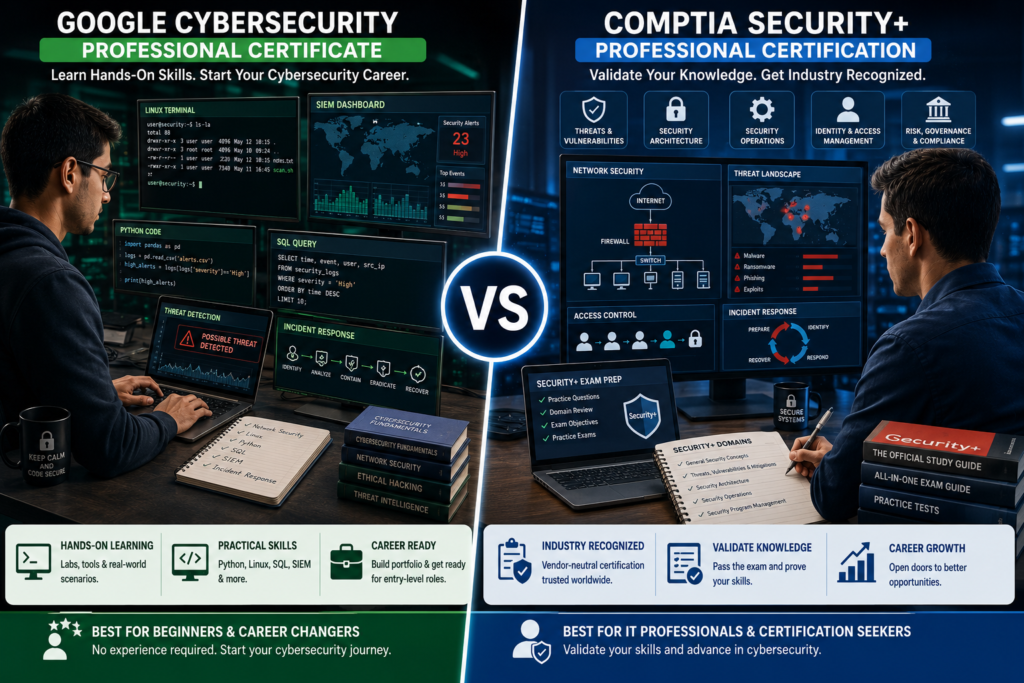
Google Cybersecurity vs CompTIA Security+ is an important comparison for anyone planning to start or advance a career in cybersecurity.
Both credentials can help you build cybersecurity knowledge, but they serve different purposes.
The Google Cybersecurity Professional Certificate is a beginner-level career program designed to teach practical cybersecurity skills to people with little or no previous experience. The current program is a 9-course series and includes hands-on learning in Python, Linux, SQL, SIEM tools, vulnerability management, threat detection, incident response, and AI applications in cybersecurity. Google says no prior experience or degree is required.
CompTIA Security+, on the other hand, is a professional cybersecurity certification based on a formal certification examination. It is widely used as a foundational cybersecurity credential and is designed to validate knowledge across areas such as security concepts, threats, vulnerabilities, security architecture, security operations, and security program management.
The difference can be summarized simply:
Google Cybersecurity teaches you how to start working in cybersecurity. Security+ validates foundational cybersecurity knowledge through a professional certification exam.
Interestingly, you don’t necessarily have to choose one or the other. Google explicitly states that its Cybersecurity Professional Certificate helps prepare learners for the CompTIA Security+ examination, and graduates can access Security+ training and the exam at a discounted price.
Table of Contents
Google Cybersecurity vs Security+: Quick Comparison
| Feature | Google Cybersecurity | CompTIA Security+ |
|---|---|---|
| Provider | CompTIA | |
| Credential Type | Professional Certificate | Professional Certification |
| Level | Beginner | Foundational / Early Career |
| Previous Experience | Not required | Recommended, but not a formal prerequisite |
| Degree | Not required | Not required |
| Formal Exam | No separate certification exam | Yes |
| Hands-on Labs | Yes | Primarily exam preparation |
| Python | Yes | Limited |
| Linux | Yes | Yes |
| SQL | Yes | Limited |
| SIEM | Yes | Yes |
| Security Fundamentals | Yes | Extensive |
| Best For | Beginners | Cybersecurity certification seekers |
| Career Stage | Entry-level | Entry-level to early-career |
The Biggest Difference Between Google Cybersecurity and Security+
The biggest difference is what each credential is designed to accomplish.
Google Cybersecurity Professional Certificate
Google’s program is primarily a learning and career-preparation program.
It teaches you practical cybersecurity concepts and gives you hands-on exposure to tools and workflows used by entry-level cybersecurity professionals.
The current program includes approximately 170 hours of instruction, practice-based assessments, hands-on activities, and portfolio activities. Google says learners can complete it in less than six months with under 10 hours of study per week.
CompTIA Security+
Security+ is primarily a professional certification.
Instead of completing a long learning program and receiving a certificate based on course completion, candidates prepare for and pass a formal certification examination.
This makes Security+ particularly useful when an employer specifically asks for a recognized cybersecurity certification.
What Is the Google Cybersecurity Professional Certificate?
The Google Cybersecurity Professional Certificate is an entry-level program designed to help learners build practical cybersecurity skills.
Google currently describes it as a beginner-level program requiring no prior experience or degree. It can be completed in approximately six months at seven hours per week according to the current Coursera listing.
The program covers areas including:
- Cybersecurity fundamentals
- Security frameworks
- Threats and vulnerabilities
- Network security
- Linux
- Python
- SQL
- SIEM
- Intrusion detection
- Vulnerability management
- Incident response
- Cyber threat intelligence
- Security operations
- AI for cybersecurity
The program is particularly useful for people who want to move from another career into cybersecurity.
What Is CompTIA Security+?
CompTIA Security+ is a vendor-neutral cybersecurity certification that validates foundational security knowledge.
Unlike a Google Career Certificate, Security+ requires candidates to pass a standardized certification examination.
The certification covers major areas of cybersecurity including:
- General security concepts
- Threats, vulnerabilities, and mitigations
- Security architecture
- Security operations
- Security program management
- Identity and access management
- Cryptography
- Incident response
- Risk management
- Governance and compliance
Security+ is therefore more focused on validating cybersecurity knowledge than providing a long, guided beginner learning experience.
Who Should Choose Google Cybersecurity?
The Google certificate is particularly suitable for:
- Students
- Recent graduates
- Career changers
- IT support professionals
- Help desk technicians
- Network professionals
- System administrators
- Beginners interested in cybersecurity
- Professionals without a cybersecurity degree
It is also a good choice if you learn better through structured coursework and hands-on exercises rather than exam preparation alone.
Who Should Choose CompTIA Security+?
Security+ is particularly suitable for:
- IT professionals moving into security
- Network administrators
- System administrators
- IT support professionals
- Cybersecurity analysts
- SOC analysts
- Defense and government IT professionals
- Professionals who want a vendor-neutral security certification
If you already have IT fundamentals and want a recognized cybersecurity certification to add to your resume, Security+ can be the stronger option.
Can You Take Security+ Without Experience?
Yes.
CompTIA does not require candidates to have a specific degree or mandatory work experience before taking Security+.
However, CompTIA recommends that candidates have foundational IT knowledge and experience before attempting the exam.
This is an important distinction:
No formal prerequisite does not mean no preparation is required.
Someone completely new to computers and networking may find Security+ considerably harder than someone who already understands:
- Networking
- Operating systems
- IP addresses
- Authentication
- Access control
- Basic troubleshooting
- Security concepts
This is one reason the Google Cybersecurity Certificate can be attractive to complete beginners.
Google Cybersecurity Curriculum
The current Google program covers a broad range of practical cybersecurity topics.
1. Foundations of Cybersecurity
Learners are introduced to:
- Cybersecurity careers
- Security principles
- Security controls
- Security frameworks
- CIA triad
- Security responsibilities
Google’s first course specifically introduces the cybersecurity profession, common security frameworks, controls, and the CIA triad.
2. Security Risks
Learners study:
- Assets
- Threats
- Vulnerabilities
- Attack surfaces
- Social engineering
- Malware
- Web-based attacks
- Threat modeling
The program includes practical exercises around identifying vulnerabilities and analyzing attack surfaces.
3. Networks
The program introduces:
- Network protocols
- Network architecture
- Network security
- Network traffic
- Security controls
4. Linux
Learners gain hands-on experience with Linux and Bash commands.
5. SQL
SQL is included because cybersecurity analysts often need to query and investigate data stored in databases.
6. Python
Python programming is used to automate security-related tasks and support analysis.
7. SIEM and Security Operations
Learners work with concepts and tools related to:
- Security monitoring
- Log analysis
- SIEM
- Threat detection
- Incident investigation
8. Incident Response
The program introduces:
- Incident identification
- Escalation
- Response
- Communication
- Stakeholder management
9. AI for Cybersecurity
The current program also incorporates AI skills, including using AI to:
- Analyze security frameworks
- Identify bugs
- Refine code
- Understand vulnerabilities
- Prioritize security alerts
These AI components are part of Google’s current version of the program.
CompTIA Security+ Exam Domains
Security+ takes a broader certification-oriented approach.
The exam evaluates knowledge across major cybersecurity areas including:
- General security concepts
- Threats, vulnerabilities, and mitigations
- Security architecture
- Security operations
- Security program management
These areas require candidates to understand security concepts rather than simply memorize definitions.
Security+ questions can also involve practical scenarios where you need to determine the best security control, response, architecture, or mitigation.
Curriculum Comparison
| Topic | Google Cybersecurity | Security+ |
| Cybersecurity Fundamentals | ✅ | ✅ |
| Threats & Vulnerabilities | ✅ | ✅ |
| Network Security | ✅ | ✅ |
| Linux | ✅ | ✅ |
| Python | ✅ | Limited |
| SQL | ✅ | Limited |
| SIEM | ✅ | ✅ |
| Incident Response | ✅ | ✅ |
| Security Architecture | ✅ | ✅ |
| Risk Management | ✅ | ✅ |
| Governance & Compliance | ✅ | ✅ |
| Hands-on Portfolio Work | ✅ | Not the primary focus |
| Formal Certification Exam | ❌ | ✅ |
Skills Comparison
Google Cybersecurity
You develop practical skills in:
- Python
- Linux
- SQL
- SIEM
- Network security
- Threat detection
- Vulnerability management
- Incident response
- Security monitoring
- Cyber threat intelligence
- Security analysis
Google specifically lists Python, Linux, SQL, SIEM, intrusion detection, vulnerability management, incident response, and threat intelligence among the program’s skills.
CompTIA Security+
Security+ focuses more heavily on broad cybersecurity knowledge, including:
- Security concepts
- Threat analysis
- Vulnerability management
- Security architecture
- Security operations
- Identity and access management
- Cryptography
- Incident response
- Risk management
- Governance
- Compliance
This makes Security+ particularly useful as a vendor-neutral foundation for cybersecurity careers.
Tools Comparison
| Tool / Technology | Google Cybersecurity | Security+ |
| Linux | ✅ Hands-on | ✅ Concepts |
| Python | ✅ Hands-on | Limited |
| SQL | ✅ Hands-on | Limited |
| SIEM | ✅ Hands-on | ✅ Concepts |
| IDS/IPS | ✅ | ✅ |
| Network Security | ✅ | ✅ |
| Vulnerability Management | ✅ | ✅ |
| Incident Response | ✅ | ✅ |
| Cryptography | Basic/Moderate | Extensive |
| Security Governance | Basic/Moderate | Extensive |
The key difference is that Google’s program puts considerable emphasis on learning by doing, while Security+ places greater emphasis on demonstrating broad security knowledge through the certification exam.
Difficulty Comparison
| Area | Google Cybersecurity | Security+ |
| Cybersecurity Fundamentals | ⭐⭐☆☆☆ | ⭐⭐⭐☆☆ |
| Networking | ⭐⭐⭐☆☆ | ⭐⭐⭐⭐☆ |
| Linux | ⭐⭐⭐☆☆ | ⭐⭐⭐☆☆ |
| Python | ⭐⭐⭐☆☆ | ⭐☆☆☆☆ |
| Cryptography | ⭐⭐☆☆☆ | ⭐⭐⭐⭐☆ |
| Security Architecture | ⭐⭐☆☆☆ | ⭐⭐⭐⭐☆ |
| Practical Labs | ⭐⭐⭐⭐☆ | ⭐⭐⭐☆☆ |
| Overall | ⭐⭐⭐☆☆ | ⭐⭐⭐⭐☆ |
Google Cybersecurity
Difficulty: 3/5
The program is deliberately designed for beginners.
CompTIA Security+
Difficulty: 4/5
Security+ is not an advanced cybersecurity certification, but the breadth of topics and formal examination make it more challenging than the Google certificate for most beginners.
Cost Comparison
The cost structure is very different.
Google Cybersecurity
Coursera currently lists the Google Cybersecurity Certificate at $49 per month in the U.S. and Canada after the initial trial period, with Google stating that many learners can complete it for under $300. Pricing can vary by country.
For Indian learners, the actual Coursera price should be checked on the enrollment page because regional pricing and promotions can change.
CompTIA Security+
Security+ involves a separate certification examination fee, in addition to any training or preparation materials you purchase.
Because CompTIA pricing can vary by region, promotions, and purchase channel, readers should verify the current exam price directly with CompTIA before purchasing.
Duration Comparison
| Factor | Google Cybersecurity | Security+ |
| Structured Course | Yes | No equivalent mandatory course |
| Recommended Study | ~6 months at 7 hours/week | Varies |
| Hands-on Exercises | Extensive | Depends on training provider |
| Exam Preparation | Included in learning pathway | Required separately |
| Formal Exam | No | Yes |
Google’s current Coursera listing estimates approximately six months at seven hours per week.
Security+ preparation time depends heavily on your existing IT knowledge.
Someone with networking and system administration experience may prepare considerably faster than a complete beginner.
The Important Connection: Google Cybersecurity + Security+
One of the strongest reasons to consider both credentials is that Google itself positions the Cybersecurity Certificate as preparation for Security+.
Google states that the certificate helps prepare learners for the CompTIA Security+ examination, and graduates can access Security+ training and the exam at a discounted price.
That creates a potentially powerful pathway:
Learn with Google → Build practical skills → Prepare for Security+ → Pass Security+
Rather than viewing these credentials as direct competitors, many learners can use them sequentially.
Which One Is Better for Beginners?
Winner: Google Cybersecurity Professional Certificate
If you have no cybersecurity or IT background, Google Cybersecurity is generally the better starting point.
It gives you a structured learning experience without requiring previous experience and introduces practical tools such as Linux, Python, SQL, SIEM, and security monitoring.
Which One Is Better for IT Professionals?
Winner: CompTIA Security+
If you already have IT fundamentals and want a recognized vendor-neutral cybersecurity certification, Security+ is usually the stronger choice.
For example, someone working as a:
- System Administrator
- Network Administrator
- IT Support Engineer
- Infrastructure Engineer
- Cloud Support Engineer
may already have enough technical foundation to move directly toward Security+ preparation.
Which One Is Better for Hands-On Learning?
Winner: Google Cybersecurity
Google’s program includes hands-on labs, practice-based assessments, portfolio activities, and exposure to Python, Linux, SQL, SIEM, and intrusion detection.
Security+ is primarily a certification exam, so the amount of hands-on practice depends on the training resources you choose.
Salary Comparison
A cybersecurity certification can strengthen your resume, but neither Google Cybersecurity nor CompTIA Security+ guarantees a specific salary. Experience, location, technical skills, industry, and job title have a much larger impact on compensation.
For a general 2026 career guide, these are reasonable salary ranges to illustrate potential career progression:
| Job Role | India | USA |
|---|---|---|
| SOC Analyst | ₹4–9 LPA | $65,000–$90,000 |
| Cybersecurity Analyst | ₹6–14 LPA | $75,000–$105,000 |
| Security Engineer | ₹8–20 LPA | $90,000–$125,000 |
| Senior Security Analyst | ₹12–25 LPA | $100,000–$135,000 |
| Security Architect | ₹20–40+ LPA | $125,000–$170,000+ |
Important: These are indicative market ranges, not salaries produced by either certification.
Which certification has greater salary potential?
CompTIA Security+ generally has stronger immediate certification value, particularly when an employer specifically asks for Security+ or a comparable cybersecurity credential.
However, the combination of:
Google Cybersecurity + Security+ + hands-on experience
can be much more valuable than either credential by itself.
Career Opportunities
Google Cybersecurity
The Google certificate is particularly useful for entering cybersecurity.
Potential entry-level roles include:
- SOC Analyst
- Junior Cybersecurity Analyst
- Security Operations Analyst
- Cybersecurity Specialist
- IT Security Analyst
- Information Security Analyst
- Security Support Analyst
The certificate is especially useful for career changers who need to demonstrate structured cybersecurity learning.
CompTIA Security+
Security+ can support applications for roles such as:
- Cybersecurity Analyst
- SOC Analyst
- Security Analyst
- Security Administrator
- Network Security Analyst
- Junior Security Engineer
- IT Security Specialist
- Security Operations Analyst
Security+ is also useful as a foundation before moving toward more specialized certifications such as CySA+, PenTest+, or advanced vendor-specific security credentials.
SOC Analyst Career Path
A particularly attractive path for beginners is the SOC Analyst route.
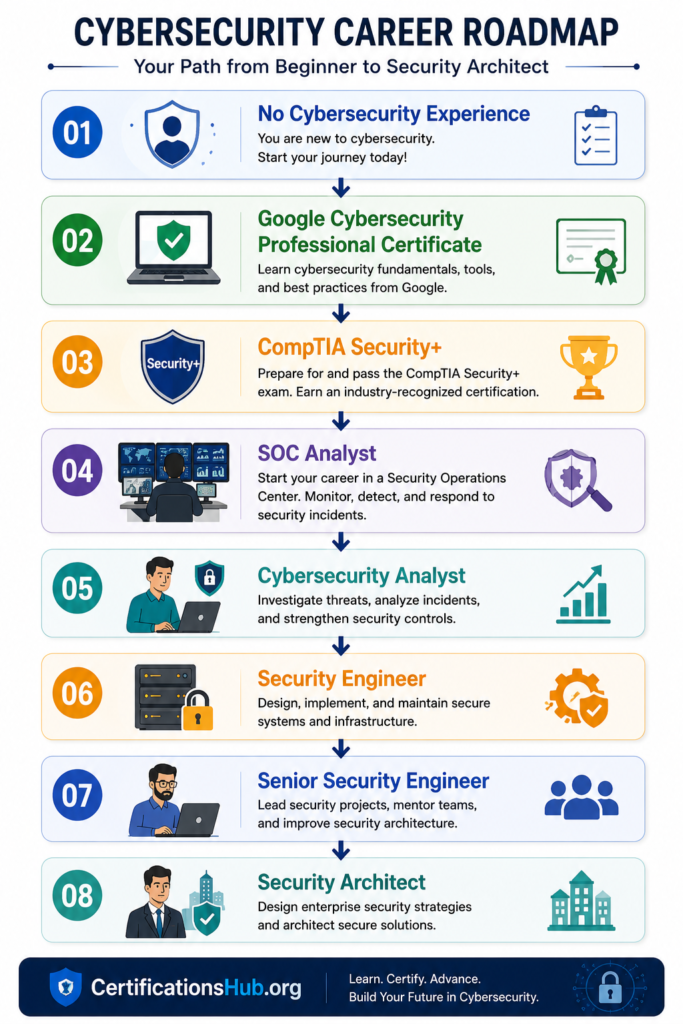
This is a recommended career progression, not a mandatory sequence. You can enter cybersecurity through other routes depending on your existing IT experience.
Employer Recognition
This is where Security+ has an important advantage.
Google Cybersecurity
The Google certificate demonstrates that you have completed structured cybersecurity training and developed practical skills.
Its strongest value is:
Learning + practical skills + portfolio development
CompTIA Security+
Security+ is an established vendor-neutral professional certification.
Its strongest value is:
Certification + standardized examination + cybersecurity knowledge validation
Security+ is also particularly relevant when job descriptions explicitly list it as a preferred or required qualification.
Pros and Cons
Google Cybersecurity Professional Certificate
Pros
- Beginner-friendly
- No previous cybersecurity experience required
- No degree required
- Hands-on learning
- Python included
- Linux included
- SQL included
- SIEM exposure
- Incident response
- Portfolio projects
- AI-related cybersecurity content
- Can help prepare you for Security+
Cons
- Not equivalent to Security+
- No separate professional certification exam
- Employer recognition varies
- Not sufficient by itself for advanced cybersecurity roles
- You’ll still need practical experience
CompTIA Security+
Pros
- Widely recognized cybersecurity certification
- Vendor-neutral
- Formal certification examination
- Strong foundational security credential
- Useful across many IT environments
- Good foundation for advanced security certifications
- Valuable for IT professionals moving into cybersecurity
Cons
- More difficult for complete beginners
- Requires dedicated exam preparation
- Less structured hands-on learning than the Google program
- Certification and training costs are separate
- Passing the exam requires broad cybersecurity knowledge
Google Cybersecurity vs Security+: Which Is Better for a SOC Analyst?
This is one of the most important questions for readers.
If you have no IT or cybersecurity experience:
Google Cybersecurity → Security+ → SOC Analyst
is a strong pathway.
Google gives you the learning foundation and hands-on exposure, while Security+ gives you a recognized professional certification.
If you already work in IT:
You may be able to go directly toward:
IT Experience → Security+ → SOC Analyst
For example, a system administrator or network administrator may already have the technical foundation needed for Security+ preparation.
Should You Do Both?
Yes — for many beginners, this is the strongest approach.
These credentials complement rather than completely replace each other.
Google Cybersecurity gives you:
- Structured learning
- Practical exercises
- Linux
- Python
- SQL
- SIEM
- Security operations
- Portfolio experience
Security+ gives you:
- Professional certification
- Standardized examination
- Broad security knowledge
- Vendor-neutral validation
- Stronger resume signaling
Google itself states that its Cybersecurity Professional Certificate helps prepare learners for the CompTIA Security+ exam.
Recommended Cybersecurity Learning Path
For a complete beginner, I recommend:
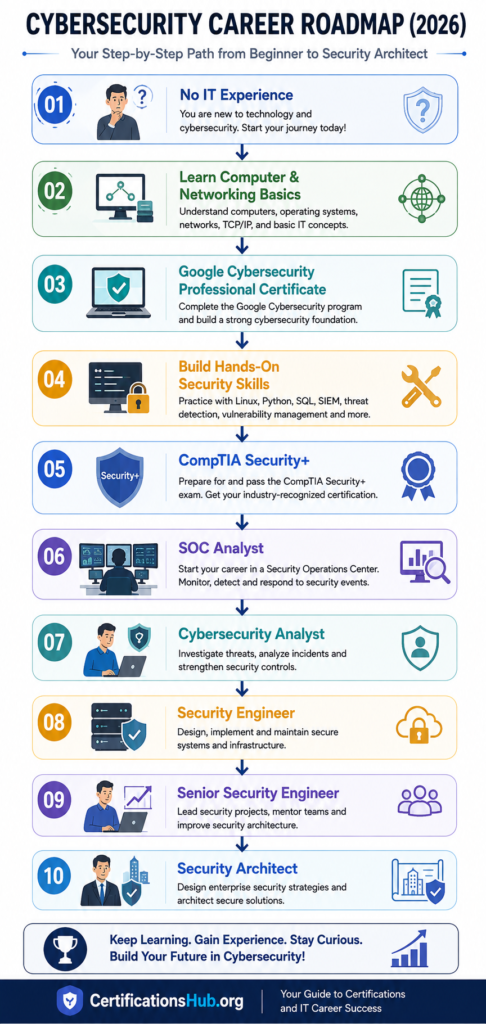
This gives learners both practical skills and professional certification.
90-Day Study Strategy
Days 1–30: Build Foundations
Focus on:
- Networking fundamentals
- Operating systems
- Linux
- Cybersecurity concepts
- CIA triad
- Threats and vulnerabilities
- Authentication
- Access control
If you’re completely new to IT, spend additional time on networking before moving deeper into cybersecurity.
Days 31–60: Google Cybersecurity
Focus on:
- Linux commands
- SQL
- Python
- Security monitoring
- SIEM
- Incident response
- Vulnerability management
- Threat detection
Complete the practical activities rather than simply watching the videos.
Days 61–90: Security+ Preparation
Focus on:
- Security concepts
- Threats and vulnerabilities
- Security architecture
- Security operations
- Identity and access management
- Cryptography
- Incident response
- Governance and risk
Then begin taking practice exams and identify your weak areas.
Google Cybersecurity vs Security+: Decision Guide
| Your Situation | Best Choice |
|---|---|
| No IT experience | Google Cybersecurity |
| No cybersecurity experience | Google Cybersecurity |
| Career changer | Google Cybersecurity |
| IT Support professional | Security+ |
| Network Administrator | Security+ |
| System Administrator | Security+ |
| Want hands-on practice | Google Cybersecurity |
| Want a professional certification | Security+ |
| Want SOC Analyst role | Both |
| Want a stronger beginner pathway | Both |
| Already experienced in IT security | Security+ or advanced certification |
Final Verdict
The Google Cybersecurity Professional Certificate and CompTIA Security+ should not be viewed as direct substitutes.
They solve different problems.
Choose Google Cybersecurity if:
- You’re new to cybersecurity.
- You’re changing careers.
- You need structured learning.
- You want hands-on practice.
- You want to learn Linux, Python, SQL, and SIEM.
- You have little or no IT experience.
Choose Security+ if:
- You already have IT fundamentals.
- You want a recognized cybersecurity certification.
- You’re comfortable preparing for a formal examination.
- Your target jobs mention Security+.
- You want to progress toward advanced cybersecurity certifications.
Best option for many beginners:
Google Cybersecurity → CompTIA Security+ → SOC Analyst → Cybersecurity Analyst → Security Engineer
Google provides the learning foundation, while Security+ provides professional certification validation.
Overall Ratings
| Credential | Best Use | Rating |
|---|---|---|
| Google Cybersecurity | Beginner learning & practical skills | ⭐⭐⭐⭐⭐ 4.8/5 |
| CompTIA Security+ | Professional cybersecurity certification | ⭐⭐⭐⭐⭐ 4.9/5 |
| Both | Strongest beginner-to-career pathway | ⭐⭐⭐⭐⭐ 5/5 |
Key Takeaways
- Google Cybersecurity is designed primarily for beginners.
- Security+ is a professional cybersecurity certification.
- Google includes hands-on exposure to Linux, Python, SQL, SIEM, and security operations.
- Security+ validates broad cybersecurity knowledge through a formal examination.
- You don’t need Google Cybersecurity before taking Security+.
- Google itself positions its certificate as preparation for Security+.
- IT professionals may be able to go directly to Security+.
- Beginners can benefit from completing Google Cybersecurity first.
- Practical experience remains essential for cybersecurity careers.
- Google Cybersecurity + Security+ can be a powerful combination for aspiring SOC Analysts.
Related Articles
- Google Cybersecurity Professional Certificate (2026)
- CompTIA Security+ Certification: Exam, Cost, Salary & Career Guide (2026)
- Google IT Support Professional Certificate (2026)
- CCNA vs CompTIA Network+ Certification
- Security+ vs CEH Certification
- Best Cybersecurity Certifications (2026)
- Google Certifications
Frequently Asked Questions (FAQs)
Is Google Cybersecurity better than Security+?
Neither is universally better.
Google Cybersecurity is better as a beginner learning program, while Security+ is stronger as a professional cybersecurity certification.
Can Google Cybersecurity get me a cybersecurity job?
It can help you qualify for entry-level opportunities, but the certificate alone does not guarantee employment.
You’ll improve your chances by developing networking skills, completing hands-on labs, building projects, and gaining practical experience.
Is Security+ harder than Google Cybersecurity?
Generally, yes.
Security+ requires preparation for a formal certification examination and covers a broad range of cybersecurity topics.
Can I take Security+ after Google Cybersecurity?
Yes. In fact, Google specifically positions its Cybersecurity Professional Certificate as preparation for Security+.
Do I need Google Cybersecurity before Security+?
No.
Google Cybersecurity is not a prerequisite for Security+.
If you already have strong IT and networking fundamentals, you can prepare for Security+ directly.
Does Google Cybersecurity teach Python?
Yes. Python is one of the practical skills included in the current Google Cybersecurity program.
Does Security+ teach Python?
Security+ is not a Python programming certification. It focuses on cybersecurity concepts and practices rather than teaching programming.
Which is better for beginners?
Google Cybersecurity is generally the better starting point for someone with little or no cybersecurity experience.
Which is better for an experienced IT professional?
CompTIA Security+ is usually the stronger choice if you already have a solid IT foundation and want to add a recognized cybersecurity certification.