

Introduction
The Google Cybersecurity Professional Certificate Review is one of the most searched topics among aspiring cybersecurity professionals looking to break into one of the fastest-growing fields in technology. Developed by Google and delivered through Coursera, this beginner-friendly certificate is designed to equip learners with practical cybersecurity skills without requiring prior IT or security experience.
With cyber threats becoming more sophisticated, organizations across industries are investing heavily in cybersecurity talent. As a result, entry-level roles such as Security Analyst, SOC Analyst, Incident Response Analyst, and Cybersecurity Technician are in high demand. Google’s program aims to prepare learners for these opportunities through hands-on labs, real-world scenarios, and practical projects.
In this comprehensive review, we’ll explore the course curriculum, duration, cost, career opportunities, salaries, advantages, disadvantages, and whether the Google Cybersecurity Professional Certificate is worth pursuing in 2026.
Table of Contents
Quick Overview
| Feature | Details |
|---|---|
| Provider | |
| Learning Platform | Coursera |
| Level | Beginner |
| Duration | 4–6 months (recommended) |
| Learning Mode | Self-paced |
| Hands-on Labs | Yes |
| Final Exam | No |
| Certificate Awarded | Google Career Certificate |
| Prerequisites | None |
| Best For | Beginners and career switchers |
What Is the Google Cybersecurity Professional Certificate?
The Google Cybersecurity Professional Certificate is an online career training program created by Google to prepare beginners for entry-level cybersecurity jobs.
Unlike many traditional certifications that focus primarily on passing an exam, this program emphasizes learning through:
- Interactive video lessons
- Hands-on labs
- Practical security exercises
- Case studies
- Real-world cybersecurity scenarios
- Portfolio-building activities
By the end of the program, learners develop foundational knowledge in security operations, network security, threat detection, incident response, and risk management.
Why Learn Cybersecurity in 2026?
Cybersecurity continues to be one of the fastest-growing areas in information technology. Organizations of all sizes need skilled professionals to protect systems, applications, networks, and sensitive data from cyberattacks.
Some of the key reasons to consider a cybersecurity career include:
- High demand for skilled professionals
- Competitive salaries
- Opportunities across multiple industries
- Strong long-term career growth
- Remote and hybrid work options
- Continuous learning and specialization opportunities
Whether you’re starting your IT journey or switching careers, cybersecurity offers a rewarding and future-proof career path.
Who Should Take This Certificate?
The Google Cybersecurity Professional Certificate is ideal for:
- Students interested in cybersecurity
- Fresh graduates
- Career changers
- IT support professionals
- Help Desk Technicians
- Network Administrators
- System Administrators
- Professionals looking to transition into security roles
It is particularly valuable for learners who prefer a structured, self-paced learning experience with practical exercises.
Who Should Avoid This Certificate?
This program may not be the best fit if you:
- Already have several years of cybersecurity experience
- Hold advanced certifications such as CISSP, GIAC, or OSCP
- Work in senior security engineering or architecture roles
- Need a certification specifically required by your employer
Experienced professionals may gain more value from intermediate or advanced cybersecurity certifications.
Prerequisites
One of the biggest advantages of the Google Cybersecurity Professional Certificate is that there are no formal prerequisites.
You only need:
- Basic computer skills
- A laptop or desktop computer
- Internet access
- Curiosity to learn
- Commitment to regular study
No degree is required.
No programming knowledge is required.
No previous cybersecurity experience is required.
Course Curriculum
The certificate is divided into multiple courses that gradually build your cybersecurity knowledge.
| Module | Topics Covered |
|---|---|
| Foundations of Cybersecurity | Security concepts, career paths, threat landscape |
| Play It Safe: Manage Security Risks | Risk management, governance, compliance |
| Connect and Protect | Networks, protocols, network security |
| Tools of the Trade | Linux, SQL, security tools |
| Assets, Threats, and Vulnerabilities | Risk assessment and vulnerability management |
| Sound the Alarm | Detection, incident response, SIEM |
| Automate Cybersecurity Tasks | Python basics and automation |
| Put It to Work | Capstone project and portfolio |
The curriculum combines theory with practical exercises, helping learners build job-ready skills.
Skills You’ll Learn
By completing this certificate, you’ll develop knowledge in several core cybersecurity domains.
Cybersecurity Fundamentals
- Confidentiality, Integrity, and Availability (CIA Triad)
- Risk Management
- Threat Modeling
- Security Frameworks
- Governance and Compliance
Networking
- TCP/IP
- DNS
- HTTP/HTTPS
- Firewalls
- VPNs
- Network Monitoring
Security Operations
- Security Information and Event Management (SIEM)
- Log Analysis
- Threat Detection
- Incident Response
- Security Monitoring
Linux
- Command-line navigation
- File permissions
- User management
- Process management
- Shell commands
SQL
- Basic database queries
- Filtering records
- Searching logs
- Investigating security incidents
Python
- Basic scripting
- Automation
- Security workflows
- Repetitive task automation
Hands-on Learning
Unlike many beginner courses, Google’s certificate includes extensive practical activities.
You’ll work with:
- Linux environments
- SQL queries
- Security logs
- Network traffic
- Threat analysis
- Security investigations
- Real-world cybersecurity scenarios
This practical approach helps learners build confidence before applying for entry-level cybersecurity positions.
Learning Format
The certificate includes:
- Video lectures
- Interactive quizzes
- Hands-on labs
- Practice activities
- Reading assignments
- Guided projects
- Portfolio exercises
Since the program is self-paced, learners can study according to their own schedules.
Course Duration
Google recommends approximately 10 hours of study per week.
| Weekly Study Time | Estimated Completion |
|---|---|
| 5 Hours | 6 Months |
| 10 Hours | 4–5 Months |
| 15 Hours | 3 Months |
| 20 Hours | 2 Months |
Many learners complete the program in about four months while balancing work or college.
Certification Cost
The Google Cybersecurity Professional Certificate is offered through Coursera’s monthly subscription model.
| Item | Details |
|---|---|
| Platform | Coursera |
| Payment | Monthly subscription |
| Financial Aid | Available for eligible learners |
| Free Trial | Often available for new users |
Because Coursera pricing can vary by country and promotional offers, always verify the latest pricing before enrolling.
Is There a Certification Exam?
Unlike certifications such as CompTIA Security+, CEH, or CISSP, there is no single proctored certification exam.
Instead, learners complete:
- Module quizzes
- Practical labs
- Assignments
- Knowledge checks
- Capstone project
- Final assessments
Once all required coursework is completed successfully, learners receive the Google Cybersecurity Professional Certificate.
Difficulty Level
| Topic | Difficulty |
|---|---|
| Security Fundamentals | ⭐⭐☆☆☆ |
| Networking | ⭐⭐⭐☆☆ |
| Linux | ⭐⭐⭐☆☆ |
| SQL | ⭐⭐⭐☆☆ |
| Python Basics | ⭐⭐⭐☆☆ |
| Incident Response | ⭐⭐⭐☆☆ |
Overall Difficulty: 3/5
The program is designed for beginners, but concepts such as Linux commands, SQL queries, and security operations may require additional practice for learners without prior IT experience.
Salary After the Google Cybersecurity Professional Certificate (India – 2026)
The Google Cybersecurity Professional Certificate is designed to prepare learners for entry-level cybersecurity roles. While salaries vary based on location, company, skills, and experience, the certificate can help you qualify for junior positions in Security Operations Centers (SOCs) and IT security teams.
| Job Role | Average Salary (India) |
|---|---|
| Cybersecurity Analyst (Entry Level) | ₹4 – ₹7 LPA |
| SOC Analyst (Level 1) | ₹4.5 – ₹8 LPA |
| Information Security Analyst | ₹5 – ₹9 LPA |
| Security Operations Associate | ₹5 – ₹8 LPA |
| Incident Response Analyst | ₹6 – ₹10 LPA |
| Cybersecurity Engineer (with experience) | ₹10 – ₹18 LPA |
Tip: Combining this certificate with hands-on labs, home projects, and certifications like CompTIA Security+ or ISC2 Certified in Cybersecurity (CC) can significantly improve your job prospects.
Global Salary Outlook
| Country | Typical Annual Salary |
|---|---|
| United States | $60,000 – $95,000 |
| Canada | CAD 60,000 – CAD 90,000 |
| United Kingdom | £35,000 – £55,000 |
| Australia | AUD 70,000 – AUD 100,000 |
Career Opportunities
Cybersecurity professionals are needed in almost every industry, including banking, healthcare, retail, government, manufacturing, and cloud computing.
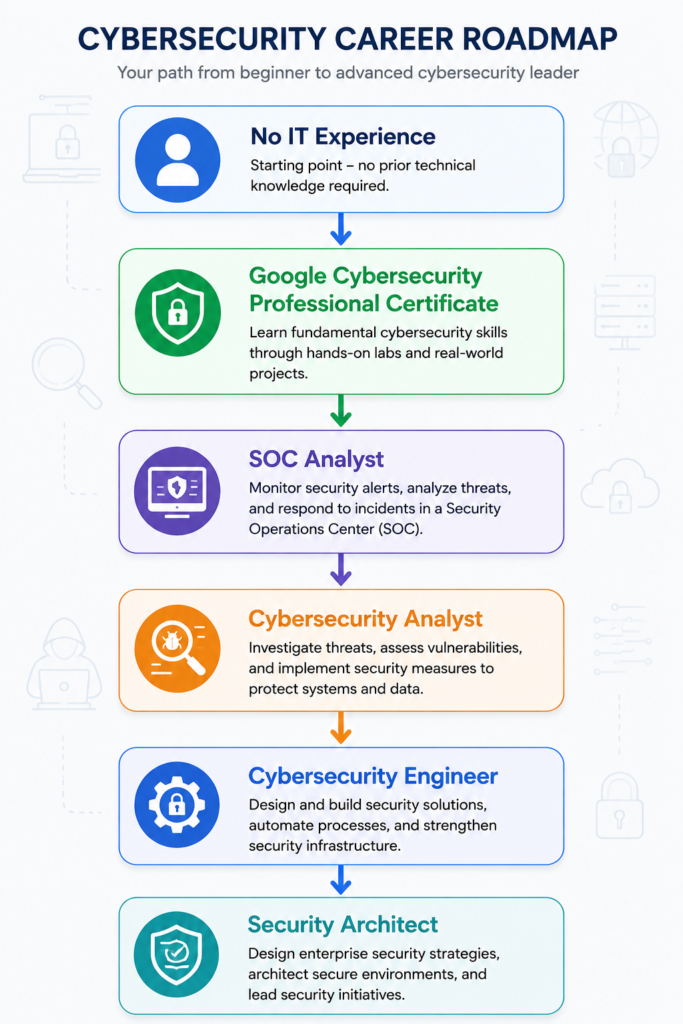
After completing the certificate, you can pursue roles such as:
- SOC Analyst
- Cybersecurity Analyst
- Information Security Analyst
- Security Operations Associate
- Incident Response Analyst
- Junior Threat Analyst
- Security Administrator
- Vulnerability Management Analyst
- Security Compliance Analyst
Career Roadmap
Skills Employers Look For
Technical Skills
- Network Security
- Linux Administration
- SIEM Tools
- Threat Detection
- Incident Response
- SQL
- Python Fundamentals
- Log Analysis
- Risk Assessment
- Security Monitoring
Soft Skills
- Analytical Thinking
- Communication
- Attention to Detail
- Problem Solving
- Documentation
- Team Collaboration
Advantages of the Google Cybersecurity Professional Certificate
Pros
- Beginner friendly
- No prior cybersecurity experience required
- Practical labs and projects
- Covers Linux, SQL, and Python basics
- Self-paced learning
- Affordable subscription model
- Recognized Google Career Certificate
- Excellent introduction to SOC operations
Disadvantages
Cons
- Not a replacement for advanced certifications
- No proctored certification exam
- Requires self-discipline to complete
- Some employers still prioritize Security+
- Python coverage is introductory
Google Cybersecurity vs CompTIA Security+
| Feature | Google Cybersecurity | CompTIA Security+ |
|---|---|---|
| Provider | CompTIA | |
| Learning Format | Online course | Certification exam |
| Beginner Friendly | ⭐⭐⭐⭐⭐ | ⭐⭐⭐⭐☆ |
| Hands-on Labs | ✔ Yes | Self-practice recommended |
| Exam Required | No | Yes |
| Industry Recognition | High | Very High |
| Vendor Neutral | No | Yes |
| Best For | Learning cybersecurity | Validating cybersecurity knowledge |
Which Should You Choose?
Choose Google Cybersecurity if you:
- Are completely new to cybersecurity.
- Prefer structured learning with practical exercises.
- Want to build foundational skills before attempting certification exams.
Choose CompTIA Security+ if you:
- Already understand cybersecurity basics.
- Need a globally recognized certification for job applications.
- Want to meet employer certification requirements.
For many beginners, a practical path is:
- Google Cybersecurity Professional Certificate
- CompTIA Security+
- Advanced certifications based on career goals
Google Cybersecurity vs ISC2 Certified in Cybersecurity (CC)
| Feature | Google Cybersecurity | ISC2 CC |
|---|---|---|
| Learning Style | Structured coursework | Certification exam |
| Hands-on Labs | ✔ Yes | Limited |
| Cost | Monthly subscription | Exam-based |
| Programming | Python Basics | Not required |
| Linux Practice | Extensive | Basic |
| Best For | Beginners wanting guided learning | Beginners seeking an entry-level certification |
8-Week Study Plan
| Week | Topics |
|---|---|
| Week 1 | Cybersecurity fundamentals |
| Week 2 | Risk management and compliance |
| Week 3 | Networking and security protocols |
| Week 4 | Linux fundamentals |
| Week 5 | SQL for cybersecurity |
| Week 6 | SIEM and incident response |
| Week 7 | Python basics and automation |
| Week 8 | Capstone project and revision |
Studying 8–10 hours per week is generally sufficient to complete the program in about two months.
Best Learning Resources
Official Resources
- Google Career Certificates
- Coursera
Supplementary Resources
- TryHackMe
- Microsoft Learn
- Cisco Networking Academy
- OWASP
- Linux Journey
- Python.org
Preparation Tips
- Complete every hands-on lab.
- Practice Linux commands daily.
- Learn basic SQL queries.
- Set up a virtual machine for experimentation.
- Read about common cyberattacks.
- Build a simple cybersecurity portfolio.
- Stay updated with cybersecurity news.
- Revise security concepts before completing assessments.
Common Mistakes to Avoid
- Skipping practical labs
- Ignoring Linux modules
- Not practicing SQL
- Treating the course as theory only
- Rushing through assessments
- Failing to build a portfolio
- Expecting the certificate alone to guarantee a job
Is the Google Cybersecurity Professional Certificate Worth It in 2026?
It is worth it if:
- You are new to cybersecurity.
- You want a structured, beginner-friendly learning path.
- You prefer hands-on practice over exam preparation.
- You are planning a career transition into cybersecurity.
- You intend to pursue advanced certifications later.
It may not be worth it if:
- You already work in cybersecurity.
- You hold advanced security certifications.
- You need a certification specifically required by your employer.
Final Verdict
The Google Cybersecurity Professional Certificate is one of the strongest beginner cybersecurity programs available in 2026. Its combination of structured lessons, practical labs, and real-world scenarios makes it an excellent choice for learners who want to build foundational security skills without prior experience.
Unlike exam-focused certifications, this program emphasizes practical learning in Linux, networking, SQL, Python, threat detection, and incident response. While it should not be viewed as a replacement for advanced certifications like CompTIA Security+ or CISSP, it provides an outstanding starting point for aspiring cybersecurity professionals.
If you’re looking to enter the cybersecurity field, switch careers, or build a strong foundation before pursuing advanced certifications, the Google Cybersecurity Professional Certificate is well worth considering.
Key Takeaways
- Designed specifically for beginners with no prerequisites.
- Covers networking, Linux, SQL, Python, SIEM, and incident response.
- Includes practical labs and hands-on exercises.
- Ideal for aspiring SOC Analysts and Cybersecurity Analysts.
- Flexible self-paced learning through Coursera.
- Strong foundation for advanced certifications such as CompTIA Security+ and ISC2 Certified in Cybersecurity (CC).
Related Articles
- Google IT Support Professional Certificate Review
- Google Data Analytics Professional Certificate Review
- Certified Ethical Hacker (CEH) Certification Guide
- Best Cybersecurity Certifications
- ISC2 Certified in Cybersecurity (CC) Guide
- CompTIA Security+ Certification Guide
- Career Change to Cybersecurity
- Best IT Certifications for Beginners
Frequently Asked Questions (FAQs)
Is the Google Cybersecurity Professional Certificate recognized by employers?
Yes. It is recognized as a beginner-level professional certificate and demonstrates practical cybersecurity knowledge, especially for entry-level roles.
Can I get a cybersecurity job after completing this certificate?
It can help you qualify for entry-level positions such as SOC Analyst or Cybersecurity Analyst. Building a portfolio, practicing hands-on skills, and preparing for interviews will improve your chances.
Does the certificate expire?
No. The Google Cybersecurity Professional Certificate does not have an expiration date.
Is programming required?
No. The course introduces Python basics, but no prior programming experience is required.
Is this certificate suitable for beginners?
Yes. It is specifically designed for learners with little or no cybersecurity background.
Which is better: Google Cybersecurity or CompTIA Security+?
If your goal is learning, Google Cybersecurity is an excellent starting point. If your goal is employer-recognized certification, CompTIA Security+ is often the stronger credential. Many learners benefit from completing both.