
Introduction
Artificial intelligence and generative AI are rapidly becoming part of cloud-based applications, business processes and technology careers.
If you want to understand AI, machine learning and generative AI on AWS without becoming a machine learning engineer, the AWS Certified AI Practitioner certification is designed specifically for that level.
The certification validates foundational knowledge of:
- Artificial intelligence
- Machine learning
- Generative AI
- Foundation models
- Prompt engineering
- Responsible AI
- AI security
- AI governance
- AWS AI services and technologies
AWS categorizes AI Practitioner as a Foundational-level certification. The current exam is AIF-C01, with a 90-minute duration, 65 questions and a standard exam fee of US$100.
Importantly, this is not a machine learning engineering certification.
AWS states that candidates are not expected to develop or code AI/ML models, perform feature engineering, tune hyperparameters, build AI/ML pipelines or perform mathematical/statistical analysis of AI/ML models for this exam.
That makes AWS Certified AI Practitioner particularly interesting for professionals who want to add AI knowledge to an existing career in:
- Cloud
- IT
- Development
- Data
- Project management
- Product management
- Business analysis
- Sales and presales
- Consulting
- AI/ML-related business roles
This guide explains the AWS Certified AI Practitioner certification in 2026, including its exam, cost, eligibility, syllabus, difficulty, preparation strategy, career opportunities and salary considerations.
Table of Contents
AWS Certified AI Practitioner: Quick Overview
| Feature | Details |
|---|---|
| Certification | AWS Certified AI Practitioner |
| Exam Code | AIF-C01 |
| Level | Foundational |
| Focus | AI, ML and Generative AI |
| Exam Duration | 90 minutes |
| Questions | 65 |
| Scored Questions | 50 |
| Unscored Questions | 15 |
| Question Types | Multiple choice, multiple response, ordering and matching |
| Exam Fee | US$100 + applicable taxes |
| India Reference Price | ₹8,553 for an exam voucher through the applicable INR pricing channel |
| Prerequisites | No formal prerequisite |
| Recommended AWS Exposure | Up to 6 months of AI/ML exposure on AWS |
| Passing Score | 700/1000 |
| Validity | 3 years |
| Delivery | Pearson VUE test center or online proctored |
| Primary Audience | Professionals seeking foundational AI/ML/GenAI knowledge on AWS |
AWS currently lists the standard AI Practitioner exam at US$100, while its exam pricing page lists ₹8,553 as the current INR price for a foundational exam voucher through the Pearson Mindhub voucher store; applicable taxes may apply.
What Is AWS Certified AI Practitioner?
AWS Certified AI Practitioner is a foundational certification that validates knowledge of AI, machine learning and generative AI concepts and their use cases on AWS.
AWS describes the certification as a good starting point for individuals exploring AI/ML on AWS, whether they are adding AI skills to an existing cloud career or beginning to work with AI/ML technologies.
The certification focuses on understanding and applying AI concepts rather than building sophisticated AI systems.
You should be able to understand questions such as:
- What is machine learning?
- What is generative AI?
- What is a foundation model?
- What is an LLM?
- What is prompt engineering?
- What is RAG?
- What are embeddings?
- When should an organization use traditional ML versus a foundation model?
- What are the limitations of generative AI?
- How can AI systems be made responsible?
- How should AI systems be secured?
- What AWS services can support AI/GenAI use cases?
What Does AWS AI Practitioner Validate?
According to the current AWS exam guide, the certification validates the ability to:
- Describe AI, ML and GenAI concepts
- Identify appropriate AI/ML and GenAI technologies for business problems
- Determine suitable AI/ML technologies for specific use cases
- Use AI, ML and GenAI technologies responsibly
This means the certification sits at the intersection of:
AI knowledge + AWS knowledge + business use cases
rather than deep model development.
Who Should Take AWS Certified AI Practitioner?
AWS specifically targets people who want to demonstrate foundational knowledge of AI/ML and generative AI on AWS.
Potential candidates include professionals working in:
- Cloud
- Development
- Data
- IT
- AI/ML
- Business functions
AWS also notes that candidates may use AI/ML technologies without necessarily building AI/ML solutions themselves.
It can be particularly useful for:
- Cloud professionals
- IT professionals
- Software developers
- Project managers
- Product managers
- Business analysts
- Consultants
- Technical sales professionals
- Presales professionals
- Solution professionals
- Data professionals
- AI-curious technology professionals
- Career switchers exploring AI
Who Should Not Take AWS AI Practitioner First?
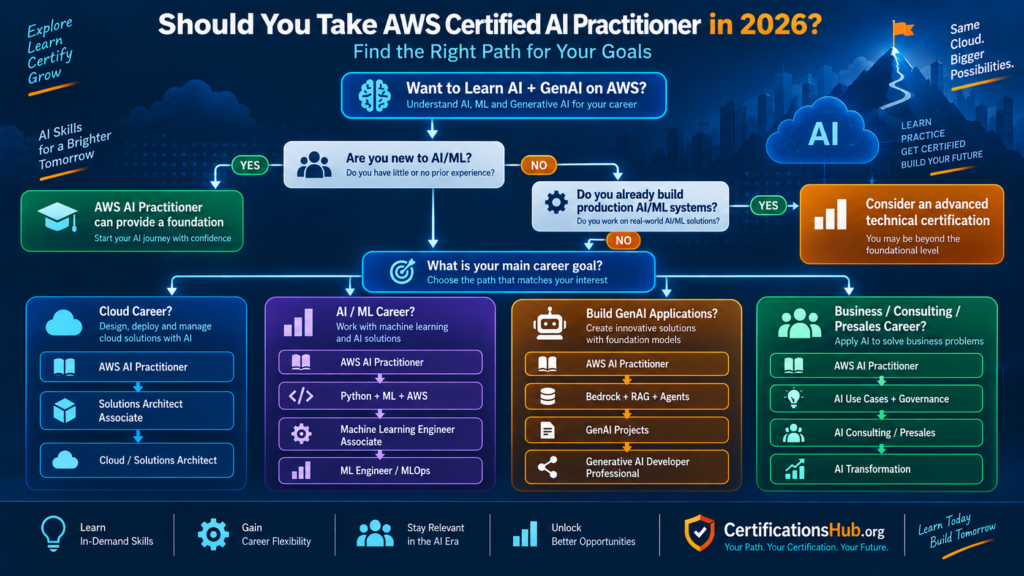
The certification may not be the best starting point if your primary goal is to become a highly technical machine learning engineer.
If your career objective is:
Build and deploy machine learning models
you will need substantially deeper skills in:
- Python
- Statistics
- Mathematics
- Machine learning algorithms
- Data preparation
- Feature engineering
- Model training
- Model evaluation
- MLOps
- Deployment
AWS explicitly lists developing or coding AI/ML models, feature engineering, hyperparameter tuning, AI/ML pipeline implementation and mathematical/statistical analysis as out of scope for the AI Practitioner target candidate.
For those careers, a role-specific Associate or Professional certification and practical projects may be more appropriate.
AWS AI Practitioner Eligibility
There is no formal prerequisite for AWS Certified AI Practitioner.
You don’t need to:
- Hold AWS Cloud Practitioner
- Hold an AWS Associate certification
- Have a computer science degree
- Be a machine learning engineer
- Complete mandatory AWS training
- Have a specific number of years of experience
However, AWS describes the target candidate as someone with up to six months of exposure to AI/ML technologies on AWS.
AWS also recommends familiarity with core AWS services and concepts such as:
- Amazon EC2
- Amazon S3
- AWS Lambda
- Amazon Bedrock
- Amazon SageMaker AI
- AWS shared responsibility model
- IAM
- AWS pricing models
Do You Need AWS Cloud Practitioner Before AI Practitioner?
No.
AWS AI Practitioner does not require AWS Cloud Practitioner as a prerequisite.
However, your preparation path should depend on your background.
If you already understand AWS
You can potentially go directly to:
AWS fundamentals → AI Practitioner
If you are new to AWS
A better learning sequence may be:
AWS Cloud fundamentals → Core AWS services → AI fundamentals → AI Practitioner
AWS itself says that people who are new to IT and AWS Cloud should first start with foundational AWS training such as Cloud Practitioner Essentials or AWS Technical Essentials.
AWS AI Practitioner vs AWS Cloud Practitioner
These two certifications are easy to confuse.
Both are foundational AWS certifications, but they focus on different subjects.
| Feature | AWS Cloud Practitioner | AWS AI Practitioner |
|---|---|---|
| Primary Focus | AWS Cloud | AI, ML & GenAI |
| Level | Foundational | Foundational |
| Exam Code | CLF-C02 | AIF-C01 |
| Duration | 90 minutes | 90 minutes |
| Questions | 65 | 65 |
| Main Objective | Cloud literacy | AI literacy on AWS |
| AI Depth | Basic | Much deeper |
| GenAI | Limited | Major component |
| Prompt Engineering | Limited | Included |
| Foundation Models | Limited | Major component |
| Responsible AI | Basic security concepts | Dedicated domain |
| AI Governance | General cloud governance | Dedicated AI security/governance |
| Best For | Cloud beginners | AI/GenAI beginners |
AWS describes Cloud Practitioner as validating high-level understanding of AWS Cloud, services and terminology, while AI Practitioner validates foundational knowledge of AI/ML and generative AI concepts and use cases on AWS.
Simple way to remember
Cloud Practitioner = Understand AWS Cloud
AI Practitioner = Understand AI on AWS
AWS AI Practitioner Exam Overview
The current AIF-C01 exam has:
- 90 minutes
- 65 questions
- 50 scored questions
- 15 unscored questions
- Minimum passing score of 700/1000
AWS states that the unscored questions are not identified during the exam.
AWS AI Practitioner Question Types
The current exam guide lists four possible question types:
Multiple Choice
One correct answer and three incorrect options.
Multiple Response
Two or more correct answers must be selected.
Ordering
You must place responses in the correct order.
Matching
You must correctly match responses with prompts.
AWS also states that unanswered questions are scored as incorrect and that there is no penalty for guessing.
AWS AI Practitioner Passing Score
The current minimum passing score is:
700 out of 1000
AWS uses a scaled scoring system rather than treating the raw percentage of correct answers as the final score.
The exam uses a compensatory scoring model, meaning you don’t have to achieve a separate passing score in every domain. You need to achieve the required overall score.
AWS AI Practitioner Exam Domains
The current AIF-C01 exam has five domains:
| Domain | Weight |
|---|---|
| Fundamentals of AI and ML | 20% |
| Fundamentals of Generative AI | 24% |
| Applications of Foundation Models | 28% |
| Guidelines for Responsible AI | 14% |
| Security, Compliance & Governance for AI Solutions | 14% |
| Total | 100% |
The largest section is Applications of Foundation Models at 28%, followed by Fundamentals of Generative AI at 24%.
That means GenAI and foundation-model concepts account for more than half of the scored content.
This is an important difference from older or generic descriptions of the certification.
Domain 1: Fundamentals of AI and ML
Weight: 20%
This domain establishes the foundation for understanding AI and machine learning.
You should understand:
- AI
- Machine learning
- Deep learning
- Neural networks
- Computer vision
- Natural language processing
- Algorithms
- Models
- Training
- Inference
- Bias
- Fairness
- Large language models
- Generative AI
- Agentic AI
The current 2026 exam guide explicitly includes GenAI and agentic AI among the concepts candidates should understand.
Types of Machine Learning
You should understand the basic differences between:
Supervised Learning
Models learn from labeled data.
Common examples include:
- Classification
- Regression
Unsupervised Learning
Models identify patterns in data without predefined labels.
Examples include:
- Clustering
Reinforcement Learning
An agent learns through interactions and feedback.
You don’t need to become a machine learning researcher for this exam.
The focus is on understanding the concepts and knowing when different approaches can be appropriate.
AI Use Cases
You should understand practical applications such as:
- Computer vision
- Natural language processing
- Speech recognition
- Recommendation systems
- Fraud detection
- Forecasting
- Knowledge bases
- AI assistants
- Agentic AI
You should also understand situations where AI may not be appropriate.
AWS specifically expects candidates to consider factors such as cost-benefit analysis and whether a deterministic outcome is required instead of a prediction.
AI/ML Development Lifecycle
You should understand the broad AI/ML lifecycle:
Data → Model → Training → Evaluation → Deployment → Monitoring → Improvement
The exam can also test concepts related to:
- Model performance
- Accuracy
- Precision
- Recall
- F1 score
- Business metrics
- ROI
- User feedback
- Production readiness
- MLOps
The emphasis is on understanding these concepts rather than performing advanced mathematical calculations.
Domain 2: Fundamentals of Generative AI
Weight: 24%
This is one of the most important parts of the exam.
You should understand:
- Generative AI
- Foundation models
- Large language models
- Tokens
- Embeddings
- Vectors
- Prompt engineering
- Transformers
- Multimodal models
- Diffusion models
- Context engineering
- Agentic AI
The current exam guide also includes concepts such as Model Context Protocol (MCP), multi-agent communication, memory management, tool usage and workflow orchestration.
Generative AI Use Cases
You should understand where GenAI can be used for:
- Text generation
- Image generation
- Video generation
- Audio generation
- Summarization
- Translation
- Code generation
- Customer service
- AI assistants
- Search
- Recommendations
- Agents
You should also understand the limitations of GenAI.
Examples include:
- Hallucinations
- Inaccuracy
- Nondeterministic outputs
- Interpretability limitations
- Cost
- Latency
- Compliance requirements
Foundation Models
You should understand the basic lifecycle of a foundation model:
Data Selection → Pre-training → Fine-tuning → Evaluation → Deployment → Feedback
You should also understand the difference between:
- Pre-trained models
- Foundation models
- Fine-tuned models
- Custom models
Tokens and GenAI Pricing
The exam expects an understanding of token-based pricing and how token usage can affect:
- Cost
- Performance
- Response length
- Application economics
This is especially important for professionals working with AI applications rather than simply using AI tools.
Domain 3: Applications of Foundation Models
Weight: 28%
This is the largest domain in the AIF-C01 exam.
It covers how foundation models are used in applications.
Key topics include:
- Foundation model selection
- Prompt engineering
- RAG
- Embeddings
- Vector databases
- Fine-tuning
- Model evaluation
- AI agents
- Cost trade-offs
Foundation Model Selection
You should understand factors such as:
- Cost
- Model size
- Latency
- Modality
- Language support
- Input/output limits
- Complexity
- Customization requirements
- Performance
- Compliance
The best model is not necessarily the largest or most capable model.
The choice depends on the business requirement.
What Is RAG?
Retrieval-Augmented Generation (RAG) is an important concept for the exam.
In simple terms:
User Question
↓
Retrieve Relevant Information
↓
Provide Context to the Model
↓
Generate Response
RAG can help applications use information from external knowledge sources rather than relying solely on the model’s pre-trained knowledge.
AWS includes Amazon Bedrock Knowledge Bases among the technologies candidates should understand.
Prompt Engineering
The exam includes concepts such as:
- Instructions
- Context
- Zero-shot prompting
- One-shot prompting
- Few-shot prompting
- Prompt templates
- Specificity
- Conciseness
- Negative prompts
- Prompt versioning
It also includes risks such as:
- Prompt injection
- Prompt hijacking
- Jailbreaking
- Data exposure
Fine-Tuning vs RAG
You should understand the basic distinction.
RAG
Provides external information to the model at inference time.
Useful when:
- Information changes frequently
- You need organization-specific knowledge
- You want grounded responses
Fine-Tuning
Changes model behavior by training it further on specific data.
Useful when:
- You need specialized behavior
- You need domain adaptation
- You have appropriate training data
The exam expects candidates to understand the trade-offs between approaches including pre-training, fine-tuning, in-context learning, RAG and model distillation.
Domain 4: Guidelines for Responsible AI
Weight: 14%
AI isn’t just about generating accurate outputs.
Organizations also need to consider:
- Fairness
- Bias
- Inclusivity
- Robustness
- Safety
- Veracity
- Transparency
- Explainability
- Privacy
The current exam guide specifically includes responsible AI practices and the legal risks associated with GenAI, including intellectual property concerns, biased outputs, hallucinations and loss of customer trust.
Responsible AI
You should understand concepts such as:
Bias
AI systems can produce systematically biased outcomes based on training data, model design or other factors.
Fairness
AI systems should be evaluated for potentially unfair outcomes across groups.
Explainability
Users and organizations may need to understand why a model produces particular results.
Transparency
Organizations should provide appropriate information about AI systems, their limitations and how they are used.
Domain 5: Security, Compliance and Governance
Weight: 14%
This domain focuses on securing and governing AI systems.
You should understand:
- IAM
- Encryption
- Data privacy
- Data governance
- Logging
- Audit trails
- Data lineage
- Security
- Prompt injection
- Data leakage
- Output validation
- Governance policies
- Compliance
AWS also includes services and features such as IAM, encryption, Amazon Macie, AWS PrivateLink, AWS shared responsibility concepts, Amazon Bedrock Guardrails and AgentCore security capabilities in the current exam scope.
AWS Services You Should Know
AI Practitioner is not simply a list of AI services.
You should understand the purpose and use cases of relevant AWS services.
Important services and technologies include:
| AWS Service / Technology | What to Understand |
|---|---|
| Amazon Bedrock | Foundation models and GenAI applications |
| Amazon SageMaker AI | Machine learning development and deployment |
| SageMaker JumpStart | Access to models and ML solutions |
| Amazon Transcribe | Speech-to-text |
| Amazon Translate | Machine translation |
| Amazon Comprehend | NLP |
| Amazon Polly | Text-to-speech |
| Amazon Lex | Conversational interfaces |
| Amazon Bedrock Knowledge Bases | RAG |
| Amazon Bedrock Guardrails | Responsible GenAI controls |
| Amazon Q | Generative AI assistants |
| Kiro | AI-assisted development |
| Strands Agents | Agent development |
| Amazon Bedrock AgentCore | Agent-related capabilities |
The current AIF-C01 exam guide includes a broad list of in-scope AWS services and features, and AWS notes that the list can change as the certification evolves.
What Is Out of Scope for AWS AI Practitioner?
This is one of the most useful things to understand before preparing.
AWS explicitly says the target candidate is not expected to perform tasks such as:
- Developing or coding AI/ML models
- Feature engineering
- Hyperparameter tuning
- Model optimization
- Building AI/ML pipelines
- Deploying AI/ML infrastructure
- Mathematical/statistical analysis of models
- Implementing AI/ML security protocols
- Building governance frameworks
Therefore:
You don’t need to become a data scientist to pass AI Practitioner.
Is AWS AI Practitioner a Technical Certification?
It is technical enough to require understanding of AI and AWS technologies, but it is not a deep engineering certification.
Think of it as:
AI Technology Literacy + AWS AI Knowledge + Business Application
rather than:
Machine Learning Engineering
This distinction is important when deciding whether the certification matches your career goals.
AWS AI Practitioner Difficulty
For a complete beginner, I would consider the exam moderate.
A reasonable practical estimate would be:
5.5–6.5/10
The difficulty depends heavily on your background.
It may feel easier if you already know:
- AWS basics
- Cloud computing
- AI terminology
- Generative AI
- LLM concepts
- Prompt engineering
It may feel harder if:
- You have never used AWS
- AI terminology is completely new
- You don’t understand basic cloud concepts
- You haven’t used GenAI tools
- You have difficulty distinguishing AWS AI services
The exam is not difficult because you need to code.
It is challenging because there are many concepts and services to understand.
How Long Does It Take to Prepare?
Your preparation time depends on your background.
| Background | Suggested Preparation |
|---|---|
| Complete AI + AWS beginner | 6–8 weeks |
| AWS professional new to AI | 4–6 weeks |
| AI professional new to AWS | 4–6 weeks |
| Cloud professional with GenAI exposure | 3–5 weeks |
| Regular AWS + GenAI user | 2–4 weeks |
These are practical estimates, not official AWS timelines.
For most working professionals, 4–6 weeks is a reasonable preparation target if they can study consistently.
Recommended Daily Study Time
If you work full-time:
60–90 minutes on weekdays
plus
2–3 hours on weekends
can provide a practical preparation schedule.
A useful study split is:
35% AI/ML concepts
35% GenAI + foundation models
20% AWS AI services
10% practice questions and revision
The exact split can be adjusted according to your weak areas.
AWS AI Practitioner Preparation Strategy
Don’t prepare by memorizing AWS service names.
Instead use:
Concept → Use Case → AWS Service → Business Problem → Practice Question
For example:
Concept
Retrieval-Augmented Generation
↓
Understand
Why an application may need external knowledge
↓
AWS
Amazon Bedrock Knowledge Bases
↓
Use Case
Enterprise knowledge assistant
↓
Practice
Identify when RAG is preferable to fine-tuning
This approach is much more effective than memorizing definitions.
AWS Certified AI Practitioner Salary, Career Opportunities & Job Roles
AWS Certified AI Practitioner is a foundational certification, so it should not be viewed as a direct qualification for senior AI engineering jobs. Its primary value is demonstrating that you understand AI, machine learning, generative AI, foundation models, responsible AI, and relevant AWS services at a foundational level.
The certification can be particularly useful for professionals who want to add AI knowledge to an existing cloud, IT, business, project management, presales, data, or technology career.
AWS Certified AI Practitioner Salary in India
There is no official salary scale associated with AWS Certified AI Practitioner. Your salary depends much more on your existing experience, technical skills, job role, company, location, and ability to apply AI in real-world projects.
For context, current salary data for related roles shows:
| Role | Indicative India Salary |
|---|---|
| Cloud Engineer | Around ₹10.5–₹10.7 LPA average |
| Machine Learning Engineer | Around ₹11.4–₹12.1 LPA average |
| Machine Learning Engineer – Hyderabad | Around ₹15.8 LPA average in a small Indeed sample |
| Experienced/specialized AI/ML roles | Can exceed ₹20 LPA |
Indeed reported an average base salary of about ₹10.68 lakh per year for Cloud Engineers in India in September 2026, based on 115 reported salaries.
For Machine Learning Engineers, Indeed reported an average base salary of about ₹12.08 lakh per year in India in August 2026, based on 55 salaries.
Indeed’s Hyderabad figure was approximately ₹15.79 lakh per year, but the estimate was based on only four reported salaries, so it should not be treated as a representative market average.
Important: These are salary figures for related job roles, not salaries guaranteed by AWS Certified AI Practitioner.
Does AWS AI Practitioner increase your salary?
Not automatically.
The certification can strengthen your profile, but employers generally pay for a combination of:
- Professional experience
- Technical skills
- Cloud knowledge
- AI/ML knowledge
- Hands-on projects
- Communication skills
- Business understanding
- Problem-solving ability
- Relevant job responsibilities
For example, someone with AWS AI Practitioner plus strong AWS architecture experience may use the certification differently from a fresher who has only passed the exam.
Think of the certification as a career accelerator or credibility signal, rather than a salary guarantee.
What Jobs Can You Get After AWS Certified AI Practitioner?
AWS AI Practitioner alone is unlikely to qualify you for a dedicated Machine Learning Engineer role.
However, it can complement several existing or emerging career paths.
Potential roles where the certification can add value
- Cloud Analyst
- Cloud Consultant
- Cloud Support Professional
- IT Business Analyst
- Technology Business Analyst
- AI Business Analyst
- AI/Cloud Presales Consultant
- Solutions Consultant
- Technical Account Manager
- Project Manager – AI/Cloud
- Product Manager – AI/Cloud
- AI Transformation Consultant
- Cloud Sales Specialist
- Technology Consultant
- Data/AI Program Coordinator
- Junior AI/ML professional
The exact role requirements vary significantly between employers.
AWS itself describes the intended audience broadly, including people working in cloud, development, data, IT, AI/ML, and line-of-business roles.
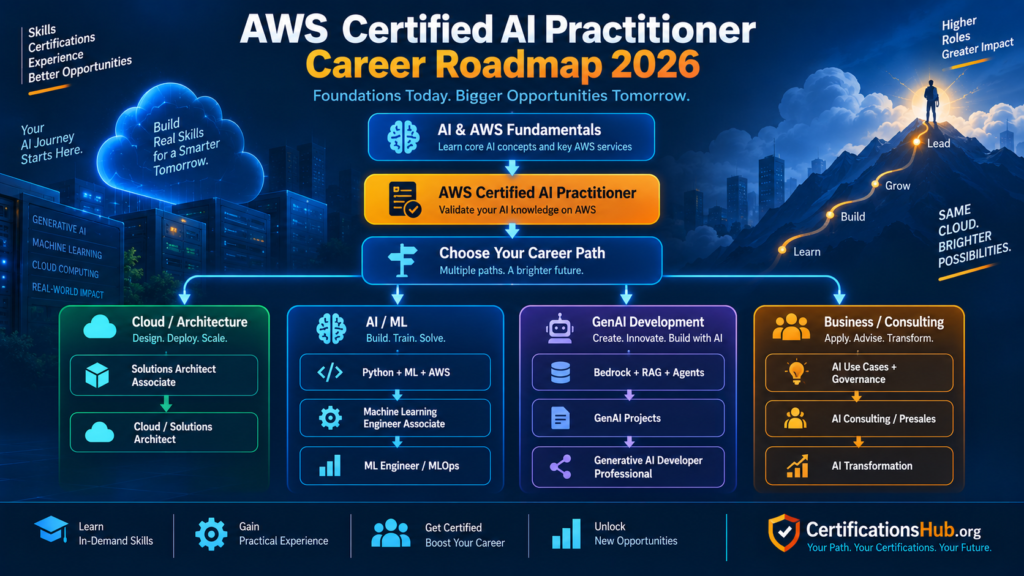
AWS AI Practitioner Career Paths
The most useful way to think about this certification is as a starting point, not an endpoint.
There are several possible paths.
Career Path 1: AI + Cloud
A beginner can build the following progression:
AWS AI Practitioner
↓
AWS Solutions Architect – Associate
↓
Hands-on AWS projects
↓
Cloud Engineer / Cloud Consultant / Solutions Architect
↓
Advanced AWS certifications
This path is particularly useful for professionals who want to combine cloud architecture with AI workloads.
AWS specifically recommends Solutions Architect – Associate for individuals transitioning toward cloud careers after AI Practitioner.
Career Path 2: AI/ML Engineering
For someone who wants a deeply technical AI career:
AWS AI Practitioner
↓
Python + SQL + Statistics
↓
Machine Learning fundamentals
↓
Amazon SageMaker + Amazon Bedrock
↓
AWS Machine Learning Engineer – Associate
↓
ML Engineer / MLOps / LLMOps / AI Engineer
AWS’s Machine Learning Engineer – Associate certification is designed for professionals who build, operationalize, deploy, maintain, monitor, and secure AI/ML solutions on AWS.
The updated MLA-C02 exam also expands into generative AI, foundation models, agentic AI, and LLM workloads.
Career Path 3: Generative AI Developer
For software developers:
AWS AI Practitioner
↓
Python / JavaScript
↓
APIs + AWS fundamentals
↓
Amazon Bedrock
↓
RAG + vector databases
↓
AI agents
↓
AWS Certified Generative AI Developer – Professional
The AWS Certified Generative AI Developer – Professional certification is designed for professionals building and deploying production-ready generative AI solutions using AWS technologies such as Amazon Bedrock. AWS recommends candidates have substantial cloud/application experience and hands-on generative AI implementation experience.
This is therefore a later-stage certification, not the natural next step for someone who is completely new to AI or cloud.
Career Path 4: AI + Business / Consulting
You don’t necessarily need to become an AI engineer.
A business or technology professional can follow:
AWS AI Practitioner
↓
AI use cases
↓
Prompt engineering
↓
GenAI business applications
↓
AI governance and responsible AI
↓
AI transformation / consulting / presales
This can be particularly useful for professionals who interact with customers, business stakeholders, project teams, or technology decision-makers.
Career Path 5: AI + Project Management
Project managers can use AI Practitioner knowledge to understand:
- AI project requirements
- Foundation models
- RAG
- AI agents
- AI risks
- Data privacy
- AI security
- AI governance
- AI implementation challenges
- AI project costs
A possible progression is:
AWS AI Practitioner
↓
AI/Cloud Project Experience
↓
AI Project Manager
↓
AI Program Manager
↓
AI Transformation / Delivery Leadership
The certification does not qualify someone automatically for these roles, but it can provide useful technical vocabulary and foundational understanding.
AWS AI Practitioner vs AWS Cloud Practitioner
These two certifications are both foundational, but they focus on different knowledge areas.
| Feature | AWS Cloud Practitioner | AWS AI Practitioner |
|---|---|---|
| Level | Foundational | Foundational |
| Primary focus | Cloud and AWS fundamentals | AI, ML and GenAI |
| Cloud concepts | Strong | Moderate |
| AI concepts | Limited | Strong |
| GenAI | Limited | Strong |
| Foundation models | Limited | Strong |
| Responsible AI | Limited | Strong |
| AI security/governance | Limited | Strong |
| Best for | AWS/cloud beginners | People exploring AI on AWS |
If someone is completely new to both AWS and cloud computing, Cloud Practitioner may provide a broader starting point.
If someone already understands cloud fundamentals and wants to move into AI, AI Practitioner can be a more directly relevant certification.
AWS also states that people new to IT and AWS Cloud should consider foundational AWS training before AI Practitioner.
AWS AI Practitioner vs Machine Learning Engineer – Associate
This is a much bigger difference.
| Feature | AI Practitioner | ML Engineer – Associate |
|---|---|---|
| Level | Foundational | Associate |
| Focus | AI/ML/GenAI concepts | Building and operating AI/ML solutions |
| Coding | Not central | Much more relevant |
| ML engineering | Foundational | Technical |
| SageMaker | Conceptual/use-case knowledge | Hands-on implementation |
| GenAI | Foundational | Implementation/operations |
| Production workloads | Limited | Core focus |
| Target audience | Broad | Technical AI/ML professionals |
AWS describes the Machine Learning Engineer – Associate as a certification for technical ML roles, including ML engineering, MLOps, LLMOps, data engineering and related positions.
Therefore:
AI Practitioner = Understand AI
ML Engineer Associate = Build and operate AI/ML
AWS AI Practitioner vs Generative AI Developer – Professional
These certifications target very different levels.
| Feature | AI Practitioner | GenAI Developer – Professional |
|---|---|---|
| Level | Foundational | Professional |
| Main focus | AI/ML/GenAI knowledge | Production GenAI development |
| Target audience | Broad technology/business audience | Developers/technical professionals |
| Coding | Not central | Important |
| RAG | Understand concepts | Implement solutions |
| AI agents | Understand concepts | Build/integrate solutions |
| Security | Foundational | Production implementation |
| Experience | No formal prerequisite | Significant AWS/application experience recommended |
AWS describes the GenAI Developer – Professional certification as validating advanced technical skills for building and deploying production-ready AI solutions.
It should therefore be viewed as a later-stage credential.
Is AWS Certified AI Practitioner Worth It in 2026?
The answer depends on your career objective.
It can be useful if you:
- Are new to AI
- Already work in AWS/cloud
- Work in IT or technology consulting
- Work in presales or solution consulting
- Manage technology projects
- Want to understand GenAI without becoming an ML engineer
- Want to transition toward AI-related work
- Want a structured introduction to AWS AI services
- Plan to pursue deeper AWS AI certifications later
It may have limited value if you:
- Already work as an experienced ML engineer
- Build production AI systems every day
- Already have advanced GenAI development experience
- Need a certification specifically proving production ML engineering skills
For experienced technical professionals, an Associate or Professional-level certification may align more closely with their responsibilities.
How to Prepare for AWS AI Practitioner in 30 Days
A 30-day plan works well if you already understand basic AWS and technology concepts.
Week 1: AI and ML Fundamentals
Study:
- AI vs ML
- Deep learning
- Neural networks
- Supervised learning
- Unsupervised learning
- Reinforcement learning
- Classification
- Regression
- Clustering
- Training vs inference
- AI lifecycle
- ML metrics
- Common AWS AI services
Goal
Be able to explain the major AI/ML concepts in simple language.
Week 2: Generative AI
Focus heavily on:
- Generative AI
- Large language models
- Foundation models
- Tokens
- Embeddings
- Vectors
- Prompt engineering
- Context
- Multimodal models
- Diffusion models
- RAG
- AI agents
- Model selection
- Inference parameters
- AI pricing concepts
Remember that GenAI and foundation-model content makes up a significant portion of the exam.
Week 3: AWS AI Applications
Focus on:
- Amazon Bedrock
- Amazon SageMaker AI
- SageMaker JumpStart
- Amazon Q
- Bedrock Knowledge Bases
- Bedrock Guardrails
- Bedrock AgentCore
- Vector databases
- RAG architectures
- Prompt management
- Fine-tuning
- Model evaluation
Don’t simply memorize service names.
Understand:
What problem does this service solve?
That is a much more useful preparation approach.
Week 4: Responsible AI + Security + Practice
Study:
- Bias
- Fairness
- Hallucinations
- Explainability
- Transparency
- Responsible AI
- Data privacy
- IAM
- Encryption
- Prompt injection
- Data leakage
- Governance
- Compliance
- Logging
- Monitoring
Then spend the final days on:
- Practice questions
- Weak areas
- AWS terminology
- Exam-style scenarios
- Timed practice
AWS recommends using its official exam-preparation plan, practice questions, pretests and practice exam resources.
60-Day AWS AI Practitioner Study Plan
If you are completely new to AI, 60 days provides more breathing room.
Days 1–15
AWS fundamentals + AI fundamentals
Days 16–30
Machine learning + GenAI fundamentals
Days 31–40
Amazon Bedrock + foundation models
Days 41–45
RAG + embeddings + vector databases
Days 46–50
Responsible AI + security
Days 51–55
Practice questions
Days 56–60
Revision + mock exams
A 60-day plan is particularly useful if you are studying alongside a full-time job.
90-Day AWS AI Practitioner Roadmap
A 90-day approach can be more valuable if your objective is career development rather than simply passing the exam.
Month 1 – Learn
Build your foundational knowledge.
Learn:
- AWS basics
- AI
- ML
- GenAI
- Foundation models
- Prompt engineering
Month 2 – Practice
Build small projects using:
- Amazon Bedrock
- RAG
- Knowledge bases
- Prompt engineering
- AI safety controls
Month 3 – Certify + Build Portfolio
Complete:
- Practice tests
- Exam preparation
- Certification
- One or two portfolio projects
- LinkedIn/GitHub documentation
- Resume update
This approach gives you something more valuable than a certification alone: evidence that you can apply what you learned.
Hands-On Projects for AWS AI Practitioner
You do not need to build a sophisticated ML model to create useful projects.
Project 1: AI Prompt Laboratory
Create a small project demonstrating different prompt techniques.
Test:
- Zero-shot prompts
- One-shot prompts
- Few-shot prompts
- Role-based prompts
- Structured prompts
- Context-rich prompts
Document how the output changes.
Portfolio outcome
Create a simple report showing:
Prompt → Model → Output → Evaluation → Improvement
Project 2: RAG Knowledge Assistant
Build a simple question-answering system using your own documents.
Example:
Company policies → Knowledge base → RAG → User question → Grounded response
Learn:
- Documents
- Chunking
- Embeddings
- Vector search
- Retrieval
- Generation
- Grounding
This project gives you practical exposure to one of the most important GenAI architecture patterns.
Project 3: AI Document Summarizer
Build an AI workflow that takes a document and produces:
- Executive summary
- Key points
- Risks
- Action items
- Questions
- Recommended next steps
This is particularly relevant to business, consulting, operations and knowledge-work scenarios.
Project 4: Responsible AI Demonstration
Create examples of:
- Biased prompts
- Hallucinations
- Unsafe outputs
- Prompt injection
- Data leakage risks
Then demonstrate how controls can reduce these risks.
This connects directly with the responsible AI and security areas of the certification.
Project 5: AI Model Selection Exercise
Take one business problem and compare models based on:
- Cost
- Latency
- Context requirements
- Modality
- Output quality
- Language requirements
- Customization
- Security
- Business requirements
Then document why you selected a particular approach.
This is excellent portfolio material because it demonstrates decision-making, rather than simply tool usage.
Common AWS AI Practitioner Preparation Mistakes
Mistake 1: Memorizing AWS service names
Knowing that Bedrock exists is not enough.
Understand what problem Bedrock solves and how it differs from services such as SageMaker AI.
Mistake 2: Ignoring RAG
RAG is an important concept within foundation-model applications.
Understand:
Documents → Chunking → Embeddings → Vector Store → Retrieval → Prompt → Foundation Model → Response
Mistake 3: Studying only GenAI
GenAI is important, but the exam also covers AI/ML fundamentals, responsible AI, security, compliance and governance.
Mistake 4: Ignoring security
Learn concepts such as:
- IAM
- Encryption
- Data privacy
- Prompt injection
- Data leakage
- Logging
- Governance
Mistake 5: Treating the certification as an engineering certification
AWS explicitly positions AI Practitioner at the foundational level and does not assess deep AI/ML engineering tasks such as developing models, hyperparameter tuning, building ML pipelines or performing advanced mathematical analysis.
Mistake 6: Using outdated exam material
AI and AWS services are changing quickly.
AWS revised the AI Practitioner exam guide in 2026, with Version 1.0 published March 26, 2026 and Version 1.1 published April 30, 2026. The revision also added agentic AI terminology to the objectives.
Always check the current AWS exam guide before booking the exam.
AWS AI Practitioner Exam-Day Tips
Read the entire scenario
Many questions contain information that helps eliminate incorrect answers.
Look for the business requirement
Ask:
- Is the priority cost?
- Security?
- Accuracy?
- Latency?
- Customization?
- Scalability?
- Data privacy?
Don’t overthink foundational questions
The exam is testing foundational understanding, not advanced research-level AI.
Eliminate clearly incorrect options
If you don’t know the answer immediately, remove the options that don’t fit the scenario.
Don’t leave questions unanswered
AWS states that unanswered questions are scored incorrect and there is no penalty for guessing.
Manage your time
The exam has 65 questions in 90 minutes, giving you approximately 83 seconds per question on average.
What Happens If You Fail AWS AI Practitioner?
AWS’s current retake policy requires a 14-calendar-day waiting period after failing before you can retake the exam. There is no limit on the number of attempts, but you must pay the applicable registration fee for each attempt.
Therefore, don’t book a retake immediately after a failed attempt.
Instead:
- Review your score report
- Identify weak domains
- Revisit the official exam guide
- Complete additional practice
- Take another mock assessment
- Schedule the exam after addressing the gaps
How Long Is AWS AI Practitioner Valid?
AWS Certified AI Practitioner is valid for three years.
AWS currently lists several recertification options, including passing the latest AI Practitioner exam, the latest AWS Certified Machine Learning Engineer – Associate exam, or the latest AWS Certified Generative AI Developer – Professional exam. These routes can renew the certification for another three years.
Does AWS AI Practitioner Give You a Discount on Future AWS Exams?
Yes.
AWS states that after earning an AWS Certification, you receive a 50% discount on your next AWS Certification exam.
This can make AI Practitioner part of a broader certification strategy.
For example:
AI Practitioner → 50% exam discount → Associate-level certification
However, your next certification should be selected based on your intended career path rather than simply collecting credentials.
AWS AI Practitioner Certification: Pros and Cons
Advantages
- Beginner-friendly AI certification
- Covers AI, ML and GenAI
- AWS-specific knowledge
- No formal prerequisite
- Useful for non-engineering technology professionals
- Can complement an existing cloud career
- Provides a foundation for deeper AI learning
- Helps build AI vocabulary for business discussions
- Can support transition into AI-related projects
Limitations
- Foundational rather than advanced
- Does not prove ML engineering ability
- Does not replace hands-on experience
- Does not qualify you automatically for AI engineering jobs
- Limited value if you already have extensive AI/ML experience
- Certification alone will not guarantee a salary increase
Who Should Take AWS Certified AI Practitioner?
Consider this certification if you are:
- A cloud beginner interested in AI
- An IT professional exploring GenAI
- A business analyst
- A project manager
- A technology consultant
- A presales professional
- A solution consultant
- A cloud professional
- A data professional
- A developer beginning an AI journey
- A technology leader who needs AI fundamentals
Who Should Skip AWS AI Practitioner?
You may not need this certification if you already:
- Build production ML systems
- Deploy GenAI applications professionally
- Work extensively with SageMaker and Bedrock
- Have advanced AI/ML experience
- Hold an advanced AI certification
- Need a certification specifically aligned with an engineering role
In such cases, a more advanced certification or hands-on project portfolio may be more relevant.
Recommended Learning Sequence After AWS AI Practitioner
A useful long-term roadmap is:
AWS AI Practitioner
↓
AWS Cloud Fundamentals
↓
Choose your specialization
Cloud / Architecture
AWS Solutions Architect – Associate
↓
Cloud projects
↓
Solutions Architect
AI / ML
Python + SQL + ML
↓
AWS Machine Learning Engineer – Associate
↓
ML Engineer / MLOps / LLMOps
GenAI Development
Python + APIs
↓
Amazon Bedrock
↓
RAG + Agents
↓
Production GenAI projects
↓
AWS Generative AI Developer – Professional
Business / Consulting
AI Practitioner
↓
AI use cases
↓
AI strategy + governance
↓
AI consulting / presales / transformation
Final Verdict: AWS Certified AI Practitioner 2026
AWS Certified AI Practitioner is best understood as an entry point into AI on AWS, rather than a certification that directly qualifies you for an AI engineering career.
Its strongest use cases are for professionals who need to understand:
- AI
- Machine learning
- Generative AI
- Foundation models
- Prompt engineering
- RAG
- AI agents
- Responsible AI
- Security
- Governance
- AWS AI services
The certification becomes significantly more valuable when it is combined with practical experience.
A strong strategy is:
Learn → Certify → Build → Apply → Specialize
Instead of stopping after passing the exam, build at least one practical AI project and then choose your next skill based on the career you want.
For a cloud career, move toward Solutions Architect – Associate.
For an AI/ML engineering career, build Python, ML and AWS skills and consider Machine Learning Engineer – Associate.
For GenAI development, build practical Bedrock, RAG and agentic-AI skills before progressing toward the Generative AI Developer – Professional certification.
AWS’s certification portfolio currently reflects these different pathways, with AI Practitioner at the foundational level and more technical certifications at the Associate and Professional levels.
Key Takeaways
- AWS Certified AI Practitioner is a Foundational-level certification.
- The current exam code is AIF-C01.
- The exam has 65 questions and lasts 90 minutes.
- The standard exam price is US$100 plus applicable taxes.
- The passing score is 700/1000.
- No formal prerequisite is required.
- The certification covers AI, ML, GenAI and AWS AI services.
- GenAI and foundation-model concepts are major areas of the exam.
- RAG, prompt engineering and AI agents are important topics.
- Responsible AI, security and governance are also tested.
- It does not assess deep AI/ML engineering skills.
- The certification is valid for three years.
- You can use it as a foundation for cloud, AI/ML, GenAI, consulting, presales or AI project-management career paths.
- Certification alone does not guarantee a job or salary increase.
- Hands-on projects can make the certification significantly more useful.
- AWS currently recommends Solutions Architect – Associate for cloud career transitions and Data Engineer Associate and/or Machine Learning Engineer Associate for data/AI/ML paths.
Related Articles
Refer to the related AWS Articles.
- AWS Certified Cloud Practitioner (CLF-C02) Complete Guide (2026)
- AWS Certification Cost in India (2026): Complete Fee, Salary & ROI Guide
- AWS Solutions Architect Associate Certification: Exam, Cost, Salary & Career Guide (2026)
- AWS Solutions Architect Associate vs Cloud Practitioner (2026)
- Best Cloud Certifications for Beginners 2026: AWS, Azure & Google Cloud
- Google Cloud Associate Cloud Engineer Certification: Exam, Cost, Salary & Career Guide (2026)
- Azure Fundamentals AZ-900: Exam, Cost, Eligibility, Salary & Career Guide (2026)
- AZ-900 vs AWS Cloud Practitioner: Which Cloud Certification Is Better?
Frequently Asked Questions (FAQs)
Is AWS Certified AI Practitioner worth it in 2026?
It can be useful for professionals who want foundational knowledge of AI, ML and generative AI on AWS. Its value is strongest when combined with relevant work experience, hands-on projects or a clear next certification.
Is AWS AI Practitioner beginner-friendly?
Yes. It is a foundational-level certification and does not have formal prerequisites.
Do I need AWS Cloud Practitioner before AI Practitioner?
No. AWS does not require Cloud Practitioner first. However, people who are new to IT and AWS Cloud may benefit from learning cloud fundamentals before taking AI Practitioner.
Is AWS AI Practitioner difficult?
It is generally more accessible than AWS associate-level technical certifications, but the difficulty depends on your background. People completely new to AI may need more preparation around GenAI, foundation models and AWS AI services.
Does AWS AI Practitioner require coding?
No advanced coding ability is required for the certification. The exam focuses on foundational AI, ML and GenAI concepts and AWS use cases rather than deep model development.
Does AWS AI Practitioner teach machine learning?
It covers foundational machine learning concepts, but it is not a complete machine-learning engineering program.
Does AWS AI Practitioner teach generative AI?
Yes. Generative AI and foundation-model concepts are major parts of the exam.
Is Amazon Bedrock included in AWS AI Practitioner?
Yes. Amazon Bedrock is an important AWS technology covered in the certification’s foundation-model and generative-AI content.
Is SageMaker included in AWS AI Practitioner?
Yes. Candidates should understand Amazon SageMaker AI and its role in AI/ML workloads.
Is RAG included in AWS AI Practitioner?
Yes. Retrieval-Augmented Generation is an important concept within foundation-model applications.
Is prompt engineering included?
Yes. Candidates should understand concepts such as zero-shot, one-shot and few-shot prompting, context, instructions, prompt templates and prompt-related risks.
Does AWS AI Practitioner cover AI agents?
Yes. Agentic AI concepts are included in the current exam objectives, with the 2026 exam-guide revision explicitly adding agentic AI terminology.
What is the AWS AI Practitioner exam code?
The current exam code is AIF-C01.
How many questions are on the AWS AI Practitioner exam?
The exam contains 65 questions. AWS states that the exam has 50 scored questions and 15 unscored questions.
What is the passing score?
The minimum passing score is 700 on a scaled score from 100 to 1,000.
How long is the AWS AI Practitioner exam?
The exam duration is 90 minutes.
How much does AWS AI Practitioner cost?
The standard AWS exam price is US$100 plus applicable taxes. The actual amount paid in India can vary based on applicable taxes and the current regional pricing mechanism.
How long is AWS AI Practitioner valid?
The certification is valid for three years.
Can I take AWS AI Practitioner without work experience?
Yes. There is no formal work-experience prerequisite. However, AWS describes the intended candidate as someone familiar with AI/ML technologies on AWS who uses, but does not necessarily build, AI/ML solutions.
Can AWS AI Practitioner help me become a Machine Learning Engineer?
It can provide foundational knowledge, but it is not sufficient by itself. You would typically need Python, statistics, ML knowledge, data skills, AWS services and hands-on experience. AWS’s Machine Learning Engineer – Associate is much more closely aligned with technical ML engineering work.
Can AWS AI Practitioner help me become a Solutions Architect?
It can provide useful AI knowledge, but you will need broader AWS architecture knowledge. AWS specifically recommends Solutions Architect – Associate for people transitioning toward cloud careers after AI Practitioner.
Should I take Cloud Practitioner or AI Practitioner first?
If you are completely new to cloud computing, Cloud Practitioner may provide a broader foundation. If you already understand AWS/cloud fundamentals and specifically want to learn AI and GenAI, AI Practitioner may be a better fit.
What should I take after AWS AI Practitioner?
Your next certification should depend on your career goal.
Cloud: Solutions Architect – Associate
Data/AI: Data Engineer – Associate or Machine Learning Engineer – Associate
GenAI development: Build hands-on GenAI experience and eventually consider Generative AI Developer – Professional.
AWS currently recommends Solutions Architect – Associate for cloud career transitions and Data Engineer Associate and/or Machine Learning Engineer Associate for data, AI and ML paths.
Can AWS AI Practitioner get me an AI job?
The certification alone is unlikely to qualify you for a technical AI engineering position. It can strengthen your profile when combined with relevant experience, technical skills and projects.