
Introduction
Azure Fundamentals AZ-900 is Microsoft’s entry-level certification for people who want to understand the fundamentals of cloud computing and Microsoft Azure.
The official certification is called Microsoft Certified: Azure Fundamentals, and it is earned by passing Exam AZ-900: Microsoft Azure Fundamentals.
In 2026, AZ-900 remains one of the most accessible ways to start learning Azure. Microsoft describes it as a common starting point for a career in Azure and positions it at the Beginner level. The certification covers foundational knowledge of cloud concepts, Azure architecture and services, and Azure management and governance.
The certification can be useful for students, career switchers, non-Azure IT professionals, business and technical professionals, and anyone who wants to understand how Microsoft’s cloud platform works.
You do not need to become an Azure administrator or developer before taking AZ-900. The exam is designed around foundational knowledge rather than advanced hands-on implementation.
However, it is important to understand what AZ-900 can and cannot do for your career. Passing the certification demonstrates foundational Azure knowledge, but it does not by itself qualify you for an experienced Azure Administrator, Cloud Engineer or Solutions Architect role.
This guide explains the Azure Fundamentals AZ-900 exam, eligibility, syllabus, cost, difficulty, preparation strategy and career relevance in 2026.
Table of Contents
Azure Fundamentals AZ-900: Quick Overview
| Feature | Details |
| Certification | Microsoft Certified: Azure Fundamentals |
| Exam | AZ-900: Microsoft Azure Fundamentals |
| Level | Beginner / Fundamentals |
| Current Exam Skills Update | Skills measured as of July 20, 2026 |
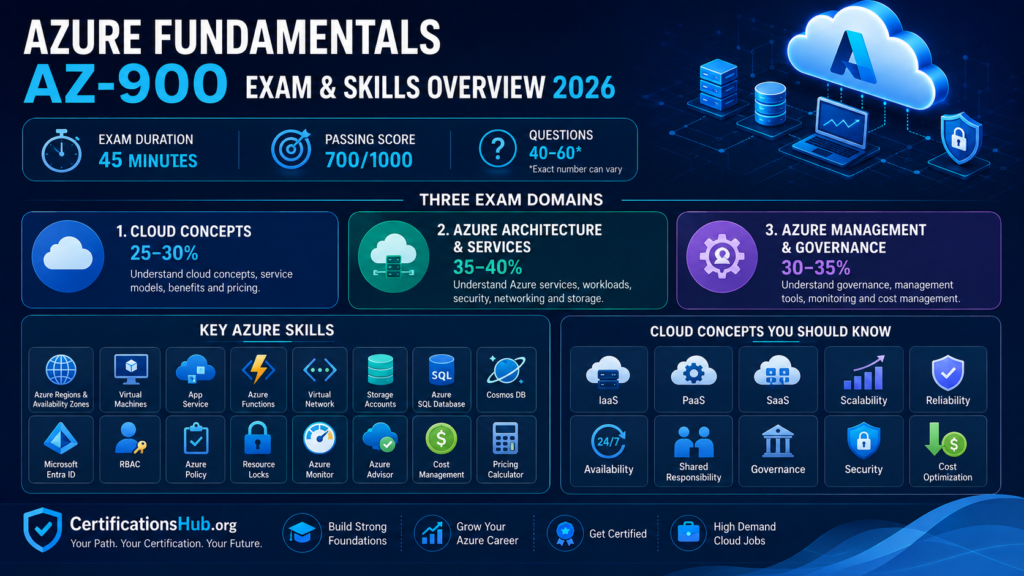
| Exam Duration | 45 minutes |
| Seat Duration | 65 minutes |
| Questions | Microsoft generally uses 40–60 questions for certification exams; the exact number can vary |
| Passing Score | 700/1000 |
| Question Types | Microsoft does not publish a fixed question-type list in advance |
| Exam Delivery | Pearson VUE test center or online proctored exam |
| Prerequisites | No formal certification prerequisite |
| Recommended Background | Basic familiarity with IT/cloud concepts is helpful |
| Certification Validity | Does not expire |
| Exam Price | $50 USD in many regions; country/region-specific pricing applies |
| Current Scope | Cloud concepts, Azure architecture/services, Azure management/governance |
Microsoft currently lists Azure Fundamentals as a Beginner-level certification and states that the price is based on the country or region where the exam is proctored. The displayed U.S.-based price is $50.
Microsoft’s current exam-duration guidance states that Fundamentals exams have 45 minutes of exam time and 65 minutes of seat time. It also notes that most Microsoft certification exams typically contain 40–60 questions, although the exact number can vary.
What Is Azure Fundamentals AZ-900?
Azure Fundamentals AZ-900 is a foundational Microsoft certification that validates your understanding of cloud computing concepts and core Microsoft Azure services.
Think of AZ-900 as an introduction to the Azure ecosystem.
You learn what Azure is, how cloud computing works, what different Azure services do, how Azure resources are organized, how Azure pricing works, and how Microsoft provides tools for security, governance, management and monitoring.
The exam does not expect you to be an expert at configuring complex Azure infrastructure.
Instead, it asks whether you understand concepts such as:
- Public, private and hybrid cloud
- IaaS, PaaS and SaaS
- Azure regions
- Availability zones
- Azure virtual machines
- Azure storage
- Azure networking
- Microsoft Entra ID
- Azure RBAC
- Azure security
- Azure pricing
- Azure Cost Management
- Azure Policy
- Resource locks
- Azure Monitor
- Azure Advisor
- Azure Service Health
Microsoft’s current AZ-900 study guide groups the exam into three broad areas: cloud concepts, Azure architecture and services, and Azure management and governance.
Who Should Take the Azure Fundamentals AZ-900 Certification?
AZ-900 is designed to be accessible to people at the beginning of their Azure journey.
1. Beginners Exploring Cloud Computing
If you are new to cloud computing, AZ-900 provides a structured introduction to the major concepts.
You can learn how cloud computing differs from traditional on-premises infrastructure without first becoming an experienced cloud administrator.
2. Students and Recent Graduates
Students interested in:
- Cloud computing
- IT infrastructure
- Azure
- DevOps
- Cybersecurity
- Software development
- Data and AI
can use AZ-900 as an introductory certification.
3. IT Professionals Moving to Azure
If you already work in:
- IT support
- Infrastructure
- Networking
- System administration
- Database administration
- Software development
AZ-900 can help you understand how these areas translate into Azure.
Microsoft’s current study guide identifies infrastructure management, database management and software development as examples of IT experience relevant to candidates.
4. Professionals Switching to Cloud
If you are moving from traditional IT into cloud computing, AZ-900 can provide a foundation before pursuing role-based certifications.
5. Non-Technical Professionals Working With Azure
You do not necessarily need to become a technical Azure administrator to benefit from understanding the platform.
For example:
- Project managers
- Sales professionals
- Business analysts
- Procurement professionals
- Technology consultants
may benefit from understanding Azure terminology and cloud concepts.
6. Professionals Working in Microsoft Ecosystems
Organizations that already use Microsoft technologies may have Azure environments alongside:
- Windows Server
- Microsoft 365
- Active Directory
- SQL Server
- Power Platform
- Microsoft security products
AZ-900 can help professionals understand how Azure fits into that broader ecosystem.
Azure Fundamentals AZ-900 Eligibility Requirements
One of the biggest advantages of AZ-900 is its accessibility.
There is no mandatory previous Microsoft certification that you must hold before taking AZ-900.
You do not need:
- Azure Administrator certification
- Azure Developer certification
- Azure Solutions Architect certification
- Microsoft 365 certification
- A college degree
- A computer science degree
Eligibility Summary
| Requirement | Required? |
| College degree | No |
| Computer science degree | No |
| Previous Microsoft certification | No |
| Azure experience | No formal requirement |
| IT experience | Helpful |
| Programming experience | No |
| Azure Administrator certification | No |
| Microsoft 365 certification | No |
| Cloud experience | No formal requirement |
Microsoft positions Azure Fundamentals as a beginner-level certification and describes it as a common starting point for an Azure career.
Recommended Background
Although there is no formal prerequisite, you will benefit from understanding basic concepts such as:
- Computers
- Networks
- Servers
- Storage
- Databases
- Applications
- Internet connectivity
You do not need advanced knowledge of these areas.
Do You Need Previous Azure Experience?
No.
You can take AZ-900 without previously working with Azure.
This is one of the main differences between AZ-900 and many advanced Azure certifications.
However, there is a difference between:
Being eligible to take AZ-900
and
Being prepared to pass AZ-900.
A beginner can prepare successfully, but understanding basic cloud concepts before starting will make the learning process much easier.
Do You Need Hands-On Azure Practice?
Hands-on experience is not mandatory, but it is useful.
For example, creating a basic Azure resource and exploring the Azure portal can help you understand concepts much faster than simply memorizing definitions.
A practical beginner approach is:
Learn the concept
↓
See the Azure service
↓
Try a simple task
↓
Understand why the service exists
↓
Practice exam questions
This is more effective than memorizing service names.
Azure Fundamentals AZ-900 Exam Overview
The current exam is:
Exam AZ-900: Microsoft Azure Fundamentals
Microsoft’s current certification information identifies AZ-900 as the exam associated with Microsoft Certified: Azure Fundamentals. The current skills update is dated July 20, 2026.
| Exam Feature | AZ-900 Details |
| Exam Code | AZ-900 |
| Exam Name | Microsoft Azure Fundamentals |
| Certification | Microsoft Certified: Azure Fundamentals |
| Level | Fundamentals |
| Exam Time | 45 minutes |
| Seat Time | 65 minutes |
| Question Count | Generally around 40–60, but Microsoft says the number can vary |
| Passing Score | 700/1000 |
| Exam Type | Proctored |
| Delivery | Pearson VUE test center or online |
| Current Skills Update | July 20, 2026 |
| Prerequisite Certification | None |
Microsoft states that exam question counts can change and that most certification exams generally contain 40–60 questions. Microsoft also states that Fundamentals exams have 45 minutes of exam time and 65 minutes of total seat time.
Passing Score
The passing score for AZ-900 is 700 out of 1,000.
A score of 700 does not necessarily mean that you must answer exactly 70% of questions correctly.
Microsoft uses scaled scoring, so candidates should not attempt to calculate a precise number of correct answers needed based solely on the 700 score.
Question Types
Microsoft does not publish a guaranteed fixed list of question formats before the exam.
Its current exam-experience documentation explains that candidates may encounter different interactive question formats and recommends using the Microsoft exam sandbox to become familiar with the interface.
For AZ-900 preparation, candidates should therefore be comfortable with straightforward knowledge questions and interactive formats that may appear in Microsoft Fundamentals exams.
Is There a Practical Lab?
AZ-900 is a Fundamentals exam rather than an advanced hands-on implementation exam.
You should not prepare for it as though you will be required to perform complex Azure administration tasks during a lab.
The focus is primarily on understanding concepts, services, use cases and Azure management/governance features.
Azure Fundamentals AZ-900 Exam Domains / Syllabus
The current AZ-900 skills measured as of July 20, 2026 are divided into three domains.
| Exam Domain | Weighting | What You Need to Understand |
| 1. Describe Cloud Concepts | 25–30% | Cloud computing, cloud models, benefits, service models and consumption-based pricing |
| 2. Describe Azure Architecture and Services | 35–40% | Azure infrastructure, compute, networking, storage, identity and security |
| 3. Describe Azure Management and Governance | 30–35% | Azure cost management, governance, deployment, monitoring and management tools |
These are the current Microsoft-published AZ-900 domain weightings.
Domain 1: Describe Cloud Concepts – 25–30%
This domain establishes the foundation.
Cloud Computing
Understand:
- What cloud computing is
- Shared responsibility model
- Public cloud
- Private cloud
- Hybrid cloud
- Consumption-based model
- Cloud pricing concepts
- Serverless computing
Benefits of Cloud Services
Know the meaning of:
- High availability
- Scalability
- Reliability
- Predictability
- Security
- Governance
- Manageability
Cloud Service Types
Understand:
- IaaS
- PaaS
- SaaS
The important part is not memorizing the acronyms.
You should understand who manages what in each service model and when each model makes sense.
Domain 2: Describe Azure Architecture and Services – 35–40%
This is the largest AZ-900 domain.
Azure Architectural Components
Understand:
- Azure regions
- Region pairs
- Sovereign regions
- Availability zones
- Azure resource groups
- Azure subscriptions
- Management groups
- Azure resources
A Simple Azure Hierarchy
Microsoft Entra Tenant
        │
        ▼
Management Groups
        │
        ▼
Subscriptions
        │
        ▼
Resource Groups
        │
        ▼
Azure Resources
Understanding this hierarchy is important because Azure uses it for organizing resources, access, governance and management.
Azure Compute
Know the purpose of:
- Azure Virtual Machines
- Virtual Machine Scale Sets
- Azure App Service
- Azure Functions
- Azure Container Instances
- Azure Kubernetes Service at a conceptual level
You should understand when you would choose virtual machines, managed application hosting, serverless compute or containers.
Azure Networking
Important services and concepts include:
- Azure Virtual Network
- Subnets
- Public and private connectivity
- Network security groups
- Azure VPN Gateway
- Azure ExpressRoute
- Azure DNS
- Azure Load Balancer
- Azure Application Gateway
- Azure Front Door
The exam is more about understanding the purpose of these services than becoming an advanced Azure network engineer.
Azure Storage
Know:
- Azure Blob Storage
- Azure Files
- Azure Queue Storage
- Azure Table Storage
- Storage accounts
- Storage tiers
- Redundancy concepts
- Azure Data Box
Understand which storage option is appropriate for different workloads.
Azure Identity and Security
Important areas include:
- Microsoft Entra ID
- Authentication
- Single sign-on
- Multi-factor authentication
- External identities
- Conditional Access
- Azure RBAC
- Zero Trust
- Defense in depth
- Microsoft Defender for Cloud
Microsoft’s current AZ-900 objectives specifically include Microsoft Entra ID, authentication methods, external identities, Conditional Access, RBAC, Zero Trust, defense in depth and Microsoft Defender for Cloud.
Domain 3: Describe Azure Management and Governance – 30–35%
This domain covers how Azure resources are managed, governed, monitored and controlled.
Azure Cost Management
Understand:
- Factors affecting Azure costs
- Azure Pricing Calculator
- Azure Cost Management
- Tags
- Consumption-based pricing
Azure Governance and Compliance
Study:
- Azure Policy
- Resource locks
- Microsoft Purview
- Governance concepts
- Compliance
Azure Management and Deployment Tools
Know the purpose of:
- Azure Portal
- Azure Cloud Shell
- Azure CLI
- Azure PowerShell
- Azure Arc
- Infrastructure as Code
- Azure Resource Manager
- ARM templates
Azure Monitoring
Understand:
- Azure Advisor
- Azure Service Health
- Azure Monitor
- Log Analytics
- Azure Monitor Alerts
- Application Insights
Microsoft’s current study guide includes cost management, governance/compliance, resource management/deployment and monitoring within this domain.
Azure Fundamentals AZ-900 Exam Topics
A useful way to organize AZ-900 preparation is around the following topic groups.
Cloud Concepts
Learn:
- Cloud computing
- Public cloud
- Private cloud
- Hybrid cloud
- IaaS
- PaaS
- SaaS
- Shared responsibility
- Consumption-based pricing
- Serverless
- Scalability
- Elasticity
- High availability
- Reliability
Azure Architecture
Understand:
- Regions
- Region pairs
- Availability zones
- Resource groups
- Subscriptions
- Management groups
- Resources
Azure Compute
Study:
- Virtual Machines
- VM Scale Sets
- App Service
- Functions
- Containers
- AKS
Azure Networking
Know:
- Virtual Network
- Subnets
- Network Security Groups
- VPN Gateway
- ExpressRoute
- DNS
- Load Balancer
- Application Gateway
- Front Door
Azure Storage
Focus on:
- Storage accounts
- Blob Storage
- Azure Files
- Queue Storage
- Table Storage
- Storage tiers
- Redundancy
- Data Box
Identity and Security
Understand:
- Microsoft Entra ID
- Authentication
- MFA
- SSO
- Conditional Access
- RBAC
- Zero Trust
- Defense in depth
- Defender for Cloud
Azure Management
Study:
- Azure Portal
- Cloud Shell
- Azure CLI
- Azure PowerShell
- Azure Resource Manager
- ARM templates
- Azure Arc
Governance
Understand:
- Azure Policy
- Resource locks
- Tags
- Microsoft Purview
- Governance
Monitoring
Know:
- Azure Monitor
- Log Analytics
- Application Insights
- Azure Advisor
- Azure Service Health
Pricing and Support
Learn:
- Azure Pricing Calculator
- Cost Management
- Consumption-based model
- Service Level Agreements
- Azure support options
- Service lifecycle concepts
Azure Services You Should Know for AZ-900
You do not need to become an expert administrator for these services.
Instead, understand what each service does, why it exists and when it might be used.
| Azure Service / Concept | What You Need to Know | Exam Importance |
| Microsoft Entra ID | Identity and access management | Very High |
| Azure Virtual Machines | Cloud-based virtual servers | Very High |
| Azure App Service | Managed application hosting | High |
| Azure Functions | Serverless compute | High |
| Azure Virtual Network | Private networking in Azure | Very High |
| Azure Storage | Core cloud storage concepts | Very High |
| Blob Storage | Object storage | Very High |
| Azure Files | Managed file shares | High |
| Azure SQL Database | Managed relational database | High |
| Azure Cosmos DB | Globally distributed NoSQL database concept | Medium-High |
| Azure Load Balancer | Network load balancing | High |
| Application Gateway | Application-layer traffic distribution | Medium-High |
| Azure Front Door | Global application delivery | Medium |
| Azure DNS | DNS hosting and resolution | Medium |
| Azure VPN Gateway | Encrypted network connectivity | Medium-High |
| ExpressRoute | Private connectivity to Azure | Medium |
| Azure Monitor | Monitoring and metrics | High |
| Azure Advisor | Recommendations for optimization | High |
| Azure Service Health | Service incidents and health information | High |
| Azure Policy | Governance and compliance | Very High |
| Resource Locks | Prevent accidental changes/deletion | High |
| Azure Cost Management | Cloud cost analysis and control | High |
| Pricing Calculator | Estimate Azure costs | High |
| Azure Portal | Web-based Azure management | High |
| Azure CLI | Command-line management | Medium |
| Azure PowerShell | PowerShell-based management | Medium |
| Azure Cloud Shell | Browser-based shell environment | Medium |
| Azure Resource Manager | Azure resource management layer | High |
| Azure Arc | Manage resources across environments | Medium |
| Microsoft Defender for Cloud | Cloud security posture and protection | High |
| Microsoft Purview | Data governance/compliance concepts | Medium |
Azure Fundamentals AZ-900 Difficulty
The Azure Fundamentals AZ-900 exam is generally considered beginner-friendly, but that does not mean it requires no preparation.
Difficulty Rating: 4/10
For someone with basic IT knowledge, AZ-900 is usually much easier than associate-level Azure certifications.
However, beginners can still struggle because Microsoft uses many similar-sounding services and concepts.
What Makes AZ-900 Difficult?
1. Azure Has Many Services
Even at the fundamentals level, you encounter a large number of Azure products.
You do not need deep technical knowledge of all of them.
You need to understand their purpose.
2. Similar Services Can Be Confusing
For example:
- Azure Load Balancer
- Application Gateway
- Front Door
all distribute traffic, but they serve different purposes.
Similarly:
- Azure Files
- Blob Storage
- Queue Storage
- Table Storage
are all storage-related but solve different problems.
3. Microsoft Terminology
AZ-900 introduces Microsoft’s terminology for:
- Resource groups
- Subscriptions
- Management groups
- Entra ID
- RBAC
- Azure Policy
- Resource locks
These can initially seem confusing.
4. Cloud Concepts Matter
Candidates sometimes focus entirely on Azure services and underestimate the cloud concepts domain.
You should understand:
- IaaS vs PaaS vs SaaS
- Public vs private vs hybrid cloud
- CapEx vs OpEx
- Scalability
- Elasticity
- Availability
- Reliability
- Shared responsibility
5. Governance and Pricing
The management and governance domain accounts for 30–35% of the exam, so it should not be treated as an optional section.
Azure Fundamentals AZ-900 Cost
Microsoft lists the price for Azure Fundamentals based on the country or region where the exam is proctored.
The Microsoft certification page currently displays US$50 for Azure Fundamentals in applicable pricing contexts.
Important: India Pricing
For Indian candidates, the final AZ-900 exam price should be checked through Microsoft’s exam scheduling flow because Microsoft uses country/region-specific pricing.
Older Microsoft Q&A discussions contain historical Indian prices, but these should not be presented as the current 2026 official India price.
Therefore, for CertificationsHub, the safest approach is to state:
Microsoft’s official AZ-900 exam price is region-specific. The certification page currently displays US$50 as the reference price, while candidates in India should verify the INR amount shown when scheduling through Microsoft/Pearson VUE.
This avoids publishing an outdated INR price as a 2026 fact.
Other Potential Costs
| Cost Component | Typical Situation |
| AZ-900 Exam | Official Microsoft exam fee; region-specific |
| Microsoft Learn Training | Free |
| Microsoft Learn Practice Assessment | Free where available |
| Paid Training Course | Optional |
| Practice Test Platform | Optional |
| Hands-On Azure Labs | May be free or may incur Azure usage charges |
| Exam Retake | Applicable exam fee normally applies |
Microsoft provides free learning resources and practice assessments through Microsoft Learn where available. The practice assessment is designed to familiarize candidates with question style, wording and difficulty, but Microsoft states that it does not replace training or hands-on experience.
Can You Get an AZ-900 Discount?
Microsoft periodically offers promotions and training events that may provide discounts.
For example, Microsoft has offered 50% exam discounts associated with certain Azure Virtual Training Day events. Availability and eligibility can change, so candidates should verify the terms of the specific offer before relying on it.
How Long Does It Take to Prepare for AZ-900?
AZ-900 generally requires considerably less preparation time than an associate-level cloud certification.
Your timeline depends on your background.
Complete Beginner
Estimated Time: 3–6 Weeks
A complete beginner should first understand:
- Basic IT concepts
- Cloud computing
- Networking basics
- Storage
- Compute
- Databases
Then move into Azure services.
IT Professional
Estimated Time: 2–4 Weeks
If you already understand:
- Servers
- Networking
- Storage
- Databases
- Infrastructure
you can focus primarily on Azure terminology and services.
Existing Azure Professional
Estimated Time: 1–2 Weeks
If you already work with Azure, your preparation may primarily involve:
- Reviewing the current AZ-900 objectives
- Identifying knowledge gaps
- Revising Azure terminology
- Taking practice assessments
These are practical preparation estimates, not Microsoft requirements.
Recommended Azure Fundamentals AZ-900 Study Strategy
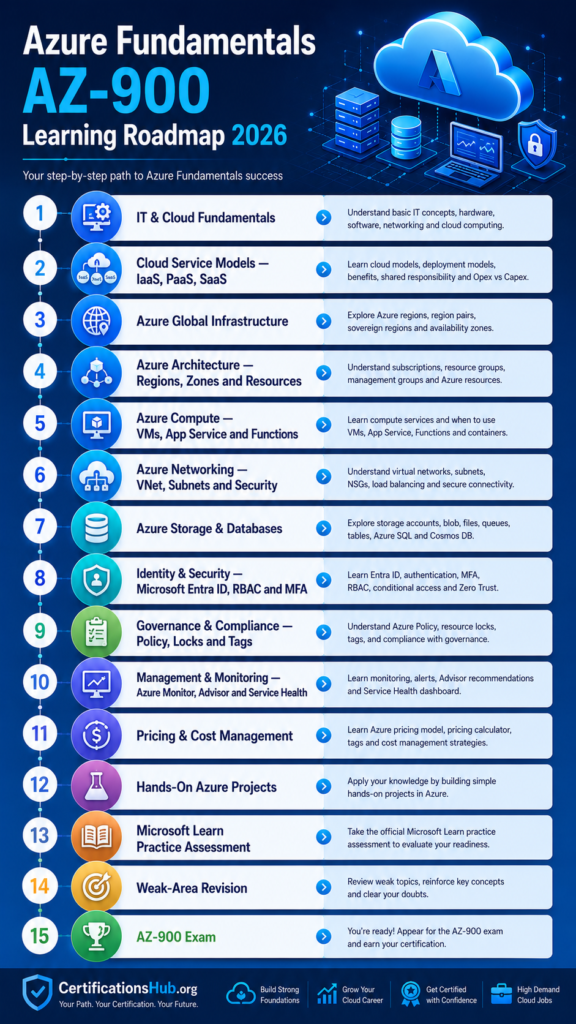
The best approach is:
Cloud Fundamentals → Azure Architecture → Azure Services → Management & Governance → Practice → Revision
Step 1: Learn Cloud Fundamentals
Start with:
- Public/private/hybrid cloud
- IaaS/PaaS/SaaS
- Shared responsibility
- Consumption-based pricing
- Scalability
- Reliability
- Availability
- Elasticity
Do not skip this section.
It represents 25–30% of the current exam.
Step 2: Learn Azure’s Structure
Understand:
Management Groups
↓
Subscriptions
↓
Resource Groups
↓
Resources
Then learn:
- Regions
- Availability zones
- Region pairs
- Sovereign regions
Step 3: Learn Core Azure Services
Prioritize:
- Entra ID
- Virtual Machines
- App Service
- Functions
- Virtual Network
- Storage
- Azure SQL
- Cosmos DB
- Load Balancer
- Application Gateway
- Monitor
Step 4: Study Security and Governance
Focus on:
- RBAC
- Zero Trust
- Defender for Cloud
- Azure Policy
- Resource Locks
- Microsoft Purview
Step 5: Study Pricing and Management
Learn:
- Pricing Calculator
- Cost Management
- Tags
- Azure Advisor
- Service Health
Step 6: Explore Azure Portal
Spend some time navigating the Azure portal.
You do not need to build complicated applications.
Simply becoming familiar with:
- Resource creation
- Resource groups
- Subscriptions
- Settings
- Monitoring
- Cost information
can make the concepts easier to remember.
Step 7: Take Microsoft’s Practice Assessment
Use the practice assessment to identify knowledge gaps.
Do not memorize the questions.
Instead, investigate why an answer is correct.
Step 8: Review the Current Exam Objectives
Before scheduling the exam, compare your preparation against the July 20, 2026 AZ-900 skills outline.
This is particularly important because Microsoft periodically updates certification objectives.
Step 9: Take the Exam
Once you can confidently explain the major Azure services and cloud concepts, you should be ready to schedule AZ-900.
Recommended Study Sequence
Azure Fundamentals AZ-900 Salary
The Azure Fundamentals AZ-900 certification can help establish foundational Azure knowledge, but it does not directly determine your salary.
AZ-900 is a Fundamentals certification, so it is important to set realistic salary expectations. Most employers do not hire experienced Cloud Engineers or Azure Administrators based on AZ-900 alone.
Instead, salary usually depends on:
- Total IT experience
- Azure hands-on experience
- Linux and Windows administration
- Networking
- PowerShell or scripting
- Infrastructure as code
- DevOps
- Security
- Containers
- Databases
- Employer
- Location
- Job responsibilities
Microsoft itself positions Azure Fundamentals as a starting point for an Azure career, rather than a certification that proves advanced job-ready Azure administration skills.
Azure Salary in India
Public salary data shows that Azure-related compensation varies considerably by role and experience.
For example, Glassdoor’s June 2026 data for Azure Cloud Engineer roles in India reports an average salary of approximately ₹7.5 lakh per year, with a typical reported range of roughly ₹4.72 lakh to ₹12.5 lakh and higher reported compensation reaching around ₹17 lakh.
For Azure Administrator roles, Glassdoor’s current India data reports an average base pay of approximately ₹6 lakh per year, with a reported base-pay range of about ₹4 lakh–₹8 lakh.
These figures are useful market indicators, but they should not be presented as the salary you will receive after passing AZ-900.
Practical Azure Career Salary Ranges in India
| Career Stage | Approximate Salary Range | Typical Profile |
|---|---|---|
| IT Support / Junior IT Role | ₹3–6 LPA | Beginner with basic IT skills |
| Junior Azure / Cloud Support | ₹4–8 LPA | AZ-900 + basic cloud knowledge |
| Azure Administrator | ₹5–10 LPA | Azure administration + IT experience |
| Azure Cloud Engineer | ₹7–15 LPA | Azure + networking + automation |
| Senior Azure Administrator / Engineer | ₹10–20+ LPA | Strong Azure + automation + experience |
| Azure Solutions Architect | ₹15–30+ LPA | Architecture + extensive cloud experience |
| Senior / Lead Cloud Architect | ₹25–40+ LPA | Advanced architecture + leadership |
These are approximate career-planning ranges rather than official Microsoft salary figures. Actual salaries can be lower or substantially higher depending on experience, employer, location and technical skills.
Why AZ-900 Alone Usually Does Not Produce a Large Salary Increase
Consider two candidates:
Candidate A
AZ-900 + no IT experience
versus
Candidate B
AZ-900 + 3 years IT experience + Azure administration + PowerShell + networking + Terraform + projects
Candidate B has a significantly stronger profile because the certification is supported by practical skills and experience.
Therefore, AZ-900 should be viewed as a foundation for a cloud career, not as a standalone salary credential.
Azure Salary in the USA and Global Market
Azure-related cloud roles in the United States generally offer higher absolute compensation than equivalent roles in India, but direct comparisons can be misleading because of:
- Cost of living
- Location
- Taxes
- Employer
- Experience
- Job level
- Bonuses
- Equity
- Total compensation structure
More importantly, AZ-900 is not a senior-level certification.
A candidate should not expect an experienced U.S. Azure Cloud Engineer or Solutions Architect salary simply because they have passed AZ-900.
The certification is better viewed as the first step toward role-based Azure credentials and practical experience.
Azure Career Opportunities
Azure Fundamentals can support several career directions.
The most appropriate path depends on your existing background.
| Career Path | What You May Work On |
| IT Support / Help Desk | Basic infrastructure and user support |
| Cloud Support Engineer | Azure resources, troubleshooting and support |
| Azure Administrator | Azure compute, storage, networking, identity and governance |
| Cloud Engineer | Azure infrastructure, automation and deployments |
| DevOps Engineer | CI/CD, infrastructure automation and cloud deployments |
| Security Engineer | Identity, security controls and cloud security |
| Cloud Consultant | Azure adoption, migration and optimization |
| Azure Solutions Architect | Designing Azure solutions around business requirements |
| Data / Database Professional | Azure SQL, databases and cloud data services |
| Cloud Project / Technical Consultant | Coordinating Azure-based technology initiatives |
AZ-900 itself is not a job-role certification.
Its primary purpose is to demonstrate foundational knowledge of Azure and cloud concepts.
For example, Microsoft describes the Azure Administrator Associate certification as an intermediate credential for professionals who configure, manage and secure Azure environments.
That makes the progression from fundamentals to role-based certification important.
Azure Fundamentals AZ-900 Career Path
A practical beginner roadmap is:
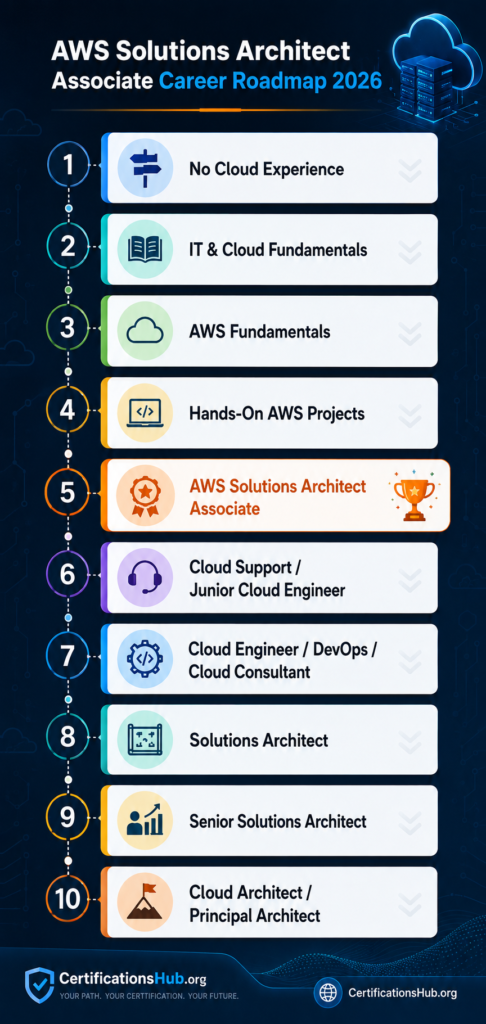
This is a career roadmap, not a mandatory Microsoft certification sequence.
Stage 1: Learn IT and Cloud Fundamentals
Before becoming an Azure professional, understand:
- Networking
- Servers
- Operating systems
- Storage
- Databases
- Virtualization
- Cloud computing
- Security fundamentals
Stage 2: Earn Azure Fundamentals AZ-900
Use AZ-900 to establish knowledge of:
- Cloud concepts
- Azure architecture
- Azure services
- Azure security
- Azure governance
- Azure management
- Azure pricing
Stage 3: Build Hands-On Azure Skills
Create simple projects involving:
- Virtual machines
- Storage
- Virtual networks
- App Service
- Azure Functions
- Azure SQL
- Monitoring
Stage 4: Choose a Role-Based Direction
Depending on your interests, you could move toward:
Azure Administration
or
Cloud Engineering
or
DevOps
or
Security
or
Data
or
Architecture
Stage 5: Earn an Intermediate Certification
For example, the Azure Administrator Associate certification is designed around implementing, managing and monitoring Azure environments and covers identities, governance, storage, compute, networking and monitoring.
Stage 6: Build Professional Experience
This is where the certification starts translating into career value.
Focus on:
- Real-world deployments
- Troubleshooting
- Automation
- Infrastructure as code
- Security
- Monitoring
- Cost optimization
- Cloud migration
Stage 7: Move Toward Architecture
With enough experience, you can progress toward architecture and senior cloud roles.
Azure Fundamentals AZ-900 vs AWS Cloud Practitioner
These are broadly comparable entry-level cloud certifications.
| Feature | Azure Fundamentals AZ-900 | AWS Cloud Practitioner |
| Provider | Microsoft Azure | Amazon Web Services |
| Level | Fundamentals | Foundational |
| Primary Focus | Azure + cloud concepts | AWS + cloud concepts |
| Technical Depth | Beginner | Beginner |
| Best For | Azure beginners | AWS beginners |
| Prerequisite | None | None |
| Career Direction | Azure/cloud | AWS/cloud |
| Next Step | Azure role-based certification | AWS Associate certifications |
Choose AZ-900 If:
- Your target employers use Azure
- You work with Microsoft technologies
- You want to enter the Azure ecosystem
- You are interested in Azure administration or cloud engineering
Choose AWS Cloud Practitioner If:
- Your target employers use AWS
- You want to pursue AWS certifications
- You want an introduction to AWS
- You are interested in AWS cloud careers
Should You Take Both?
You can, but it is usually better for a beginner to learn one cloud platform properly first.
For example:
AZ-900 → Azure projects → Azure Administrator → Azure specialization
is generally more useful than:
AZ-900 → Cloud Practitioner → several unrelated beginner certifications
without developing practical skills.
Azure Fundamentals AZ-900 vs AWS Solutions Architect Associate
This is an important comparison because these certifications are at different levels.
| Feature | AZ-900 | AWS Solutions Architect Associate |
| Level | Fundamentals | Associate |
| Difficulty | Beginner | Moderate |
| Primary Focus | Cloud + Azure fundamentals | AWS solution architecture |
| Technical Depth | Basic | Intermediate |
| Best For | Azure beginners | Cloud/IT professionals |
| Architecture Depth | Introductory | Much deeper |
| Hands-On Experience | Helpful | Strongly recommended |
| Career Use | Foundation | Technical cloud/architecture foundation |
| Next Step | Azure role-based certification | Cloud engineering / architecture experience |
If you are completely new to cloud, AZ-900 is the more accessible starting point.
If you already have IT infrastructure experience and want a more technical architecture certification, an associate-level certification such as AWS SAA may be more appropriate.
Azure Fundamentals AZ-900 vs Azure Administrator Associate
These certifications are complementary rather than direct alternatives.
| Feature | AZ-900 | Azure Administrator Associate |
| Level | Beginner | Intermediate |
| Purpose | Understand Azure | Administer Azure |
| Azure Architecture | Basic | Deeper |
| Compute | Understand services | Configure/manage |
| Networking | Understand concepts | Implement/manage |
| Storage | Understand options | Implement/manage |
| Identity | Foundational | Operational |
| Governance | Foundational | Practical |
| Hands-On Skills | Helpful | Important |
| Career Stage | Entry/foundation | Technical role |
Microsoft currently classifies Azure Administrator Associate as Intermediate, and the certification covers implementing, managing and monitoring Azure environments.
Recommended Progression
AZ-900
   ↓
Hands-On Azure
   ↓
Azure Administrator / Role-Based Certification
   ↓
Cloud Engineer
   ↓
Specialization
   ↓
Solutions Architect / Senior Cloud Role
Pros and Cons of Azure Fundamentals AZ-900
Pros
1. Beginner-Friendly
AZ-900 is designed for people beginning their Azure journey.
2. No Mandatory Prerequisites
You can take the exam without another Microsoft certification.
3. Covers Broad Cloud Concepts
You learn concepts that are useful beyond Azure.
4. Useful for Career Switchers
It can provide a structured starting point for people moving toward cloud.
5. Recognized Microsoft Credential
The certification demonstrates foundational Azure knowledge.
6. Low-Cost Entry Point
Compared with many professional certifications, the exam has a relatively low official list price in many regions.
7. Does Not Expire
Microsoft states that Fundamentals certifications do not expire.
Cons
1. Limited Technical Depth
AZ-900 does not prove that you can administer a production Azure environment.
2. Certification Alone Is Not Enough for Most Cloud Jobs
Practical skills and experience remain important.
3. Large Number of Azure Services
Beginners can find the breadth of Azure terminology challenging.
4. Not a High-Level Architecture Certification
It should not be confused with advanced Azure architecture credentials.
5. Azure Skills Need Continuous Learning
Although the certification itself does not expire, Azure services and cloud technology continue to evolve.
Is Azure Fundamentals AZ-900 Worth It in 2026?
Yes, for beginners and professionals who want to enter the Azure ecosystem.
AZ-900 remains particularly useful if you:
- Are new to cloud computing
- Want to understand Azure
- Work in a Microsoft environment
- Are moving from traditional IT to cloud
- Want a structured starting point
- Plan to pursue an Azure role-based certification
Microsoft currently describes Azure Fundamentals as a common starting point in a journey toward a career in Azure.
However, the value of AZ-900 decreases if your only goal is to collect certifications.
The strongest approach is:
AZ-900 + Hands-On Azure + Projects + Technical Skills + Experience
rather than:
AZ-900 = Cloud Job
Who Should NOT Take Azure Fundamentals AZ-900 Yet?
AZ-900 is beginner-friendly, but there are situations where you may want to prepare first.
You Have No Basic IT Knowledge
Learn basic:
- Networking
- Servers
- Storage
- Databases
- Operating systems
first.
You Already Have Strong Azure Experience
If you are already administering Azure professionally, AZ-900 may add limited technical value. A role-based certification may be more relevant.
You Want to Become a Cloud Engineer Immediately
AZ-900 alone will not provide all the technical skills required.
You should plan to add:
- Networking
- Linux/Windows administration
- PowerShell
- Azure CLI
- Terraform
- Git
- CI/CD
- Monitoring
- Security
You Are Only Studying to Memorize Questions
This is a weak preparation strategy.
The objective should be to understand Azure concepts rather than memorize practice-test answers.
Azure Fundamentals AZ-900 Preparation Roadmap
A practical preparation roadmap can be divided into seven stages.
Stage 1: Learn Cloud Concepts
Study:
- Public/private/hybrid cloud
- IaaS/PaaS/SaaS
- Shared responsibility
- Consumption-based model
- Scalability
- Elasticity
- Reliability
- Availability
Stage 2: Learn Azure Architecture
Understand:
- Regions
- Availability zones
- Region pairs
- Subscriptions
- Resource groups
- Management groups
- Azure resources
Stage 3: Learn Core Azure Services
Prioritize:
- Virtual Machines
- App Service
- Functions
- Virtual Network
- Storage
- Azure SQL
- Cosmos DB
- Load Balancer
- Application Gateway
Stage 4: Learn Identity and Security
Focus on:
- Microsoft Entra ID
- MFA
- SSO
- Conditional Access
- RBAC
- Zero Trust
- Defender for Cloud
Stage 5: Learn Governance
Study:
- Azure Policy
- Resource Locks
- Tags
- Microsoft Purview
Stage 6: Learn Cost and Monitoring
Understand:
- Pricing Calculator
- Cost Management
- Azure Advisor
- Service Health
- Azure Monitor
Stage 7: Practice and Review
Use:
- Microsoft Learn
- Official AZ-900 study guide
- Microsoft practice assessment
- Azure portal exploration
- Hands-on exercises
Microsoft provides dedicated learning paths covering all three current AZ-900 domains through Microsoft Learn.
30-Day AZ-900 Study Plan
A 30-day schedule is comfortable for most beginners.
| Days | Focus |
| 1–3 | Cloud computing fundamentals |
| 4–5 | Public/private/hybrid cloud |
| 6–7 | IaaS, PaaS, SaaS + shared responsibility |
| 8–10 | Azure regions, zones and architecture |
| 11–13 | Azure compute |
| 14–16 | Azure networking |
| 17–19 | Azure storage and databases |
| 20–21 | Entra ID and security |
| 22–23 | Governance and compliance |
| 24–25 | Pricing and cost management |
| 26 | Azure management and monitoring |
| 27 | Microsoft Learn practice assessment |
| 28 | Weak-area revision |
| 29 | Full revision |
| 30 | Final practice + exam readiness |
60-Day AZ-900 Study Plan
A 60-day plan is useful if you are completely new to cloud.
| Period | Focus |
| Days 1–7 | IT + cloud fundamentals |
| Days 8–14 | Cloud service models and benefits |
| Days 15–21 | Azure global infrastructure |
| Days 22–28 | Azure compute |
| Days 29–35 | Networking |
| Days 36–42 | Storage + databases |
| Days 43–47 | Identity + security |
| Days 48–51 | Governance |
| Days 52–54 | Pricing + cost management |
| Days 55–56 | Monitoring + management |
| Day 57 | Practice assessment |
| Day 58 | Weak-area revision |
| Day 59 | Full revision |
| Day 60 | Final assessment + exam readiness |
90-Day AZ-900 Study Plan
A 90-day plan is more than enough for most beginners and allows additional hands-on practice.
| Period | Focus |
| Days 1–15 | IT and cloud fundamentals |
| Days 16–25 | Cloud models and service models |
| Days 26–35 | Azure architecture |
| Days 36–45 | Compute |
| Days 46–55 | Networking |
| Days 56–65 | Storage + databases |
| Days 66–72 | Identity + security |
| Days 73–78 | Governance + compliance |
| Days 79–82 | Pricing + cost |
| Days 83–85 | Management + monitoring |
| Days 86–87 | Hands-on review |
| Day 88 | Practice assessment |
| Day 89 | Weak-area revision |
| Day 90 | Final exam preparation |
Hands-On Projects to Build Before AZ-900
AZ-900 does not require advanced projects, but small hands-on exercises can dramatically improve understanding.
Project 1: Create an Azure Resource Group
Build
Create a resource group and explore how Azure resources are organized.
Learn
- Resource groups
- Azure resources
- Resource lifecycle
- Organization
Project 2: Deploy a Simple Azure Virtual Machine
Build
Create a basic Windows or Linux virtual machine.
Learn
- Compute
- VM sizing
- Networking
- Storage
- Public/private access
Project 3: Create an Azure Storage Account
Explore:
- Blob storage
- Storage tiers
- Redundancy
- Access controls
Learn
How Azure storage supports different workloads.
Project 4: Create an Azure Virtual Network
Build a basic:
Virtual Network
      │
      ├── Subnet 1
      │
      └── Subnet 2
Learn
- VNet
- Subnets
- Network security
- Private connectivity
Project 5: Deploy a Simple App Service
Deploy a basic web application to Azure App Service.
Learn
- PaaS
- Managed application hosting
- Scaling
- App deployment
Project 6: Explore Azure Monitor
Create a simple resource and explore:
- Metrics
- Alerts
- Logs
- Monitoring dashboards
Learn
Why cloud monitoring is important.
Common Mistakes Candidates Make
1. Ignoring Cloud Concepts
Do not focus exclusively on Azure services.
Cloud concepts represent 25–30% of the current exam.
2. Memorizing Service Names
Understand what each service does.
3. Confusing Azure Services
Learn the differences between similar services.
For example:
Load Balancer vs Application Gateway vs Front Door
and:
Blob Storage vs Azure Files vs Queue Storage
4. Ignoring Governance
Azure Policy, resource locks, tags and management groups matter.
5. Ignoring Pricing
Understand:
- Consumption-based pricing
- Pricing Calculator
- Cost Management
- Tags
- Cost optimization
6. Studying From an Outdated Course
Microsoft updates the AZ-900 skills outline periodically.
Always compare your preparation with the current Microsoft study guide. The current version was updated July 20, 2026.
7. Overcomplicating Preparation
AZ-900 is a Fundamentals exam.
You do not need to become an expert Azure administrator before taking it.
8. Not Using Microsoft Learn
Microsoft provides official learning paths specifically mapped to the current AZ-900 domains.
Exam-Day Tips
1. Read the Question Carefully
Look for what the question is actually testing.
2. Identify the Azure Service Category
Ask:
Is this compute, storage, networking, security, identity, governance or monitoring?
This often makes elimination easier.
3. Don’t Overthink Simple Questions
AZ-900 is a Fundamentals exam.
If an answer clearly matches the requirement, do not invent unnecessary complexity.
4. Pay Attention to Similar Services
Know the major differences between services with overlapping capabilities.
5. Watch for Cloud Terminology
Be comfortable with:
- CapEx
- OpEx
- IaaS
- PaaS
- SaaS
- Elasticity
- Scalability
- Availability
- Reliability
6. Use the Microsoft Exam Sandbox
Microsoft recommends becoming familiar with the exam interface and interactive question experience before taking a certification exam.
7. Manage Your Time
You have 45 minutes of exam time, so avoid spending too long on any one question.
8. Don’t Panic If You See an Unfamiliar Service
Focus on the context and eliminate obviously inappropriate options.
Final Verdict
Azure Fundamentals AZ-900 is worth considering in 2026 if you are starting your cloud journey or want a structured introduction to Microsoft Azure.
It is beginner-friendly, does not require a previous Microsoft certification, and covers the essential concepts needed to understand the Azure ecosystem.
The certification is particularly useful for:
- Students
- Career switchers
- IT professionals
- Microsoft technology professionals
- Cloud beginners
- Business and technical professionals working with Azure
However, AZ-900 should be viewed as a starting point rather than an endpoint.
If your ultimate goal is to become an Azure Cloud Engineer, Administrator, DevOps Engineer, Security Engineer or Solutions Architect, you will need to continue beyond the fundamentals level.
A stronger career formula is:
AZ-900
↓
Hands-On Azure
↓
Role-Based Azure Skills
↓
Projects
↓
Professional Experience
↓
Advanced Azure Certification
↓
Cloud Career Growth
The certification itself does not guarantee a job or salary. Its real value comes from using the foundational knowledge to build practical Azure skills.
Key Takeaways
- Azure Fundamentals AZ-900 is Microsoft’s beginner-level Azure certification.
- The current exam is Exam AZ-900: Microsoft Azure Fundamentals.
- The current skills outline was updated July 20, 2026.
- The three exam domains are Cloud Concepts, Azure Architecture and Services, and Azure Management and Governance.
- Current domain weightings are 25–30%, 35–40%, and 30–35%.
- The exam time is 45 minutes with 65 minutes of total seat time.
- The passing score is 700/1000.
- Microsoft does not require previous Azure certification or professional Azure experience.
- AZ-900 does not require programming.
- Microsoft uses country/region-specific exam pricing; the certification page currently shows US$50 in applicable pricing contexts.
- AZ-900 does not expire, because Microsoft Fundamentals certifications do not require renewal.
- AZ-900 can help start an Azure career but does not guarantee a cloud job.
- Hands-on Azure projects should be added after or alongside certification preparation.
- Azure Administrator Associate is a logical next step for candidates interested in Azure administration.
- Salary depends much more on experience, technical skills, role and employer than on AZ-900 alone.
Related Articles
- AWS Cloud Practitioner Complete Guide (2026)
- AWS Solutions Architect Associate Certification: Exam, Cost, Salary & Career Guide (2026)
- AWS vs Azure Certification 2026: Complete Comparison of Cost, Salary & Career
- AWS Certification Cost in India (2026): Complete Fee, Salary & ROI Guide
- Azure Administrator Associate Certification Guide (2026)
- Microsoft Azure Certifications Roadmap (2026)
- Azure vs AWS Certification Cost & Salary Comparison (2026)
- Cloud Certifications for Beginners (2026)
Frequently Asked Questions About Azure Fundamentals AZ-900
Is Azure Fundamentals AZ-900 worth it in 2026?
Yes. It remains a useful entry-level certification for people who want to understand Azure and begin an Azure/cloud career. Microsoft currently describes it as a common starting point for an Azure career.
Is AZ-900 difficult?
AZ-900 is generally beginner-friendly. A reasonable difficulty rating is around 4/10, although candidates unfamiliar with cloud terminology may need more preparation.
Is AZ-900 suitable for beginners?
Yes. It is specifically positioned as a Beginner-level Microsoft certification.
Do I need Azure experience before taking AZ-900?
No. There is no formal Azure experience requirement.
Do I need coding for AZ-900?
No. Programming is not a prerequisite.
Do I need a degree for AZ-900?
No. Microsoft does not require a college or computer science degree.
What is the AZ-900 passing score?
The passing score is 700 out of 1,000.
How many questions are on AZ-900?
Microsoft says most certification exams generally contain 40–60 questions, but the exact number can vary. Candidates should therefore not rely on a fixed question count.
How long is the AZ-900 exam?
The current exam time is 45 minutes, with 65 minutes of total seat time.
How much does AZ-900 cost?
Microsoft uses country/region-specific pricing. The certification page currently displays a reference price of US$50 in applicable regions. Indian candidates should verify the current INR price during the Microsoft/Pearson VUE scheduling process.
Does AZ-900 expire?
No.
Microsoft states that Fundamentals certifications do not expire and therefore do not require renewal
Can I get a job after AZ-900?
AZ-900 can strengthen your profile, but it does not guarantee employment.
For technical Azure jobs, combine it with:
Azure hands-on projects
Networking
Windows/Linux
PowerShell
Azure CLI
Terraform
Git
Monitoring
Security
What salary can I expect after AZ-900?
There is no fixed AZ-900 salary.
For context, current public salary data places Azure Cloud Engineer compensation in India around ₹7.5 lakh annually on average, while Azure Administrator data is around ₹6 lakh average base pay. These figures represent job roles and experience levels, not the value of the AZ-900 certification itself.
AZ-900 vs AWS Cloud Practitioner — which is better?
Neither is universally better.
Choose AZ-900 if you want to specialize in Microsoft Azure.
Choose AWS Cloud Practitioner if you want to start with AWS.
AZ-900 vs AWS Solutions Architect Associate — which should I take?
If you are completely new to cloud, AZ-900 is generally easier.
If you already have IT experience and want a deeper technical architecture certification, AWS Solutions Architect Associate is a more advanced option.
Can I take AZ-900 without another Microsoft certification?
Yes. There is no prerequisite certification.
How many times can I retake AZ-900?
If you fail your first attempt, Microsoft currently allows a retake after 24 hours. Subsequent attempts have a 14-day waiting period, and Microsoft limits candidates to five attempts within a 12-month period from the first attempt. Applicable exam fees normally apply to retakes.
What should I study for AZ-900?
Focus on the three current domains:
Cloud concepts
Azure architecture and services
Azure management and governance
The current weighting is 25–30%, 35–40%, and 30–35%, respectively.
Is Microsoft Learn enough to prepare for AZ-900?
For many beginners, Microsoft Learn provides a strong foundation because Microsoft provides learning paths mapped to the current exam domains.
However, some candidates may benefit from additional practice questions and hands-on Azure exercises.
What should I take after AZ-900?
Your next certification should depend on your career goal.
For Azure administration, Azure Administrator Associate is a logical next step.
For other careers, you may choose Azure security, data, AI, development, DevOps or architecture pathways.