
Introduction
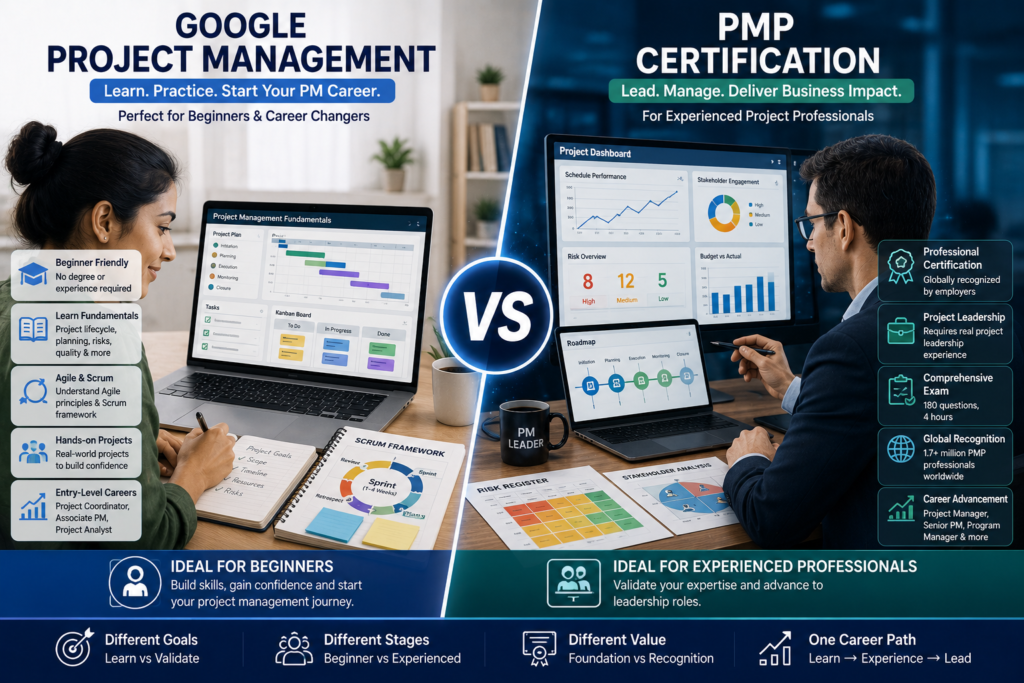
Google Project Management vs PMP is one of the most important comparisons for professionals deciding how to enter or advance in project management.
The two credentials serve very different purposes.
The Google Project Management Professional Certificate is a beginner-level career program designed to help people develop the practical skills needed for entry-level project management roles. Google states that no degree or previous project management experience is required, and the current Coursera program is designed around approximately six months at 10 hours per week.
The Project Management Professional (PMP) certification from the Project Management Institute (PMI), by contrast, is an experienced-professional certification. Candidates must meet specific education, project leadership experience, and project management training requirements before taking the exam. PMI’s current 2026 requirements include 36 months of project leadership experience for candidates with a bachelor’s degree, or 60 months with a secondary-school qualification, plus 35 hours of project professional training in the applicable pathway.
The difference is therefore simple:
Google Project Management helps you learn project management. PMP validates that you already have substantial project leadership experience.
That distinction is critical when deciding which credential is right for you.
Table of Contents
Google Project Management vs PMP: Quick Comparison
| Feature | Google Project Management | PMP |
|---|---|---|
| Provider | PMI | |
| Platform / Organization | Coursera | Project Management Institute |
| Level | Beginner | Advanced / Professional |
| Experience Required | No | Yes |
| Degree Required | No | Education pathway applies |
| Formal Exam | No traditional certification exam | Yes |
| Project Leadership Experience | Not required | Required |
| Training Requirement | Program itself provides learning | 35 hours of project professional training |
| Agile | Yes | Yes |
| Predictive / Traditional PM | Yes | Yes |
| Hybrid | Yes | Yes |
| Best For | Beginners & career changers | Experienced project professionals |
| Career Goal | Enter project management | Advance/validate PM expertise |
| Difficulty | ⭐⭐⭐☆☆ | ⭐⭐⭐⭐☆ |
| Credential Type | Career certificate | Professional certification |
The Biggest Difference Between Google Project Management and PMP
The biggest difference is experience.
Google’s program is designed to teach project management fundamentals to someone who may be starting from zero. Coursera describes it as a beginner-level program with no degree or previous experience required.
PMP is fundamentally different. PMI requires candidates to demonstrate professional project leadership experience before they can sit for the examination.
Under PMI’s current 2026 requirements, the main pathways include:
| Education | Project Leadership Experience |
| Secondary/high-school qualification | 60 months |
| Associate’s degree or equivalent qualification | 48 months |
| Bachelor’s degree or higher | 36 months |
| PMI GAC-accredited bachelor’s/postgraduate program | 24 months |
The experience must be from the past 10 years and cannot be double-counted across overlapping projects. Candidates also need 35 hours of project professional training, subject to PMI’s applicable requirements.
This means you generally cannot replace the PMP experience requirement simply by completing the Google Project Management Certificate.
What Is the Google Project Management Professional Certificate?
The Google Project Management Professional Certificate is a beginner-friendly online program designed to prepare learners for entry-level project management work.
The current Coursera listing describes it as a seven-course series, including the core project management learning plus an AI-focused job-search course. It is rated beginner level and recommends approximately six months at 10 hours per week.
The program covers practical project management skills such as:
- Project initiation
- Project planning
- Project execution
- Project closure
- Agile project management
- Scrum
- Stakeholder management
- Project documentation
- Risk management
- Quality management
- Communication
- Project scheduling
- Team management
The program also includes hands-on projects and a capstone experience designed to help learners demonstrate their skills.
Who Is It For?
The Google certificate is particularly suitable for:
- Students
- Recent graduates
- Career changers
- Administrative professionals
- Business analysts
- IT professionals moving into project management
- Professionals supporting projects without a formal PM title
- Beginners interested in Agile and traditional project management
What Is PMP Certification?
The Project Management Professional (PMP) is a globally recognized professional certification from PMI that validates project leadership capability.
PMI describes PMP as demonstrating the ability to lead projects across predictive, agile, and hybrid ways of working.
Unlike the Google certificate, PMP requires applicants to demonstrate professional experience before taking the examination.
The certification evaluates project management knowledge and judgment across three major domains in the current 2026 exam:
- People — 33%
- Process — 41%
- Business Environment — 26%
The current PMP exam contains 180 questions and provides 240 minutes to complete the examination. PMI also includes two 10-minute breaks.
Important: The PMP Exam Changed in 2026
This is particularly important for anyone reading a PMP comparison published before July 2026.
PMI launched an updated PMP examination in July 2026. The revised exam places greater emphasis on:
- Artificial intelligence
- Sustainability
- Stakeholder engagement
- Business outcomes
- Value creation
- Business impact
- Adaptive project environments
PMI also changed the domain weighting from the previous structure to People 33%, Process 41%, and Business Environment 26%.
Therefore, older PMP articles and study guides may contain outdated exam information.
For CertificationsHub, this is an important SEO opportunity: the article should clearly identify the 2026 PMP exam structure rather than recycling older PMP information.
Google Project Management Curriculum
The Google certificate focuses on practical project management fundamentals.
Key areas include:
Project Initiation
You’ll learn how projects are started and how project managers define:
- Project goals
- Scope
- Stakeholders
- Roles
- Responsibilities
- Project charters
Project Planning
Planning includes:
- Project schedules
- Milestones
- Resources
- Risks
- Budgets
- Communication
- Quality
Project Execution
The program teaches learners how to manage teams, communicate with stakeholders, monitor quality, and keep projects moving toward their objectives.
Agile Project Management
Learners are introduced to Agile concepts and Scrum, including:
- Scrum roles
- Scrum events
- Product backlogs
- Sprint planning
- Retrospectives
- Agile teamwork
Project Closure
The program also covers project closing activities, documentation, quality evaluation, and lessons learned.
Google’s current program additionally incorporates AI-related project management applications, including using generative AI for project charters, risk identification, communication, and meetings.
PMP Curriculum and Exam Domains
PMP takes a broader professional perspective.
The current exam focuses on three domains:
| Domain | Weight |
| People | 33% |
| Process | 41% |
| Business Environment | 26% |
People
This area evaluates skills related to:
- Leading teams
- Managing stakeholders
- Communication
- Collaboration
- Conflict
- Team performance
Process
This is the largest current PMP domain and covers the practical management of project work.
Topics include:
- Planning
- Scope
- Schedule
- Risk
- Quality
- Resources
- Delivery
- Measurement
- Project control
Business Environment
The 2026 exam gives significantly more weight to the business environment than the previous exam.
This area includes:
- Business value
- Strategic alignment
- Benefits
- Governance
- Sustainability
- Organizational considerations
- Business impact
PMI says the updated exam is designed around outcomes, value, and business impact rather than simply following project management processes.
Eligibility Comparison
This is one of the most important sections for readers.
| Requirement | Google Project Management | PMP |
| Degree | Not required | Education pathway required |
| PM Experience | Not required | Required |
| Project Leadership | Not required | Required |
| Formal Training | Program provides structured learning | 35 hours required |
| Application | No PMI application | PMI application required |
| Exam | No PMP-style exam | 180-question exam |
Google Project Management
You can start the Google certificate without a degree or previous project management experience.
PMP
PMP requires professional project leadership experience and qualifying education/training. Under the current 2026 pathway, a bachelor’s degree or higher generally requires three years of project leadership experience, while a secondary-school qualification requires five years.
Cost Comparison
The two credentials have very different cost structures.
Google Project Management
The Google certificate is delivered through Coursera’s subscription model. The total cost depends largely on how quickly you complete the program.
PMP
PMI currently lists the PMP examination fee at:
- PMI member: $405
- Non-member: $655
PMI notes that the exam fee is paid after the application has been accepted and the candidate is ready to schedule the examination.
Additional PMP costs can include:
- PMI membership
- Exam preparation
- Practice exams
- Training
- Study materials
- Retake fees, if necessary
Therefore, the total investment in PMP is typically considerably higher than simply completing the Google certificate.
Which One Is Easier?
Google Project Management
Difficulty: ⭐⭐⭐☆☆
The Google certificate is designed for beginners and does not require previous project management experience. It focuses on learning concepts and applying them through practical exercises.
PMP
Difficulty: ⭐⭐⭐⭐☆
PMP is substantially more demanding because it combines:
- Professional experience
- Project management knowledge
- Scenario-based decision-making
- Exam preparation
- Application requirements
The PMP examination is also a timed professional certification exam with 180 questions over four hours.
Time Commitment
| Activity | Google Project Management | PMP |
| Learning | ~6 months at 10 hrs/week | Varies |
| Experience Requirement | None | 2–5 years depending on pathway |
| Exam Preparation | No separate certification exam | Significant |
| Certification Exam | No | 180 questions |
| Best Approach | Self-paced learning | Structured exam preparation |
Google estimates approximately six months at 10 hours per week for its current program.
PMP preparation varies considerably depending on prior experience, training, and study habits.
Which One Should You Choose?
At this point, the decision is already becoming clear:
Choose Google Project Management if:
- You’re new to project management.
- You don’t have formal PM experience.
- You’re changing careers.
- You want an entry-level PM role.
- You want to learn Agile and Scrum fundamentals.
- You want an affordable starting point.
Choose PMP if:
- You already lead projects professionally.
- You meet PMI’s eligibility requirements.
- You want a globally recognized professional certification.
- You’re targeting Project Manager or senior PM roles.
- You want to strengthen your professional credibility.
Salary Comparison
One of the biggest reasons professionals consider PMP is its potential impact on career progression and earning power.
However, it is important to understand that the Google Project Management Certificate itself does not guarantee a particular salary. It is primarily a foundational learning credential, while PMP validates professional project leadership experience.
PMI’s latest salary research, published in its 14th edition in December 2025, found that PMP-certified respondents reported 17% higher median salaries than non-certified respondents across 21 countries. In the United States, the median salary reported by PMP-certified respondents was $135,000.
For India specifically, PMI’s salary research has also shown a substantial relationship between PMP certification and compensation. In the 13th edition data, PMP-certified respondents in India reported a median annual salary of $28,141, compared with $20,800 for non-PMP respondents—a reported 35% difference.
These figures should not be interpreted as meaning that earning PMP automatically produces a 35% raise. PMP candidates already tend to have more experience, and experience, industry, job level, and employer all affect compensation.
Typical Career Progression
| Career Stage | Typical Role | Salary Potential |
|---|---|---|
| Entry Level | Project Coordinator | Lower |
| Early Career | Associate Project Manager | Moderate |
| Mid Career | Project Manager | High |
| Experienced | Senior Project Manager | Higher |
| Leadership | Program Manager | Very High |
| Executive | PMO / Delivery Leader | Executive-level |
The key takeaway is that experience + project leadership + PMP is much more valuable than the certification alone.
Career Opportunities
Google Project Management Certificate
The Google certificate can help beginners qualify for roles such as:
- Project Coordinator
- Project Assistant
- Junior Project Manager
- Associate Project Manager
- Project Analyst
- Operations Coordinator
- Scrum Coordinator
- Junior Program Coordinator
It is particularly useful when you’re trying to move into project management without having held a formal Project Manager title.
PMP Certification
PMP is better aligned with experienced project management roles such as:
- Project Manager
- Senior Project Manager
- IT Project Manager
- Technical Project Manager
- Program Manager
- Project Management Consultant
- PMO Manager
- Delivery Manager
- Transformation Manager
The credential is recognized across industries and is not tied to one particular methodology or industry. PMI describes PMP as validating the ability to lead projects using predictive, agile, or hybrid approaches.
Recognition and Employer Value
This is another major difference.
Google Project Management
The Google certificate is particularly valuable as a learning and career-entry credential.
It demonstrates that you have studied project management concepts and completed practical coursework.
It is strongest when combined with:
- Work experience
- Project participation
- Agile experience
- Scrum knowledge
- Strong communication skills
- A project portfolio
PMP
PMP carries substantially stronger professional signaling for experienced project managers.
PMI says more than 1.7 million professionals hold PMP certification globally and describes it as the world’s most widely held project certification.
The certification is therefore particularly useful when competing for experienced Project Manager, Senior Project Manager, Program Manager, and leadership positions.
Can Google Project Management Help You Prepare for PMP?
Yes—but indirectly.
The Google certificate can provide a strong foundation in:
- Project planning
- Stakeholder management
- Risk management
- Agile
- Scrum
- Project documentation
- Communication
- Project execution
These concepts overlap with areas tested by PMP.
However, the Google certificate does not replace PMP eligibility requirements.
If you want to take PMP, you still need to satisfy PMI’s education and project leadership experience requirements and complete the required professional training.
Think of the relationship this way:
Google Project Management teaches you the fundamentals. PMP validates your professional project leadership experience.
Can You Do Both?
Absolutely.
For many professionals, completing both can be an excellent strategy.
A practical progression is:
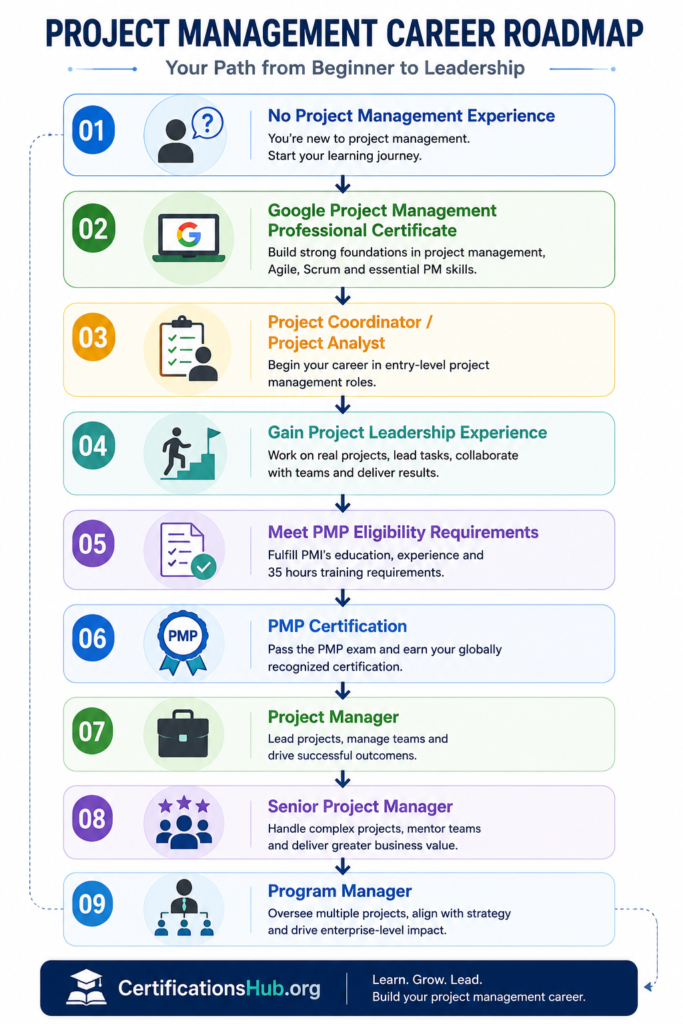
This approach is especially useful for career changers because it separates learning project management from proving professional project leadership experience.
Which Is Better for Beginners?
Winner: Google Project Management
Choose Google Project Management if:
- You are completely new to project management.
- You have no formal PM experience.
- You are changing careers.
- You want to understand project management before committing to PMP.
- You want a relatively short, structured learning program.
- You want to qualify for entry-level project roles.
The Google certificate removes one of the biggest barriers for beginners: experience.
You can start learning without first becoming eligible for a professional certification exam.
Which Is Better for Experienced Professionals?
Winner: PMP
If you already have substantial project leadership experience and meet PMI’s eligibility requirements, PMP is the stronger credential.
PMP makes more sense if you’re targeting:
- Project Manager
- Senior Project Manager
- Program Manager
- PMO leadership
- Delivery leadership
- Transformation leadership
- Consulting
The credential is designed specifically to validate professional project leadership rather than simply introduce project management concepts.
Which Is Better for IT Professionals?
For IT professionals, the answer depends on experience.
IT Professional With No PM Experience
Start with:
Google Project Management → Project Experience → PMP
IT Professional Already Managing Projects
You may be able to skip the Google certificate and focus directly on:
PMP Eligibility → 35 Hours Training → PMP Preparation → PMP Exam
This is particularly relevant for professionals who have already been managing projects as part of their existing roles.
Google Project Management vs PMP: Pros and Cons
Google Project Management
Pros
- Beginner friendly
- No project management experience required
- No degree required
- Practical curriculum
- Covers Agile and Scrum
- Good career-switching credential
- Self-paced
- Lower barrier to entry
Cons
- Not equivalent to PMP
- Limited professional recognition compared with PMP
- Does not replace project leadership experience
- Less useful for senior PM positions
- No professional certification examination
PMP
Pros
- Globally recognized
- Strong employer recognition
- Designed for experienced professionals
- Covers predictive, agile, and hybrid approaches
- Strong career advancement potential
- Associated with higher median salaries
- Useful for senior PM and leadership roles
Cons
- Experience requirement
- More expensive
- Significant preparation required
- Challenging examination
- Requires ongoing certification maintenance
Google Project Management vs PMP: Which One Should You Choose?
| Your Situation | Best Choice |
| No PM experience | Google Project Management |
| Career changer | Google Project Management |
| Student | Google Project Management |
| Project Coordinator | Google Project Management |
| Already leading projects | PMP |
| 3+ years qualifying experience with bachelor’s degree | PMP* |
| Senior Project Manager | PMP |
| Program Manager | PMP |
| PMO leadership | PMP |
| Want both | Google → Experience → PMP |
*Actual PMP eligibility depends on PMI’s current requirements and how your project leadership experience is documented. Always verify eligibility directly with PMI before applying.
90-Day Career Strategy
If you’re starting from zero, don’t try to jump immediately into PMP.
Days 1–30: Build Foundations
Complete the Google Project Management coursework and learn:
- Project lifecycle
- Project scope
- Scheduling
- Stakeholders
- Risk
- Agile
- Scrum
Days 31–60: Gain Practical Experience
Look for opportunities to participate in projects at work.
You could volunteer to manage:
- Process improvement
- Software implementation
- Internal initiatives
- Client deliverables
- Migration activities
- Reporting projects
- Training initiatives
Document your responsibilities and outcomes.
Days 61–90: Evaluate Your PMP Path
Review your project leadership experience against PMI’s current eligibility requirements.
If you’re eligible:
- Complete qualifying project management training.
- Prepare your PMP application.
- Study the current PMP exam content.
- Practice scenario-based questions.
- Schedule the exam.
Final Verdict
The Google Project Management Certificate and PMP are not really competing certifications—they are credentials for different stages of a project management career.
If you’re starting from zero, Google Project Management is the better choice.
It gives you a structured introduction to project management, Agile, Scrum, planning, risk, stakeholders, and project execution without requiring previous experience.
If you’re already managing projects and meet PMI’s requirements, PMP is the stronger choice.
It provides professional validation of your project leadership experience and has much stronger recognition for experienced project management roles.
Our Recommendation
For beginners:
Google Project Management → Gain Experience → PMP
For experienced project professionals:
Qualify → Prepare → PMP
For the strongest long-term path:
Google Project Management + Real Project Experience + PMP
This combination gives you both the knowledge foundation and the professional credential.
Key Takeaways
- Google Project Management is designed primarily for beginners.
- PMP is designed for experienced project professionals.
- Google does not require previous PM experience.
- PMP requires qualifying project leadership experience and education/training.
- Google is useful for career changers and entry-level PM candidates.
- PMP is better suited to Project Managers, Senior PMs, Program Managers, and PMO leaders.
- The Google certificate can provide useful foundational knowledge before pursuing PMP.
- Google Project Management does not replace PMP eligibility requirements.
- PMI’s latest salary research shows PMP-certified professionals report higher median salaries than non-certified professionals.
- For many career changers, Google → Experience → PMP is the most logical progression.
Related Articles
- Google Project Management Professional Certificate (2026)
- PMP Certification: Exam, Cost, Salary & Career Guide (2026)
- CAPM vs PMP Certification: Which One Is Better?
- PMP vs Scrum Master Certification: Which One Is Better in 2026?
- Best Project Management Certifications (2026)
- Google Certifications
Frequently Asked Questions (FAQs)
Is Google Project Management better than PMP?
No credential is universally better.
Google Project Management is better for beginners, while PMP is better for experienced project professionals who meet PMI’s eligibility requirements.
Can I get a Project Manager job with the Google Project Management Certificate?
Yes, it can help you qualify for entry-level project management roles, but the certificate alone does not guarantee employment.
Practical project experience, communication, leadership, and industry knowledge are also important.
Can Google Project Management replace PMP?
No.
The Google certificate does not replace PMI’s PMP eligibility requirements or certification examination.
Should I take Google Project Management before PMP?
If you are a beginner, it can be a very good starting point.
If you already have substantial project leadership experience, you may benefit more from going directly toward PMP preparation.
Is PMP harder than Google Project Management?
Yes.
Google Project Management is designed as beginner-level training. PMP requires qualifying professional experience and a substantial certification examination.
Which one is cheaper?
Google Project Management is generally less expensive because it is delivered as an online Coursera program.
PMP requires an examination fee, qualifying training, preparation resources, and potentially PMI membership.
PMI currently lists the PMP examination fee as $405 for members and $655 for non-members on its certification page.
Does Google Project Management count as PMP experience?
No.
Completing a course does not itself create the project leadership experience required for PMP eligibility.
Your qualifying experience must come from actually leading and directing projects in accordance with PMI’s requirements.
Is PMP worth it in 2026?
For professionals who meet the eligibility requirements and want to advance in project management, PMP can be a strong investment.
PMI’s latest salary research reports a 17% higher median salary among PMP-certified respondents across 21 countries, although the relationship between certification and salary should not be interpreted as a guaranteed raise.