
Introduction
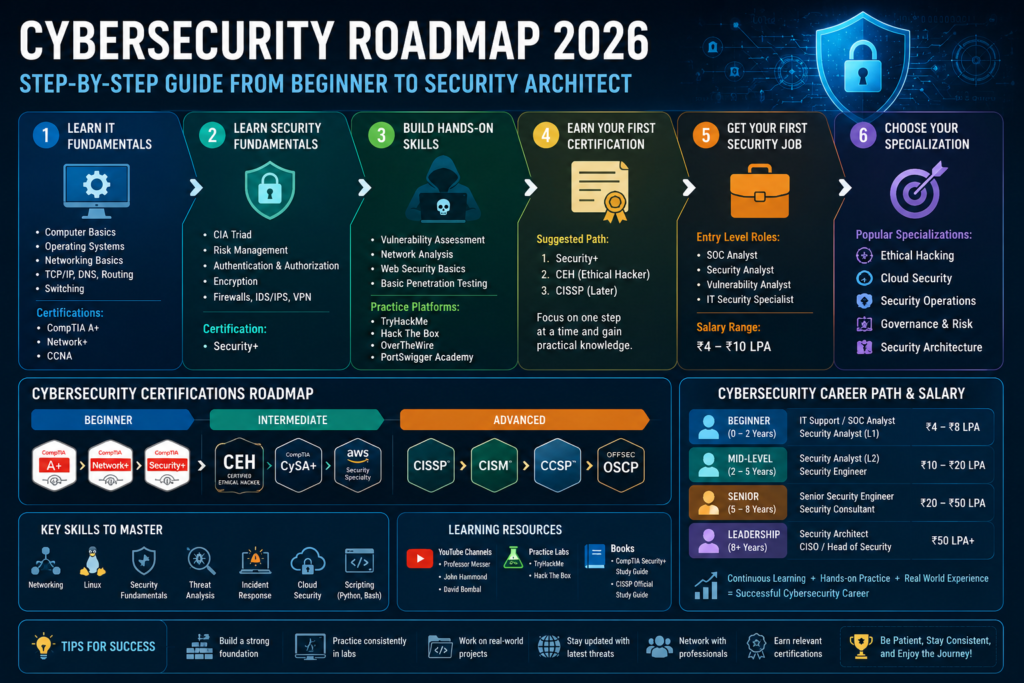
Cybersecurity Roadmap guides aspiring security professionals through the skills, certifications, tools, and career paths needed to build a successful cybersecurity career in 2026.
With cyber attacks increasing every year, organizations need skilled professionals to protect networks, systems, cloud environments, and sensitive data. Whether you come from an IT background or are switching careers, cybersecurity offers excellent growth opportunities and competitive salaries.
In this roadmap, you’ll learn exactly what to study, which certifications to pursue, and how to progress from a beginner to a security architect.
Why Choose Cybersecurity in 2026?
Include:
- Growing demand
- High salaries
- Remote opportunities
- Multiple specializations
- Global demand
Salary Table:
| Level | Salary |
|---|---|
| Beginner | ₹4–8 LPA |
| Mid-Level | ₹10–20 LPA |
| Senior | ₹20–50 LPA |
| Leadership | ₹50 LPA+ |
Cybersecurity Skills You Must Learn in 2026
A successful cybersecurity professional needs a combination of technical knowledge, practical skills, and security awareness. While certifications help validate your knowledge, employers increasingly look for candidates who can demonstrate hands-on experience.
The most important cybersecurity skills include:
Networking
Understanding networking fundamentals is critical because most cyberattacks target networks, servers, and connected devices.
Key topics include:
- TCP/IP
- DNS
- Routing
- Switching
- VPNs
- Firewalls
Professionals who understand how networks operate can identify security weaknesses much more effectively.
Linux
Linux powers a significant percentage of servers, cloud platforms, and security tools.
Important Linux skills include:
- File permissions
- User management
- Networking commands
- Package management
- Shell scripting
Cloud Security
As organizations migrate workloads to the cloud, cloud security skills are becoming increasingly valuable.
Learn:
- AWS security fundamentals
- Azure security concepts
- Identity and access management
- Cloud monitoring
- Data protection
Cloud security professionals are among the highest-paid cybersecurity specialists today.
Scripting
Basic scripting helps automate repetitive security tasks.
Recommended languages:
- Python
- Bash
- PowerShell
Even beginner-level scripting knowledge can significantly improve productivity.
Stage 1: Learn IT Fundamentals
Topics:
- Computer Hardware
- Operating Systems
- Windows
- Linux
- Networking Basics
- DNS
- TCP/IP
- Routing
- Switching
Recommended Certifications:
- CompTIA A+
- CompTIA Network+
- CCNA
Refer to these certifications for more information:
Stage 2: Learn Security Fundamentals
Topics:
- CIA Triad
- Risk Management
- Authentication
- Authorization
- Encryption
- Firewalls
- IDS/IPS
- VPN
Recommended Certification:
- Security+
Refer to these certifications for more information:
Stage 3: Build Hands-On Skills
Platforms:
- TryHackMe
- Hack The Box
- OverTheWire
- PortSwigger Academy
Skills:
- Vulnerability Assessment
- Network Analysis
- Web Security
- Basic Pen Testing
Create a Home Cybersecurity Lab
One of the biggest mistakes beginners make is relying only on certification study materials.
A home lab allows you to practice real-world cybersecurity concepts safely.
You can build a basic cybersecurity lab using:
- VirtualBox
- VMware Workstation
- Kali Linux
- Ubuntu
- Windows Evaluation VMs
In your lab, practice:
- Network scanning
- Vulnerability assessments
- Firewall configurations
- Password security
- Security monitoring
Employers often value practical experience more than certifications alone.
Stage 4: Earn Your First Cybersecurity Certification
Suggested Path:
- Security+
- CEH
- CISSP (Later)
Refer to these certifications for more information:
Stage 5: Get Your First Security Job
Roles:
- SOC Analyst
- Security Analyst
- Vulnerability Analyst
- IT Security Specialist
Salary Range:
₹4–10 LPA
Cybersecurity Career Paths Explained
Cybersecurity is a broad field with many specialization options.
SOC Analyst
Security Operations Center (SOC) Analysts monitor security alerts, investigate incidents, and respond to threats.
Typical salary:
₹4–10 LPA
Penetration Tester
Penetration Testers simulate cyberattacks to identify security weaknesses.
Typical salary:
₹8–20 LPA
Security Engineer
Security Engineers design and implement security controls across networks and cloud environments.
Typical salary:
₹10–25 LPA
Security Architect
Security Architects create enterprise-wide security strategies and frameworks.
Typical salary:
₹25–50+ LPA
Cloud Security Engineer
Cloud Security Engineers secure AWS, Azure, and Google Cloud environments.
Typical salary:
₹12–35+ LPA
Stage 6: Choose a Specialization
Option 1: Ethical Hacking
Certifications:
- CEH
- OSCP
Option 2: Cloud Security
Certifications:
- AWS Security Specialty
- Azure Security Engineer
Option 3: Security Operations
Certifications:
- Security+
- CySA+
Option 4: Governance & Risk
Certifications:
- CISSP
- CISM
Option 5: Security Architecture
Certifications:
- CISSP
- CCSP
Cybersecurity Certifications Roadmap
Create a simple roadmap:
Beginner
- CompTIA A+
- Network+
- Security+
Intermediate
- CEH
- CySA+
- AWS Security
Advanced
- CISSP
- CISM
- CCSP
- OSCP
Cybersecurity Learning Resources
Books:
- CompTIA Security+ Study Guide
- CISSP Official Study Guide
YouTube:
- Professor Messer
- John Hammond
- David Bombal
Labs:
Common Mistakes Beginners Make
- Skipping networking fundamentals
- Collecting certifications without practice
- Ignoring Linux
- Ignoring cloud security
- Not building a home lab
How Long Does It Take?
| Starting Point | Time |
|---|---|
| Complete Beginner | 12–24 Months |
| IT Support Background | 6–12 Months |
| Network Engineer | 6–9 Months |
Cybersecurity Roadmap Timeline for Beginners
Many aspiring professionals ask how long it takes to become job-ready.
A realistic roadmap looks like this:
Months 1–3
- Learn networking fundamentals
- Study operating systems
- Begin Linux learning
Months 4–6
- Study security fundamentals
- Complete Security+ preparation
- Start hands-on labs
Months 7–12
- Earn Security+ certification
- Practice in TryHackMe
- Build home lab projects
Months 12–18
- Pursue CEH or CySA+
- Apply for SOC Analyst roles
- Gain practical experience
Years 2–5
- Specialize in ethical hacking, cloud security, governance, or architecture
- Pursue advanced certifications such as CISSP
These additions alone will push the article well beyond 1,500 words, which is much better for a pillar roadmap article. For CertificationsHub, roadmap posts should generally be:
- Certification Guides → 1,500–2,000 words
- Comparison Posts → 1,500–2,500 words
- Roadmaps → 2,000–3,500 words
- Pillar Articles → 3,000–5,000 words
That gives you a much stronger chance of ranking for competitive keywords like Cybersecurity Roadmap, which typically have long-form content ranking on page 1.
Final Thoughts
Cybersecurity Roadmap is not about collecting certifications—it is about building practical skills, gaining hands-on experience, and continuously learning. Start with networking and security fundamentals, earn your first certification, practice in labs, and gradually specialize in a cybersecurity domain that matches your interests.