
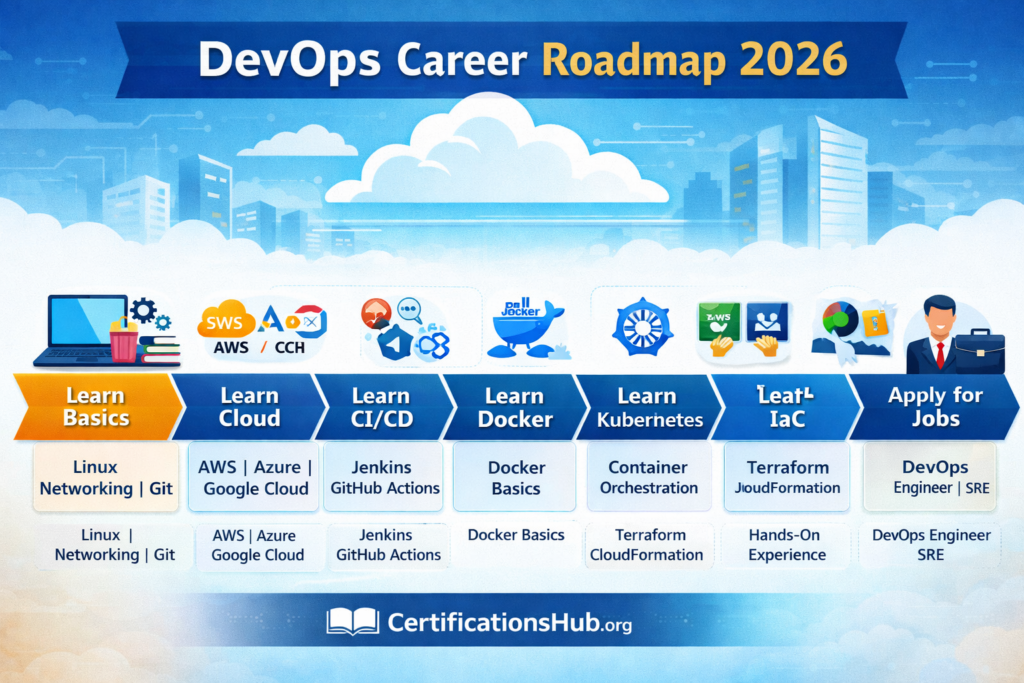
🚀 DevOps Engineer Roadmap 2026 is one of the most searched career paths in IT today. With companies focusing on automation, cloud computing, and faster software delivery, the demand for DevOps Engineers is growing rapidly.
In this complete roadmap, you’ll learn:
- What DevOps is
- Skills required
- Step-by-step learning path
- Tools and certifications
- Salary in India
- How to start from scratch
💼 What Does a DevOps Engineer Do?
A DevOps Engineer acts as a bridge between development and operations teams. Their main goal is to automate and streamline the software development lifecycle.
Key Responsibilities:
- Build and manage CI/CD pipelines
- Automate infrastructure and deployments
- Monitor system performance
- Manage cloud environments
- Improve system reliability and scalability
👉 In simple terms:
DevOps engineers ensure software is built, tested, and deployed quickly and reliably.
💰 DevOps Engineer Salary in India (2026)
DevOps Engineers are among the highest-paid professionals in IT.
| Experience Level | Average Salary |
|---|---|
| Beginner (0–2 yrs) | ₹5 – ₹10 LPA |
| Mid-Level (3–6 yrs) | ₹12 – ₹25 LPA |
| Senior (7+ yrs) | ₹30+ LPA |
👉 With cloud certifications and hands-on experience, salaries can grow even faster.
🧠 Skills Required to Become a DevOps Engineer
Before diving into tools, focus on building strong fundamentals.
🔹 1. Linux & System Administration
Linux is the backbone of DevOps.
You should know:
- File system management
- Permissions
- Process handling
🔹 2. Networking Basics
- HTTP/HTTPS
- DNS
- Load balancing
👉 This helps you understand how applications communicate.
🔹 3. Programming & Scripting
- Python (recommended)
- Bash scripting
🔹 4. Cloud Platforms
- AWS
- Azure
- Google Cloud
👉 If you’re new, start with AWS.
🔹 5. DevOps Tools & Concepts
- CI/CD pipelines
- Containerization
- Infrastructure as Code
🗺️ DevOps Engineer Roadmap (Step-by-Step)
Follow this roadmap to become job-ready 👇
✅ Step 1: Learn the Basics
Start with:
- Linux
- Networking
- Git & version control
👉 If you’re switching careers, read:
How to switch to an IT Career without a CS Degree
✅ Step 2: Learn Cloud Computing
Choose one platform:
- AWS (recommended)
- Azure
- Google Cloud
👉 You can follow:
✅ Step 3: Understand CI/CD
CI/CD is the core of DevOps.
Learn:
- Continuous Integration
- Continuous Deployment
Tools:
- Jenkins
- GitHub Actions
- GitLab CI
✅ Step 4: Learn Docker (Containerization)
Docker helps you package applications into containers.
You should learn:
- Docker images
- Containers
- Dockerfiles
To get started with containers, refer to the official Docker documentation.
✅ Step 5: Learn Kubernetes (Orchestration)
Kubernetes helps manage containers at scale.
Key concepts:
- Pods
- Clusters
- Auto-scaling
Learn more about container orchestration on the official Kubernetes website.
✅ Step 6: Learn Infrastructure as Code (IaC)
IaC tools help automate infrastructure.
Popular tools:
- Terraform
- AWS CloudFormation
✅ Step 7: Build Real Projects
This is critical for getting hired.
Project ideas:
- Create a CI/CD pipeline using Jenkins
- Deploy a Dockerized app on AWS
- Build a Kubernetes cluster
👉 Projects are more important than certifications.
✅ Step 8: Get DevOps Certifications
Certifications validate your skills and improve job chances.
Beginner:
- AWS Certified Cloud Practitioner
Intermediate:
- AWS DevOps Engineer
- Azure DevOps Engineer
You can explore exam details on the AWS DevOps Engineer certification page.
✅ Step 9: Apply for DevOps Jobs
Start applying for:
- DevOps Engineer
- Cloud DevOps Engineer
- Site Reliability Engineer (SRE)
🧰 Essential DevOps Tools You Must Learn
| Category | Tools |
|---|---|
| Version Control | Git |
| CI/CD | Jenkins, GitHub Actions |
| Containers | Docker |
| Orchestration | Kubernetes |
| IaC | Terraform |
| Cloud | AWS, Azure |
⚔️ DevOps vs Cloud Engineer – What’s the Difference?
| Cloud Engineer | DevOps Engineer |
|---|---|
| Focus on infrastructure | Focus on automation |
| Works on cloud setup | Works on pipelines |
| Less scripting | More scripting |
👉 DevOps builds on cloud knowledge, so both roles are closely related.
📊 DevOps Roadmap Summary
| Step | Action |
|---|---|
| 1 | Learn Linux & Git |
| 2 | Learn Cloud |
| 3 | Learn CI/CD |
| 4 | Learn Docker |
| 5 | Learn Kubernetes |
| 6 | Learn Terraform |
| 7 | Build projects |
| 8 | Get certified |
| 9 | Apply for jobs |
🚀 Final Thoughts
DevOps is one of the best career choices in 2026 due to its high demand and strong salary growth.
Key Takeaways:
- Focus on hands-on learning
- Learn tools step-by-step
- Build real-world projects
👉 With consistent effort, you can become a DevOps Engineer in 6–12 months, even as a beginner.