
Introduction
Cybersecurity is no longer limited to protecting firewalls and antivirus systems.
Modern security teams need professionals who can analyze security alerts, investigate suspicious activity, prioritize vulnerabilities, hunt for threats, respond to incidents and communicate security findings to business and technical stakeholders.
This is where the CompTIA Cybersecurity Analyst (CySA+) certification fits.
CompTIA CySA+ is an intermediate-level cybersecurity certification focused on security operations, vulnerability management, incident response and security reporting.
The current 2026 exam is CySA+ CS0-004 (V4), which launched on June 23, 2026. The previous CS0-003 version is being retired in English on December 22, 2026.
The current CS0-004 exam also introduces updated topics such as:
- AI in security operations
- Cloud and hybrid security operations
- Zero Trust Network Architecture
- SASE
- EPSS
- SBOM
- SOAR
- XDR
- Threat hunting
- Modern vulnerability management
- Incident response
- Security reporting and communication
The certification is designed for professionals who want to move beyond basic cybersecurity concepts and develop stronger analyst-level defensive security skills.
This guide explains the CompTIA CySA+ Certification in 2026, including the current CS0-004 exam, cost, eligibility, syllabus, exam domains, difficulty, preparation strategy and career relevance.
Table of Contents
CompTIA CySA+ Quick Overview
| Feature | Details |
|---|---|
| Certification | CompTIA Cybersecurity Analyst (CySA+) |
| Current Exam | CS0-004 |
| Version | V4 |
| Level | Intermediate / Analyst-level |
| Exam Duration | 165 minutes |
| Questions | Maximum of 85 |
| Question Types | Multiple-choice + Performance-based questions |
| Passing Score | 750/900 |
| Exam Price | US$439 list price |
| Prerequisites | No formal prerequisite |
| Recommended Experience | Approximately 4 years of hands-on experience in a SOC analyst or vulnerability analyst role |
| Delivery | Pearson VUE test center or online testing |
| Validity | 3 years |
| Renewal | Continuing education or other approved CompTIA renewal paths |
| Primary Focus | Security operations, vulnerability management, incident response and reporting |
CompTIA’s current CS0-004 objectives specify a maximum of 85 questions, 165 minutes, multiple-choice and performance-based questions, a 750/900 passing score and approximately four years of hands-on experience in a SOC analyst or vulnerability analyst role as recommended background.
The current U.S. list price is US$439. Regional pricing can differ, so candidates in India should verify the final price displayed by CompTIA before purchasing the exam voucher.
What Is CompTIA CySA+?
CompTIA Cybersecurity Analyst (CySA+) is a cybersecurity certification focused on the practical work performed by security analysts.
Rather than testing only whether you can define security terms, CySA+ focuses heavily on your ability to interpret security information and decide what action should be taken.
For example, you may need to understand:
- Is this network traffic suspicious?
- Is this security alert a true positive or a false positive?
- Which vulnerability should be remediated first?
- What evidence should be collected during an incident?
- What should happen during containment?
- Which threat intelligence is relevant?
- What does a particular log indicate?
- How should a security finding be communicated to management?
- How can automation improve security operations?
This makes CySA+ particularly relevant to the defensive cybersecurity / blue-team side of cybersecurity.
What Does CySA+ Validate?
The current CS0-004 exam validates knowledge and skills related to:
- Detecting malicious activity
- Analyzing security indicators
- Security operations
- Threat intelligence
- Threat hunting
- Vulnerability management
- Vulnerability prioritization
- Incident response
- Incident management
- Security reporting
- Stakeholder communication
- Security operations improvement
The certification therefore sits between broad cybersecurity fundamentals and more specialized security roles.
A simplified progression is:
Security Fundamentals
↓
Security Operations
↓
Threat Detection + Vulnerability Management
↓
Incident Response
↓
Security Analyst
Who Should Take CompTIA CySA+?
CySA+ is primarily aimed at professionals who already have some cybersecurity or IT experience.
It can be particularly relevant to:
- SOC Analysts
- Security Analysts
- Cybersecurity Analysts
- Vulnerability Analysts
- Incident Response Analysts
- Threat Hunters
- Security Operations professionals
- Security Engineers
- Network Security professionals
- IT administrators moving into cybersecurity
- Security consultants
- Cybersecurity professionals looking for an intermediate certification
CompTIA recommends approximately four years of hands-on experience in a SOC analyst or vulnerability analyst role for the current CS0-004 exam. This is recommended preparation guidance rather than a formal registration prerequisite.
Is CySA+ Suitable for Beginners?
This is an important question.
CySA+ is not designed as a first cybersecurity certification for someone with no IT or security knowledge.
You should ideally understand:
- Networking
- Operating systems
- Authentication
- Access control
- Security fundamentals
- TCP/IP
- Firewalls
- IDS/IPS
- Malware
- Vulnerabilities
- Basic security architecture
A common learning path is:
Networking Fundamentals
↓
Security+ or Equivalent Security Knowledge
↓
Hands-On IT/Security Experience
↓
CySA+
However, the certification itself does not require you to hold Security+ or another CompTIA certification.
Do You Need Security+ Before CySA+?
No.
CompTIA does not require Security+ as a formal prerequisite.
However, Security+ knowledge is extremely useful because CySA+ builds on many security fundamentals.
Think of the difference as:
Security+ → Understand cybersecurity
CySA+ → Analyze and respond to cybersecurity events
If you have no security background, studying Security+ topics before CySA+ can make the learning curve much easier.
CySA+ vs Security+
These certifications are closely related but serve different purposes.
| Feature | Security+ | CySA+ |
|---|---|---|
| Level | Foundational / early-career | Intermediate |
| Primary Focus | Broad cybersecurity | Security analysis |
| Security Operations | Foundational | Strong |
| Threat Hunting | Limited | Strong |
| Vulnerability Management | Covered | Detailed |
| Incident Response | Foundational | Detailed |
| Log Analysis | Basic | Important |
| Security Reporting | General | Dedicated domain |
| AI in Security Operations | Limited/current-version dependent | Included in CS0-004 |
| Target Audience | Broad security audience | Security analysts |
| Hands-on emphasis | Moderate | Higher |
A simple way to remember the difference:
Security+ asks:
“What security concept or control applies?”
CySA+ asks:
“You are the analyst. Here is the evidence. What should you do next?”
That analyst-oriented focus is one of the biggest differences between the two certifications.
CompTIA CySA+ Eligibility
There is no formal prerequisite for taking the CySA+ examination.
However, CompTIA recommends approximately:
4 years of hands-on experience in a SOC analyst or vulnerability analyst role.
The current CS0-004 objectives describe this as recommended experience rather than an eligibility requirement.
You do not need:
- A college degree
- Security+
- Network+
- A specific job title
- Previous CompTIA certifications
But you should have enough foundational knowledge to understand cybersecurity operations.
CompTIA CySA+ Exam Code
The current exam code is:
CS0-004
It is also referred to as:
CySA+ V4
The exam launched on June 23, 2026.
The previous CS0-003 exam remains available in English until December 22, 2026, but candidates starting preparation now should focus on CS0-004.
The transition is important because the newer exam includes updated areas such as:
- AI in security operations
- Zero Trust
- SASE
- EPSS
- SBOM
- XDR
- Cloud and hybrid monitoring
- Updated automation concepts
CS0-004 vs CS0-003: What Changed?
The four major domains remain, but their weighting changed.
| Domain | CS0-004 | CS0-003 |
|---|---|---|
| Security Operations | 34% | 33% |
| Vulnerability Management | 26% | 30% |
| Incident Response & Management | 24% | 20% |
| Reporting & Communication | 16% | 17% |
The biggest change is the increase in Incident Response and Management from 20% to 24%.
Vulnerability Management decreased from 30% to 26%.
The new version also adds or expands topics such as AI in security operations, cloud/hybrid environments, Zero Trust, SASE, EPSS, SBOM, SOAR and XDR.
Important for 2026 candidates
If you are buying a CySA+ book or course, check that it specifically says:
CS0-004 / V4
Do not assume that a highly rated CySA+ resource is current.
CompTIA CySA+ Exam Format
The CS0-004 exam allows a maximum of:
85 questions
You have:
165 minutes
The exam includes:
- Multiple-choice questions
- Performance-based questions (PBQs)
The performance-based component is particularly important because it reflects the practical nature of the certification.
You may need to interpret information such as:
- Logs
- Network traffic
- Security alerts
- Vulnerability scan output
- Incident information
- Security configurations
The current exam format and passing score are specified in the CS0-004 objectives.
What Are Performance-Based Questions?
Performance-based questions are designed to test whether you can apply knowledge rather than simply recognize a definition.
For example, a question may provide:
A security alert + network information + system information
and ask you to determine:
What is happening?
or:
What should the analyst do next?
You therefore need to practice interpreting security evidence rather than relying entirely on flashcards.
CompTIA CySA+ Passing Score
The passing score is:
750 out of 900
This is a scaled score, not a simple percentage.
Therefore, you should not interpret 750/900 as “I need exactly 83.3% correct.”
CompTIA uses scaled scoring, so there is no publicly defined fixed number of questions that you can get wrong and still guarantee a passing result.
CompTIA CySA+ Exam Cost in 2026
The current U.S. list price for CySA+ CS0-004 is:
US$439
This is the exam voucher price and does not necessarily include:
- Training
- Books
- Practice exams
- Labs
- Retake costs
CompTIA increased its exam pricing in 2026, with current CySA+ pricing reported at $439.
What about India?
CompTIA uses regional pricing, so the actual amount displayed to an Indian candidate can differ from the U.S. list price.
For CertificationsHub readers in India, the safest approach is to check the current CompTIA checkout price before purchasing.
Avoid relying on old articles quoting ₹30,000–₹35,000 because voucher pricing can change.
Total Cost of CySA+ Certification
The exam voucher is only one component of the overall cost.
A self-study candidate may spend money on:
| Expense | Typical Cost |
|---|---|
| Exam voucher | US$439 list price |
| Study book | Varies |
| Practice tests | Varies |
| Cybersecurity labs | Free to paid |
| Training course | Varies significantly |
| Retake | Additional exam fee |
| Renewal | CE-related costs may apply |
You can reduce the total cost substantially through:
- Free study resources
- Free cybersecurity labs
- Employer-sponsored training
- Discounted vouchers
- CompTIA bundles
- Self-study
The most important thing is to avoid booking the exam before you are ready, because a failed attempt means paying for another exam.
CompTIA CySA+ Certification Validity
CySA+ is valid for:
3 years
CompTIA certifications can be renewed through the Continuing Education (CE) program and other approved renewal routes.
For CySA+, CompTIA’s renewal framework includes earning 60 Continuing Education Units (CEUs) during the three-year cycle or completing another approved renewal path.
This means candidates should consider renewal when planning the certification as part of a long-term cybersecurity career.
CompTIA CySA+ Exam Domains
The current CS0-004 exam has four domains:
| Domain | Weight |
|---|---|
| 1. Security Operations | 34% |
| 2. Vulnerability Management | 26% |
| 3. Incident Response and Management | 24% |
| 4. Reporting and Communication | 16% |
| Total | 100% |
Security Operations is the largest domain at 34%.
Security Operations + Vulnerability Management together represent 60% of the exam.
That makes these two areas particularly important during preparation.
Domain 1: Security Operations
Weight: 34%
This is the largest section of the current CySA+ exam.
The domain focuses on the day-to-day activities of a security analyst.
Key areas include:
- System architecture
- Network architecture
- Logging
- Network monitoring
- Endpoint monitoring
- Identity-related indicators
- Malicious activity
- Security tools
- Threat intelligence
- Threat hunting
- Security automation
- Process improvement
- AI in security operations
Security Architecture for Analysts
You should understand concepts such as:
- Network segmentation
- Zero Trust
- SASE
- Cloud environments
- Hybrid environments
- Virtualization
- Containers
- APIs
- IAM
- Privileged access management
- Secrets management
- Encryption
- OT/ICS/SCADA environments
The objective is not to become a network architect.
Instead, you need to understand how architecture affects security monitoring and investigation.
Analyzing Indicators of Malicious Activity
This is a major analyst skill.
You should recognize indicators such as:
Network Indicators
- Unexpected ports
- Rogue devices
- Scanning
- Beaconing
- Command-and-control traffic
- Unusual outbound connections
- Data exfiltration
Host Indicators
- Unexpected processes
- Unauthorized software
- File modifications
- Unusual resource consumption
- Suspicious command-line activity
- Living-off-the-land techniques
Identity Indicators
- Impossible travel
- Unusual login locations
- Privilege escalation
- Suspicious authentication
- Unauthorized access
Application Indicators
- Web attacks
- Suspicious API activity
- Unexpected application behavior
- Malicious input
The exam expects you to interpret these indicators in context rather than simply memorize their definitions.
Security Tools You Should Understand
The current CS0-004 objectives include a broad range of security tools and technologies.
You should understand the purpose of tools such as:
- SIEM
- EDR
- XDR
- IDS/IPS
- Wireshark
- tcpdump
- Snort
- Suricata
- Zeek
- Vulnerability scanners
- YARA
- VirusTotal
- CyberChef
- Threat intelligence platforms
- Sandboxing tools
You don’t necessarily need to become an expert administrator of every tool.
You should understand:
What does the tool do?
What evidence does it provide?
When would a security analyst use it?
SIEM and Log Analysis
SIEM knowledge is particularly important for a CySA+ candidate.
You should understand how security information can be collected from:
- Firewalls
- Servers
- Endpoints
- Applications
- Proxies
- Authentication systems
- Cloud environments
- Network devices
The basic workflow is:
Log Source
↓
Collection
↓
Normalization
↓
Correlation
↓
Alert
↓
Investigation
↓
Response
You should also understand concepts such as:
- Log retention
- Time synchronization
- Log integrity
- Correlation
- Alert tuning
- False positives
- Detection rules
Threat Intelligence
CySA+ expects candidates to understand threat intelligence concepts and how intelligence supports security operations.
Important concepts include:
- Indicators of compromise
- Tactics
- Techniques
- Procedures
- Threat actors
- Threat intelligence feeds
- Open-source intelligence
- Threat intelligence platforms
- MITRE ATT&CK
- Pyramid of Pain
- Threat hunting
A useful distinction is:
Threat intelligence tells you what threats to look for.
Threat hunting is the process of actively looking for evidence of those threats.
Threat Hunting
Threat hunting is a proactive cybersecurity activity.
Instead of waiting for a security alert, analysts develop a hypothesis and search for evidence.
Example:
Hypothesis:
An attacker may be using compromised credentials to access internal systems.
↓
Search authentication logs
↓
Identify unusual login behavior
↓
Correlate with endpoint activity
↓
Investigate
↓
Determine whether malicious activity occurred
The exam expects you to understand this analytical mindset.
Automation and Process Improvement
Modern SOC teams cannot manually investigate every alert.
CySA+ therefore includes concepts such as:
- SOAR
- Playbooks
- Runbooks
- APIs
- Webhooks
- Data enrichment
- Alert tuning
- Rule tuning
- Automation
- Infrastructure as Code
The objective is to understand how automation can improve:
- Detection
- Investigation
- Enrichment
- Ticket creation
- Notification
- Response
AI in Security Operations
One of the most notable additions to CS0-004 is explicit coverage of AI in security operations.
Candidates should understand how AI can support activities such as:
- Alert triage
- Log analysis
- Artifact comparison
- Incident investigation
- Event correlation
- Documentation
- Automation
But the exam also expects you to understand AI-related risks.
These include:
- Hallucinations
- Data exposure
- Model poisoning
- Malicious prompts
- Privacy issues
- Governance
- Human oversight
The key principle is:
AI can assist the analyst, but its output must be validated.
The addition of AI in security operations is one of the clearest differences between CS0-004 and the previous version.
Domain 2: Vulnerability Management
Weight: 26%
Vulnerability management is the second-largest CySA+ domain.
It focuses on identifying, analyzing, prioritizing and mitigating vulnerabilities.
The basic lifecycle is:
Discover
↓
Scan
↓
Analyze
↓
Prioritize
↓
Remediate
↓
Verify
↓
Report
Vulnerability Scanning
You should understand different approaches to vulnerability scanning.
Examples include:
- Credentialed scanning
- Non-credentialed scanning
- Network scanning
- Host scanning
- Application scanning
- Internal scanning
- External scanning
- Authenticated scanning
You should understand why an organization might choose one method over another.
Vulnerability Assessment Output
A scanner can produce hundreds or thousands of findings.
The analyst’s job is not simply to identify vulnerabilities.
The analyst must determine:
Which vulnerabilities matter most?
You should understand concepts such as:
- Severity
- Exploitability
- Asset criticality
- Exposure
- Business impact
- Existing controls
- Compensating controls
- Known exploitation
- Remediation timelines
CVSS and Risk-Based Prioritization
CVSS is an important vulnerability scoring concept.
However, a high CVSS score does not automatically mean that vulnerability should be fixed first.
Consider:
CVSS + Exploitability + Asset Value + Exposure + Business Impact
For example:
A critical vulnerability on an isolated test server may be less urgent than a medium-severity vulnerability affecting an internet-facing production system containing sensitive data.
CySA+ expects candidates to think in terms of risk, not just vulnerability scores.
EPSS
The newer CS0-004 exam also expands the vulnerability-management discussion with EPSS, the Exploit Prediction Scoring System.
EPSS helps estimate the likelihood that a software vulnerability will be exploited in the wild.
This can complement other risk information when organizations prioritize remediation.
The broader lesson is:
Vulnerability prioritization should combine technical severity with exploitation likelihood and business context.
Vulnerability Remediation
Once vulnerabilities are prioritized, organizations may use controls such as:
- Patching
- Configuration changes
- Access restrictions
- Network segmentation
- Application updates
- Compensating controls
- System replacement
- Risk acceptance
You should also understand the importance of:
Verification
After remediation, the organization should confirm that the vulnerability has actually been addressed.
Domain 3: Incident Response and Management
Weight: 24%
This domain has become more important in CS0-004.
Its weight increased from 20% in CS0-003 to 24% in CS0-004.
Key topics include:
- Attack methodologies
- Incident response
- Detection
- Analysis
- Containment
- Eradication
- Recovery
- Evidence handling
- Root cause analysis
- Lessons learned
Incident Response Lifecycle
You should understand the major stages of incident response.
A practical model is:
Preparation
↓
Detection & Analysis
↓
Containment
↓
Eradication
↓
Recovery
↓
Lessons Learned
Different frameworks may use different terminology, so focus on understanding the purpose of each stage.
Attack Methodology Frameworks
CySA+ candidates should understand frameworks and methodologies used to analyze attacks.
Examples include:
- MITRE ATT&CK
- Cyber Kill Chain
- Attack lifecycle concepts
The important question is not simply:
What is MITRE ATT&CK?
You should understand how an analyst might use it to:
- Map attacker behavior
- Identify techniques
- Investigate activity
- Improve detections
- Support threat hunting
- Communicate findings
Evidence Handling
During an incident, evidence must be handled carefully.
You should understand:
- Evidence preservation
- Chain of custody
- Volatility
- Acquisition
- Integrity
- Documentation
For example, volatile information such as memory may need to be collected before less volatile information such as disk data.
Containment, Eradication and Recovery
These three concepts are easy to confuse.
Containment
Stop the incident from spreading.
Examples:
- Isolate an endpoint
- Block malicious traffic
- Disable compromised accounts
Eradication
Remove the underlying cause.
Examples:
- Remove malware
- Delete persistence mechanisms
- Patch exploited vulnerabilities
- Reset compromised credentials
Recovery
Return systems to normal operation.
Examples:
- Restore systems
- Validate functionality
- Monitor for recurrence
- Return services to production
Domain 4: Reporting and Communication
Weight: 16%
This is the smallest domain, but it should not be ignored.
Security analysts need to communicate technical findings clearly.
You should understand:
- Vulnerability reports
- Incident reports
- Executive reporting
- Technical reporting
- Metrics
- KPIs
- Escalation
- Stakeholder communication
- Root cause analysis
- Lessons learned
- Remediation status
Technical vs Executive Communication
A technical security team may need:
- IP addresses
- Indicators
- Logs
- Attack techniques
- Affected systems
- Technical remediation
Senior management may instead need:
- Business impact
- Risk
- Financial impact
- Affected services
- Regulatory implications
- Recommended action
- Timeline
A good cybersecurity analyst must be able to translate technical findings into business-relevant information.
Cybersecurity Metrics
CySA+ also expects candidates to understand security metrics.
Examples include:
- Mean Time to Detect (MTTD)
- Mean Time to Respond (MTTR)
- Mean Time to Contain
- Vulnerability remediation rate
- SLA compliance
- Number of incidents
- False-positive rate
- Recurring vulnerabilities
The goal is to understand what the metric tells the organization and how it can support decision-making.
What Technologies Should You Practice?
The current CS0-004 objectives include a broad sample hardware and software list to help candidates build hands-on practice environments.
Examples include:
Operating Systems
- Windows
- Linux
- Kali Linux
- Commando VM
Network / Security Tools
- Wireshark
- tcpdump
- IDS/IPS
- Firewalls
SIEM
- Splunk
- Elastic/ELK
- Graylog
Vulnerability Scanners
- Nessus
- OpenVAS
Lab Environments
- Metasploitable
- Cloud environments
CompTIA’s objectives describe these as sample technologies rather than an exhaustive list.
Is CySA+ a Hands-On Certification?
CySA+ is more practical than many entry-level cybersecurity certifications.
The exam includes performance-based questions, and the objectives emphasize tasks such as:
- Analyzing logs
- Investigating indicators
- Interpreting vulnerability scans
- Threat hunting
- Incident response
- Security reporting
However, passing CySA+ does not automatically prove professional-level expertise with a specific SIEM, EDR, vulnerability scanner or cloud platform.
Hands-on experience is still important.
CompTIA CySA+ Difficulty
CySA+ should generally be considered an intermediate cybersecurity certification.
A practical difficulty estimate for a candidate with the recommended background would be:
6.5–7.5/10
For someone with no security operations experience, it can feel significantly harder.
The biggest difficulty is not memorizing terminology.
It is learning to:
Analyze → Prioritize → Investigate → Respond → Communicate
That is why hands-on labs are particularly valuable.
How Long Does It Take to Prepare for CySA+?
Preparation time varies considerably.
| Background | Suggested Preparation |
|---|---|
| Complete cybersecurity beginner | 10–16 weeks |
| Security+ knowledge, little hands-on experience | 8–12 weeks |
| IT professional with security experience | 6–10 weeks |
| SOC / security analyst | 4–8 weeks |
| Experienced cybersecurity professional | 3–6 weeks |
These are practical estimates rather than CompTIA guarantees.
If you are completely new to cybersecurity, do not rush into CySA+ simply because the certification is popular.
Build the fundamentals first.
Recommended Daily Study Time
For someone working full-time:
60–90 minutes per weekday
plus
2–3 hours on weekends
is a reasonable target.
A practical weekly split could be:
- 35% Security Operations
- 25% Vulnerability Management
- 25% Incident Response
- 15% Reporting & Communication
This roughly follows the current exam weighting.
How to Prepare for CySA+
The most effective approach is:
Learn the concept
↓
See the evidence
↓
Analyze the evidence
↓
Decide what to do
↓
Practice a scenario
For example:
Topic
Suspicious outbound network traffic
↓
Learn
Understand command-and-control traffic
↓
Practice
Analyze a packet capture
↓
Investigate
Identify suspicious destination and behavior
↓
Respond
Determine the appropriate containment action
↓
Report
Document the finding and recommended next step
This is much closer to how CySA+ tests analyst thinking.
Recommended Study Order
Because Security Operations carries the largest weighting, a logical study sequence is:
Phase 1
Security fundamentals + networking
Phase 2
Security Operations
Phase 3
Vulnerability Management
Phase 4
Incident Response
Phase 5
Reporting & Communication
Phase 6
Hands-on labs
Phase 7
Practice tests + PBQs
The current domain weighting supports giving the most preparation time to Security Operations, followed by Vulnerability Management and Incident Response.
CompTIA CySA+ Salary in India
There is no official salary associated with the CompTIA CySA+ certification.
Your compensation will depend on factors such as:
- Cybersecurity experience
- Job role
- Security tools you know
- SIEM/EDR experience
- Cloud security skills
- Incident-response experience
- Location
- Company
- Industry
- Communication and analytical skills
For a current market reference, Indeed reported an average Security Analyst salary of approximately ₹8.67 lakh per year in India, based on 18 reported salaries, updated September 1, 2026. The reported range was approximately ₹5.83 lakh to ₹12.90 lakh.
For Hyderabad, Indeed’s figures have varied considerably depending on the sample and update date. One July 2026 snapshot reported approximately ₹7.01 lakh per year, based on only five salaries, while another July snapshot showed approximately ₹10.35 lakh based on 10 salaries. These small samples demonstrate why salary figures should be treated as indicative rather than guaranteed.
Indicative cybersecurity salary ranges
| Career Stage | Approximate Market Range |
|---|---|
| Entry-level cybersecurity/SOC roles | ₹3–6 LPA |
| Security Analyst | ₹6–10 LPA |
| Experienced Security Analyst | ₹8–15+ LPA |
| Senior Security Analyst / Specialist | ₹12–20+ LPA |
| Security Engineer / specialized roles | ₹15–25+ LPA |
| Security Architect / senior specialist | ₹20 LPA+ |
These ranges are career-market estimates, not official CySA+ salary figures. Actual compensation can be significantly different.
The important point is that CySA+ can complement a cybersecurity career, but the certification alone does not guarantee a salary increase.
Does CySA+ Increase Your Salary?
Not automatically.
A certification may strengthen a resume, but employers typically evaluate the entire profile.
For example:
Profile A
CySA+ + no practical experience
Profile B
CySA+ + SIEM + EDR + vulnerability management + incident-response experience
The second profile demonstrates substantially more job-relevant capability.
CySA+ becomes more valuable when combined with practical skills such as:
- Splunk
- Microsoft Sentinel
- CrowdStrike
- Microsoft Defender
- Wireshark
- Nessus
- Nmap
- Linux
- Python
- PowerShell
- Cloud security
- Threat intelligence
- MITRE ATT&CK
What Jobs Can You Get After CySA+?
CySA+ is closely aligned with defensive cybersecurity and security operations.
Potential job titles include:
- SOC Analyst
- Security Analyst
- Cybersecurity Analyst
- Security Operations Analyst
- Vulnerability Analyst
- Incident Response Analyst
- Threat Intelligence Analyst
- Threat Hunter
- Security Monitoring Analyst
- Security Operations Engineer
- Junior Security Engineer
- Cyber Defense Analyst
- Security Consultant
- Vulnerability Management Specialist
- Detection Engineer
The exact requirements vary by employer.
CySA+ is particularly relevant where the job involves detecting, analyzing, prioritizing and responding to security events.
CySA+ Career Path
A common cybersecurity career progression can look like:
IT / Networking Fundamentals
↓
Security+ or equivalent knowledge
↓
SOC Analyst / Security Operations
↓
CySA+
↓
Security Analyst
↓
Senior Security Analyst
↓
Threat Hunter / Incident Responder / Security Engineer
↓
Security Architect / Security Manager
CySA+ is therefore best viewed as part of a broader cybersecurity career path rather than as a standalone job qualification.
Career Path 1: SOC Analyst
A common entry route is:
Security Fundamentals
↓
SIEM + Networking + Linux
↓
SOC Analyst
↓
CySA+
↓
L2/L3 Security Analyst
The analyst may work with:
- SIEM
- EDR
- IDS/IPS
- Firewalls
- Threat intelligence
- Security alerts
- Incident tickets
- Authentication logs
CySA+ can provide structured knowledge for this type of work.
Career Path 2: Vulnerability Management
Another path is:
Networking + Security Fundamentals
↓
Vulnerability Scanning
↓
Vulnerability Analyst
↓
CySA+
↓
Vulnerability Management Specialist
↓
Exposure Management / Security Engineering
Important skills include:
- Nessus
- Qualys
- OpenVAS
- CVSS
- EPSS
- Asset management
- Patch management
- Risk prioritization
- Remediation validation
Career Path 3: Incident Response
For people interested in cybersecurity investigations:
Security Fundamentals
↓
SOC Experience
↓
CySA+
↓
Incident Response Analyst
↓
Digital Forensics / Incident Response
↓
Senior Incident Responder
Important skills include:
- Log analysis
- Malware analysis fundamentals
- Memory and disk evidence
- Network traffic
- Endpoint investigation
- MITRE ATT&CK
- Containment
- Eradication
- Recovery
Career Path 4: Threat Hunting
For a more proactive security path:
SOC Analyst
↓
SIEM + Threat Intelligence
↓
CySA+
↓
Threat Hunter
↓
Detection Engineer / Advanced Threat Hunter
Threat hunters investigate activity that may not yet have generated a conventional security alert.
Useful skills include:
- MITRE ATT&CK
- KQL
- SPL
- Sigma
- YARA
- Network analysis
- Endpoint telemetry
- Threat intelligence
Career Path 5: Cloud Security
CySA+ can also be combined with cloud security.
A possible pathway is:
CySA+
↓
AWS/Azure fundamentals
↓
Cloud Security
↓
Cloud Security Engineer
↓
Cloud Security Architect
Useful additional certifications can include cloud-specific security certifications from AWS, Microsoft or other vendors.
The important point is that CySA+ provides a security-analysis foundation, while cloud certifications provide platform-specific knowledge.
CySA+ vs Security+
This is one of the most important comparisons for beginners.
| Area | Security+ | CySA+ |
|---|---|---|
| Level | Foundational | Intermediate |
| Cybersecurity breadth | Broad | More specialized |
| Security operations | Basic/foundational | Strong |
| Vulnerability management | Foundational | Detailed |
| Threat hunting | Limited | Strong |
| Incident response | Foundational | Strong |
| Log analysis | Basic | Strong |
| Security analytics | Limited | Strong |
| PBQs | Yes | Yes |
| Best use | Build security foundation | Develop analyst skills |
Simple rule
If you’re new to cybersecurity:
Security+ → CySA+
If you already have substantial security operations experience:
CySA+ may be more directly relevant.
CySA+ vs PenTest+
These certifications move in different directions.
| Area | CySA+ | PenTest+ |
|---|---|---|
| Main orientation | Defensive | Offensive |
| Security operations | Strong | Moderate |
| Threat detection | Strong | Moderate |
| Vulnerability management | Strong | Strong |
| Incident response | Strong | Limited |
| Penetration testing | Limited | Strong |
| Exploitation | Limited | Strong |
| Threat hunting | Strong | Limited |
| Best fit | Blue team | Red team / offensive security |
In simple terms:
CySA+ = Detect and defend
PenTest+ = Test and exploit
Someone interested in SOC, detection and incident response will generally find CySA+ more closely aligned with those responsibilities.
CySA+ vs SecurityX
SecurityX is a more advanced CompTIA cybersecurity certification aimed at experienced security professionals.
A simplified progression is:
Security+
↓
CySA+
↓
SecurityX
However, the best certification sequence depends on your role.
CySA+ focuses heavily on analyst activities such as security operations, vulnerability management and incident response.
SecurityX is more oriented toward advanced enterprise security leadership and architecture responsibilities.
CySA+ vs CISSP
These certifications serve different purposes.
| Area | CySA+ | CISSP |
|---|---|---|
| Primary focus | Security analysis | Broad security leadership |
| Level | Intermediate | Advanced |
| Security operations | Strong | Covered |
| Incident response | Strong | Covered |
| Security architecture | Moderate | Strong |
| Governance | Covered | Strong |
| Management | Limited | Strong |
| Target audience | Analysts | Experienced security professionals |
CySA+ is therefore much more directly aligned with hands-on analyst responsibilities.
CISSP is broader and is generally associated with experienced cybersecurity professionals moving toward senior, architecture, management or leadership responsibilities.
Is CompTIA CySA+ Worth It in 2026?
CySA+ can be useful if your objective is to develop or demonstrate cybersecurity analyst skills.
It is particularly relevant if you want to work with:
- SOC operations
- Threat detection
- Vulnerability management
- Incident response
- Threat hunting
- Security monitoring
- Security analytics
The current CS0-004 version also incorporates modern areas such as AI in security operations, cloud/hybrid environments, Zero Trust, SASE, EPSS, SBOM, SOAR and XDR.
It may be less useful if:
- You have no IT/security foundation
- You are looking for a purely offensive-security certification
- You already work at an advanced security-architecture level
- Your career is focused primarily on governance rather than technical analysis
- You expect the certification alone to get you a cybersecurity job
Who Should Take CySA+ in 2026?
CySA+ is worth considering if you are:
- Working in a SOC
- Working as a security analyst
- Working in vulnerability management
- Moving from IT administration into cybersecurity
- Interested in threat hunting
- Interested in incident response
- Interested in blue-team cybersecurity
- Preparing for more advanced cybersecurity roles
- Looking for an intermediate cybersecurity certification
Who Should Not Start With CySA+?
CySA+ may not be the right first certification if you don’t understand:
- Networking
- Operating systems
- Authentication
- Security fundamentals
- Firewalls
- Malware
- Vulnerabilities
- Basic cybersecurity terminology
In that situation, start with foundational networking and security knowledge first.
A common route is:
Network Fundamentals → Security+ → Hands-on Labs → CySA+
30-Day CySA+ Study Plan
A 30-day plan is realistic mainly for candidates who already have cybersecurity experience.
Week 1: Security Operations
Study:
- SIEM
- EDR/XDR
- IDS/IPS
- Logging
- Threat intelligence
- Threat hunting
- Network indicators
- Host indicators
- Identity indicators
- Security architecture
- MITRE ATT&CK
Practice:
- Read logs
- Analyze alerts
- Investigate suspicious IPs
- Identify false positives
Week 2: Vulnerability Management
Study:
- Vulnerability scanning
- Asset management
- CVE
- CVSS
- EPSS
- Risk prioritization
- Patch management
- Configuration management
- Remediation
- Validation
- Cloud vulnerabilities
Practice:
Vulnerability → Risk → Priority → Remediation
Week 3: Incident Response
Study:
- Incident identification
- Analysis
- Containment
- Eradication
- Recovery
- Evidence handling
- Chain of custody
- Root cause analysis
- Malware investigation
- Attack frameworks
Practice:
Take a simulated incident and document:
Detection → Investigation → Containment → Eradication → Recovery → Lessons Learned
Week 4: Reporting + Practice
Focus on:
- Security reports
- Executive summaries
- Technical reports
- KPIs
- MTTD
- MTTR
- Risk communication
- Remediation recommendations
Then complete:
- Practice tests
- Performance-based questions
- Weak-area revision
- Timed practice
60-Day CySA+ Study Plan
A 60-day plan is better for candidates who have Security+ knowledge but limited practical experience.
Days 1–15
Networking + security fundamentals
Days 16–30
Security Operations
Days 31–40
Vulnerability Management
Days 41–50
Incident Response
Days 51–55
Reporting and Communication
Days 56–60
PBQs + practice exams + revision
90-Day CySA+ Career Preparation Plan
If your objective is not simply to pass the exam but to become employable as a cybersecurity analyst, use a 90-day approach.
Month 1 — Foundation
Learn:
- Networking
- Linux
- Security fundamentals
- SIEM fundamentals
- Logs
- Threat intelligence
Month 2 — Analyst Skills
Practice:
- SIEM queries
- Vulnerability scanning
- Wireshark
- Nmap
- Threat hunting
- MITRE ATT&CK
- Incident response
Month 3 — Certification + Portfolio
Complete:
- CS0-004 preparation
- Practice exams
- PBQs
- Certification
- Portfolio projects
- Resume update
- LinkedIn profile update
- Job applications
This approach gives you both certification and practical evidence.
Hands-On CySA+ Projects
Passing CySA+ is much more valuable when you can demonstrate practical security skills.
Project 1: Build a Mini SOC Lab
Create a small security monitoring environment.
Possible components:
- Windows VM
- Linux VM
- SIEM
- Syslog
- Endpoint logs
- Network traffic
- Sample attack activity
Practice:
Generate Event → Detect → Investigate → Document
Project 2: Vulnerability Assessment Lab
Set up a deliberately vulnerable lab environment.
Use a vulnerability scanner to identify:
- Open ports
- Outdated software
- Weak configurations
- Vulnerabilities
Then create a report:
| Finding | Severity | Asset | Risk | Recommendation |
|---|
This directly supports CySA+ vulnerability-management concepts.
Project 3: Wireshark Investigation
Use a packet capture containing suspicious traffic.
Identify:
- Source IP
- Destination IP
- Protocol
- Ports
- DNS activity
- HTTP activity
- Suspicious connections
Create a short incident report explaining:
What happened?
What evidence supports your conclusion?
What should the analyst do next?
Project 4: SIEM Alert Investigation
Create a simulated alert:
Multiple failed logins → Successful login → Privilege escalation
Investigate:
- Source IP
- User
- Timestamp
- Location
- Device
- Authentication method
- Subsequent activity
Determine whether it is:
Benign → Suspicious → Confirmed incident
Project 5: Threat Hunting Exercise
Choose a MITRE ATT&CK technique.
Create a hypothesis.
For example:
An attacker may be using PowerShell for malicious execution.
Search available logs for:
- PowerShell execution
- Unusual parent processes
- Encoded commands
- Suspicious users
- Unusual network connections
Document:
Hypothesis → Evidence → Analysis → Conclusion → Detection improvement
Project 6: Vulnerability Prioritization Dashboard
Create a spreadsheet or dashboard containing:
- Asset
- Vulnerability
- CVSS
- EPSS
- Internet exposure
- Asset criticality
- Exploit availability
- Business impact
- Remediation deadline
- Status
Then rank the remediation workload based on risk.
This is a strong portfolio project because it demonstrates that vulnerability management is about prioritization, not simply scanning.
Common CySA+ Preparation Mistakes
Mistake 1: Studying only theory
CySA+ is analyst-oriented.
Practice interpreting evidence.
Mistake 2: Ignoring PBQs
Performance-based questions require a different preparation approach.
Practice:
- Logs
- Network traffic
- Vulnerability reports
- Security alerts
- Incident scenarios
Mistake 3: Memorizing tools without understanding them
Don’t simply memorize:
SIEM = Security Information and Event Management
Understand:
What data goes into a SIEM?
How does correlation work?
Why does an analyst use it?
Mistake 4: Ignoring networking
You cannot become an effective security analyst without understanding network behavior.
Review:
- TCP/IP
- DNS
- HTTP/HTTPS
- Ports
- Routing
- VPN
- NAT
- Firewalls
Mistake 5: Treating every vulnerability equally
CySA+ expects risk-based thinking.
Consider:
Severity + Exploitability + Exposure + Asset Value + Business Impact
Mistake 6: Ignoring communication
Security analysts must communicate findings to technical teams and management.
Mistake 7: Using CS0-003 material without checking it
The current exam is CS0-004.
Candidates should verify that courses, books and practice tests are aligned with the current version.
CySA+ Exam-Day Strategy
Start with the easier questions
Don’t spend several minutes on one difficult question.
Flag it and continue.
Pay attention to the scenario
Look for:
- Symptoms
- Evidence
- Constraints
- Business requirements
- Security objectives
For PBQs, understand the task before clicking
Read the instructions carefully.
Identify:
What information is being provided?
What outcome is required?
Think like an analyst
Ask:
What does the evidence actually prove?
Avoid choosing an answer simply because it sounds technically impressive.
Prioritize the appropriate response
When an incident is underway, determine whether the question is asking for:
- Detection
- Investigation
- Containment
- Eradication
- Recovery
- Documentation
These are not interchangeable.
What Happens If You Fail CySA+?
If you fail the exam, use the result as a diagnostic tool.
Review:
- Which domains were weak?
- Were PBQs difficult?
- Did you struggle with logs?
- Did you struggle with vulnerability prioritization?
- Did incident-response questions cause problems?
- Were you running out of time?
Then revise those areas before attempting the exam again.
Don’t simply repeat the same study plan.
Is CySA+ Good for Career Switching?
CySA+ can support a career transition into cybersecurity, but the certification should be combined with practical experience.
For someone switching from IT into cybersecurity, a stronger combination is:
Networking
Security fundamentals
CySA+
Hands-on SOC labs
SIEM skills
Job applications
rather than:
CySA+ alone → Cybersecurity job
Can CySA+ Help You Become a SOC Analyst?
Yes, the knowledge covered by CySA+ is closely related to SOC analyst responsibilities.
However, employers may also expect familiarity with:
- SIEM
- EDR
- Networking
- Windows
- Linux
- Incident response
- Threat intelligence
- Ticketing systems
- Cloud platforms
- Scripting
Therefore, build a small SOC portfolio alongside the certification.
Can CySA+ Help You Become a Penetration Tester?
It can provide useful defensive knowledge, but CySA+ is not primarily a penetration-testing certification.
If your target role involves:
- Exploitation
- Web application testing
- Vulnerability exploitation
- Red-team operations
- Penetration testing
you should develop additional offensive-security skills and consider certifications specifically aligned with that path.
Can CySA+ Help With Cloud Security?
Yes, particularly because modern security operations increasingly involve cloud and hybrid environments.
But you should add platform-specific knowledge.
For example:
CySA+
↓
AWS/Azure fundamentals
↓
Cloud security
↓
Cloud security projects
↓
Cloud Security Engineer
Does CySA+ Expire?
Yes.
CySA+ is valid for three years.
CompTIA uses a Continuing Education system for renewal, and CySA+ can be renewed through approved CE activities or other qualifying CompTIA certification pathways.
Candidates should check the current CompTIA renewal requirements when planning their three-year cycle because renewal policies and eligible activities can change.
Best Skills to Combine With CySA+
If your goal is employability rather than simply passing the exam, build a skills stack.
Core
- Networking
- Linux
- Windows
- Security fundamentals
Security Operations
- SIEM
- EDR/XDR
- IDS/IPS
- Threat intelligence
Analysis
- Wireshark
- Nmap
- Logs
- Packet analysis
- MITRE ATT&CK
Vulnerability Management
- Nessus
- CVSS
- EPSS
- Patch management
Automation
- Python
- PowerShell
- Bash
- Regex
- SOAR
Cloud
- AWS
- Azure
- Cloud security
This combination is much more powerful than collecting certifications without hands-on experience.
Recommended CySA+ Learning Roadmap
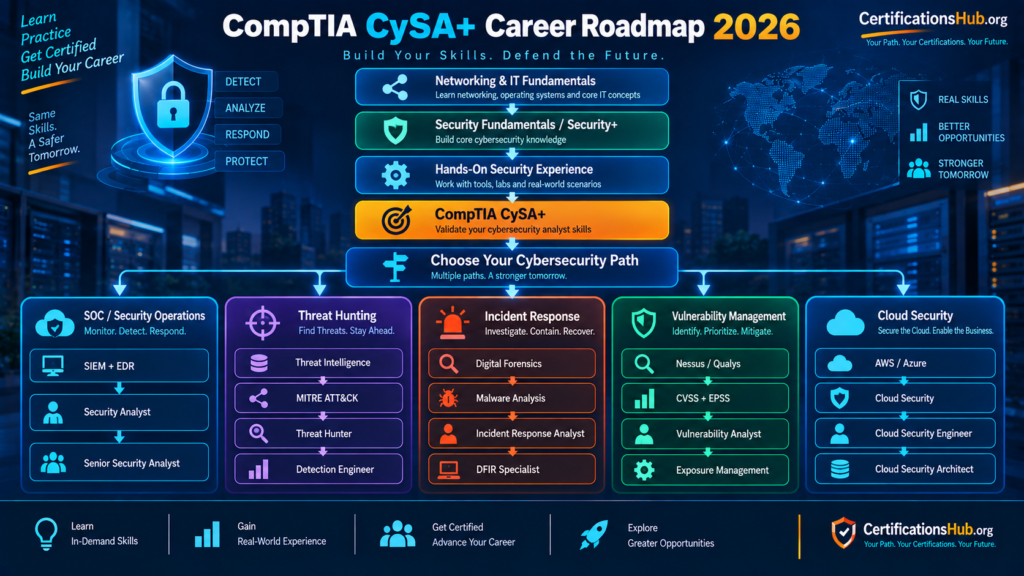
A practical long-term path is:
Networking Fundamentals
↓
Security Fundamentals
↓
Security+
↓
SOC / Security Lab Experience
↓
CySA+
↓
SIEM + EDR + Threat Hunting
↓
Choose a Specialization
Blue Team
Threat Hunting → Detection Engineering
Incident Response
DFIR → Incident Response
Vulnerability Management
Exposure Management → Security Engineering
Cloud Security
AWS/Azure → Cloud Security Engineer
Security Architecture
Security Engineering → Security Architecture
Final Verdict: CompTIA CySA+ Certification 2026
CompTIA CySA+ is best understood as an intermediate cybersecurity analyst certification.
It is particularly relevant to professionals who want to develop skills in:
- Security operations
- Threat detection
- Vulnerability management
- Threat intelligence
- Threat hunting
- Incident response
- Security reporting
- Security automation
The current CS0-004 exam also brings modern security topics such as AI in security operations, cloud and hybrid environments, Zero Trust, SASE, EPSS, SBOM, SOAR and XDR into the certification’s scope.
However, CySA+ should not be treated as a substitute for practical cybersecurity experience.
A strong career strategy is:
Learn → Practice → Certify → Build a Portfolio → Gain Experience → Specialize
For someone starting from zero, build networking and security fundamentals first.
For someone with Security+ knowledge, CySA+ can be a logical next step toward analyst-oriented cybersecurity roles.
For an experienced cybersecurity professional, the certification can complement an existing security operations, vulnerability management or incident-response background.
The most important lesson is:
CySA+ can demonstrate cybersecurity knowledge, but your ability to analyze real security evidence is what turns that knowledge into professional capability.
Key Takeaways
- CySA+ stands for CompTIA Cybersecurity Analyst.
- The current 2026 exam is CS0-004 / V4.
- CS0-004 launched on June 23, 2026.
- The exam has a maximum of 85 questions.
- Exam duration is 165 minutes.
- It includes multiple-choice and performance-based questions.
- The passing score is 750/900.
- The U.S. list price is US$439.
- There is no formal prerequisite.
- CompTIA recommends approximately four years of relevant hands-on experience.
- The certification is valid for three years.
- Security Operations is the largest domain at 34%.
- Vulnerability Management accounts for 26%.
- Incident Response and Management accounts for 24%.
- Reporting and Communication accounts for 16%.
- AI in security operations is included in the current exam.
- CySA+ is strongly aligned with SOC and security analyst responsibilities.
- Hands-on SIEM, EDR, networking and threat-hunting skills can significantly strengthen the certification.
- CySA+ is not primarily a penetration-testing certification.
- CySA+ alone does not guarantee a cybersecurity job or salary increase.
- Candidates starting preparation in late 2026 should use CS0-004-specific study material.
Refer to the other related Articles
Add these links naturally throughout the article:
- CompTIA Security+ Certification: Exam, Cost, Salary & Career Guide (2026)
- Best Cybersecurity Certifications for Beginners 2026
- CompTIA Security+ vs CySA+: Which Certification Should You Choose?
- AWS Certified Security – Specialty: Exam, Cost, Salary & Career Guide
- Azure Security Engineer Associate AZ-500: Exam, Cost, Salary & Career Guide
- AWS Certified Cloud Practitioner (CLF-C02) Complete Guide (2026)
- Best Cloud Certifications for Beginners 2026: AWS, Azure & Google Cloud
Frequently Asked Questions (FAQs)
What is CompTIA CySA+?
CySA+ stands for CompTIA Cybersecurity Analyst. It is an intermediate cybersecurity certification focused on security operations, vulnerability management, incident response and reporting.
What is the current CySA+ exam code?
The current exam is CS0-004, also known as CySA+ V4.
When was CS0-004 launched?
The current CS0-004 exam launched on June 23, 2026.
Is CS0-003 still available?
Yes, but the older CS0-003 is scheduled to retire in English on December 22, 2026. Candidates starting preparation in late 2026 should therefore check that their study materials are aligned with CS0-004.
Is CySA+ harder than Security+?
CySA+ is generally positioned at a more specialized, analyst-oriented level. Candidates who already understand Security+ concepts and have practical security experience may find the transition easier.
Is CySA+ good for beginners?
It can be challenging for complete beginners. CompTIA recommends approximately four years of hands-on experience in a SOC analyst or vulnerability analyst role, although this is not a formal prerequisite.
Do I need Security+ before CySA+?
No. Security+ is not a formal prerequisite.
However, Security+ knowledge can provide a useful foundation.
Does CySA+ require coding?
It does not require advanced software development.
However, cybersecurity analysts can benefit from understanding basic:
Python
PowerShell
Bash
Regular expressions
Scripting concepts
Does CySA+ include performance-based questions?
Yes. The CS0-004 exam includes performance-based questions in addition to multiple-choice questions.
How many questions are on CySA+?
The current CS0-004 exam has a maximum of 85 questions.
How long is the CySA+ exam?
The current exam duration is 165 minutes.
What is the CySA+ passing score?
The passing score is 750 on a 100–900 scale.
How much does CySA+ cost?
The current U.S. list price is US$439. Regional pricing may differ.
How long is CySA+ valid?
CySA+ is valid for three years.
What are the CySA+ domains?
The four current CS0-004 domains are:
Security Operations — 34%
Vulnerability Management — 26%
Incident Response and Management — 24%
Reporting and Communication — 16%
Is AI included in CySA+?
Yes. The current CS0-004 objectives include AI in security operations, including potential uses and associated security considerations.
Does CySA+ cover threat hunting?
Yes. Threat hunting is an important part of security operations and threat analysis.
Does CySA+ cover vulnerability management?
Yes. Vulnerability Management represents 26% of the current exam.
Does CySA+ cover incident response?
Yes. Incident Response and Management represents 24% of the current exam.
Is CySA+ useful for SOC analysts?
Yes. Security operations, threat detection, log analysis, vulnerability management and incident response are closely related to SOC responsibilities.
Is CySA+ useful for cloud security?
It can provide a security-operations foundation, but you should add cloud-specific security skills and experience.
Can CySA+ get me a cybersecurity job?
The certification alone does not guarantee employment. A stronger profile combines CySA+ with hands-on labs, security tools, networking and relevant experience.
Is CySA+ worth it in 2026?
It can be useful for professionals targeting security analyst, SOC, vulnerability management, threat hunting and incident-response career paths. Its value is strongest when combined with practical experience.
What should I learn after CySA+?
That depends on your career direction.
SOC / Detection
SIEM + EDR + Threat Hunting
Incident Response
Digital Forensics + Malware Analysis
Cloud Security
AWS/Azure + Cloud Security
Offensive Security
Penetration Testing + Red Team Skills
Security Leadership
Security Architecture + Governance + Advanced Certifications