
Introduction
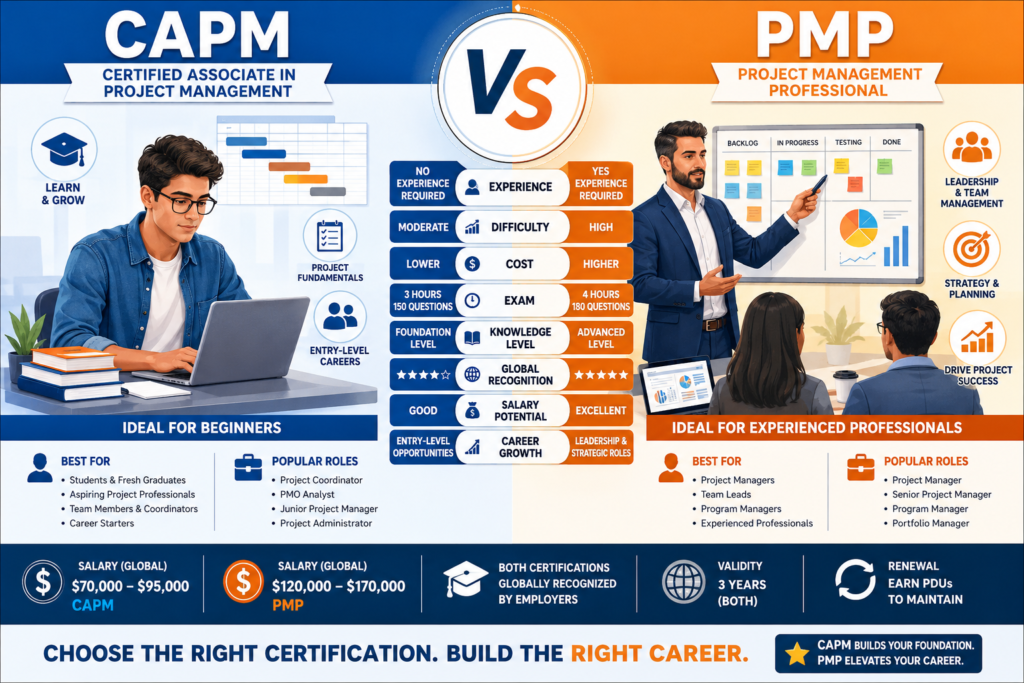
Project management continues to be one of the fastest-growing professions worldwide. Organizations across industries need skilled professionals who can plan, execute, and deliver projects successfully. If you’re planning to build a career in project management, you’ve probably come across two of the most recognized certifications from the Project Management Institute (PMI)—the Certified Associate in Project Management (CAPM) and the Project Management Professional (PMP).
Many beginners struggle to decide between these certifications. Should you start with CAPM, or can you directly pursue PMP? Which certification offers better salaries? Which one is easier to earn? And most importantly, which certification is better for your career goals in 2026?
In this comprehensive CAPM vs PMP comparison guide, we’ll answer all these questions by comparing eligibility, exam format, costs, difficulty, salaries, career opportunities, industry demand, and much more.
Whether you’re a student, recent graduate, aspiring project coordinator, or experienced project manager, this guide will help you choose the certification that best matches your career path.
Table of Contents
Quick Comparison Table
| Feature | CAPM | PMP |
|---|---|---|
| Full Form | Certified Associate in Project Management | Project Management Professional |
| Provider | Project Management Institute (PMI) | Project Management Institute (PMI) |
| Level | Entry-Level | Advanced |
| Experience Required | No | Yes |
| Exam Duration | 3 Hours | Around 4 Hours |
| Number of Questions | 150 | 180 |
| Difficulty | Moderate | High |
| Average Salary (US) | $70,000–$95,000 | $120,000–$170,000 |
| Average Salary (India) | ₹5–10 LPA | ₹15–35 LPA |
| Best For | Beginners | Experienced Professionals |
| Global Recognition | Excellent | Excellent |
What is CAPM Certification?
The Certified Associate in Project Management (CAPM) is an entry-level project management certification offered by the Project Management Institute (PMI). It is designed for individuals who want to start a career in project management but do not yet have significant professional experience.
CAPM validates your understanding of project management concepts, terminology, predictive and agile methodologies, and project management fundamentals.
Unlike PMP, CAPM focuses on knowledge rather than practical project leadership experience.
Key Highlights
| Feature | Details |
|---|---|
| Certification | CAPM |
| Provider | PMI |
| Level | Beginner |
| Experience Needed | No |
| Validity | 3 Years |
| Exam Questions | 150 |
| Duration | 180 Minutes |
Who Should Pursue CAPM?
CAPM is ideal for:
- College students
- Fresh graduates
- Business analysts
- Junior project coordinators
- Team members aspiring to become project managers
- Professionals switching careers
If you’re just beginning your project management journey, CAPM helps build credibility and demonstrates your commitment to employers.
CAPM Eligibility
To become CAPM certified, you need:
- High school diploma (or equivalent)
- 23 hours of project management education
No project management work experience is required.
This makes CAPM one of the most accessible project management certifications available today.
CAPM Exam Details
| Component | Details |
|---|---|
| Questions | 150 |
| Duration | 3 Hours |
| Question Type | Multiple Choice |
| Exam Mode | Online or Test Center |
| Passing Score | PMI does not officially disclose |
The exam focuses on:
- Predictive project management
- Agile principles
- Business analysis framework
- Project life cycle
- Risk management
- Stakeholder management
Benefits of CAPM Certification
Easy Entry into Project Management
CAPM helps candidates without experience demonstrate project management knowledge.
Globally Recognized
Since PMI is respected worldwide, CAPM is accepted across multiple industries.
Better Job Opportunities
CAPM improves your chances of securing roles like:
- Project Coordinator
- Junior Project Manager
- PMO Analyst
- Project Administrator
- Business Analyst
Foundation for PMP
Many professionals use CAPM as a stepping stone before pursuing PMP later in their careers.
💡 Tip: If you don’t yet qualify for PMP because of experience requirements, CAPM is an excellent way to begin building your project management credentials.
What is PMP Certification?
The Project Management Professional (PMP) certification is PMI’s flagship credential and is widely regarded as the gold standard in project management.
Unlike CAPM, PMP validates your ability to lead and manage projects successfully using predictive, agile, and hybrid approaches.
It is intended for experienced professionals responsible for managing teams, budgets, stakeholders, and project outcomes.
PMP Highlights
| Feature | Details |
|---|---|
| Certification | PMP |
| Provider | PMI |
| Level | Advanced |
| Experience | Required |
| Exam Questions | 180 |
| Duration | Around 230 Minutes |
| Validity | 3 Years |
Who Should Pursue PMP?
PMP is best suited for:
- Project Managers
- Senior Business Analysts
- Team Leads
- Program Managers
- Delivery Managers
- Technical Managers
- Consultants
- PMO Professionals
PMP Eligibility
Candidates must meet one of the following requirements.
Option 1
Bachelor’s Degree
PLUS
36 months of project management experience
PLUS
35 hours of project management education or CAPM certification.
Option 2
Secondary School Diploma
PLUS
60 months of project management experience
PLUS
35 hours of project management education.
PMP Exam Details
| Component | Details |
|---|---|
| Questions | 180 |
| Duration | Approximately 230 Minutes |
| Question Types | Multiple Choice, Multiple Response, Drag & Drop, Matching |
| Mode | Online or Test Center |
The PMP exam tests practical project management skills through real-world scenarios rather than memorization.
Domains Covered
The PMP exam is divided into three domains.
| Domain | Weight |
|---|---|
| People | 42% |
| Process | 50% |
| Business Environment | 8% |
The exam includes:
- Agile
- Scrum
- Hybrid Project Management
- Leadership
- Communication
- Stakeholder Engagement
- Risk Management
- Procurement
- Quality
- Budget Management
Benefits of PMP Certification
Higher Salary
PMP-certified professionals consistently earn among the highest salaries in project management.
Better Leadership Roles
PMP prepares professionals for managing large teams and enterprise-level projects.
Global Recognition
PMP is accepted in over 200 countries.
Increased Job Opportunities
Many organizations list PMP as either preferred or mandatory for project management positions.
💡 Important: PMP is intended for experienced professionals. If you lack the required project management experience, CAPM is the more appropriate starting point.
CAPM vs PMP: Eligibility Comparison
| Criteria | CAPM | PMP |
|---|---|---|
| Experience Required | No | Yes |
| Education | High School | Bachelor’s or High School |
| Training | 23 Hours | 35 Hours |
| Suitable for Beginners | Yes | No |
| Suitable for Experienced Professionals | Limited | Excellent |
CAPM vs PMP: Exam Pattern Comparison
| Feature | CAPM | PMP |
|---|---|---|
| Questions | 150 | 180 |
| Duration | 180 Minutes | Around 230 Minutes |
| Difficulty | Moderate | High |
| Scenario-Based Questions | Few | Many |
| Agile Coverage | Moderate | Extensive |
| Leadership Questions | Limited | Extensive |
Why Are CAPM and PMP So Popular?
Both certifications are issued by PMI, the world’s leading organization for project management standards.
Organizations increasingly adopt standardized project management practices, creating strong demand for certified professionals.
Industries hiring CAPM and PMP holders include:
- Information Technology
- Healthcare
- Construction
- Banking
- Consulting
- Telecommunications
- Government
- Manufacturing
- Retail
- Energy
Because project management skills are transferable, both certifications provide opportunities across nearly every major industry.
CAPM vs PMP: Detailed Comparison
Now that you understand what each certification offers, let’s compare CAPM vs PMP across the factors that matter most when choosing the right certification.
CAPM vs PMP: Cost Comparison
Certification costs are an important consideration, especially if you’re self-funding your learning journey. While both certifications are offered by PMI, the PMP exam generally costs more because it targets experienced professionals.
📌 Tip: PMI members receive discounted exam fees. If you’re planning to take either exam, a PMI membership can help reduce the overall cost.
CAPM vs PMP Exam Cost
| Cost Component | CAPM | PMP |
|---|---|---|
| Exam Fee (PMI Member) | Lower | Lower than non-member rate |
| Exam Fee (Non-Member) | Higher | Higher |
| Training Cost | Usually lower | Usually higher |
| Study Material | Moderate | Moderate to High |
| Renewal Cost | Every 3 years | Every 3 years |
Which Certification Offers Better Value?
| If You Are… | Better Choice |
|---|---|
| Student | CAPM |
| Fresh Graduate | CAPM |
| Working Professional with Experience | PMP |
| Career Changer | Depends on experience |
Although PMP requires a larger investment, it generally provides a much higher return through increased earning potential and access to senior project management roles.
CAPM vs PMP: Difficulty Comparison
One of the most common questions is:
Is CAPM easier than PMP?
The answer is yes.
CAPM focuses on understanding project management concepts, terminology, and frameworks. The questions are generally knowledge-based.
PMP, on the other hand, emphasizes applying project management principles to real-world situations. Candidates must analyze scenarios, make decisions, and demonstrate leadership thinking.
Difficulty Comparison
| Factor | CAPM | PMP |
|---|---|---|
| Overall Difficulty | Moderate | High |
| Scenario-Based Questions | Limited | Extensive |
| Experience Needed | No | Yes |
| Practical Knowledge | Basic | Advanced |
| Recommended Study Time | 1–2 months | 2–4 months |
Why PMP Is More Challenging
PMP candidates are expected to demonstrate proficiency in:
- Managing project teams
- Resolving stakeholder conflicts
- Handling project risks
- Budget management
- Agile delivery
- Hybrid project management
- Business value realization
Without real-world project experience, many PMP questions can be difficult to interpret.
💡 CertificationsHub Tip: If you’re new to project management, don’t underestimate the value of building a strong foundation with CAPM before pursuing PMP.
CAPM vs PMP: Skills Covered
Although both certifications are based on PMI’s project management principles, the depth of coverage differs significantly.
Skills Covered by CAPM
CAPM introduces candidates to:
- Project life cycle
- Project management terminology
- Scheduling basics
- Cost estimation
- Scope management
- Risk management fundamentals
- Agile concepts
- Business analysis basics
- Communication
- Stakeholder awareness
Ideal Outcome
CAPM prepares you to support project managers rather than lead complex projects independently.
Skills Covered by PMP
PMP develops advanced capabilities in:
- Project leadership
- Team management
- Agile project delivery
- Hybrid methodologies
- Risk response planning
- Budget control
- Procurement management
- Stakeholder engagement
- Strategic planning
- Change management
- Conflict resolution
- Business environment alignment
Ideal Outcome
PMP prepares professionals to lead projects from initiation to closure while managing people, processes, budgets, and business outcomes.
Skills Comparison Table
| Skill | CAPM | PMP |
|---|---|---|
| Project Fundamentals | ✔️ | ✔️ |
| Agile | ✔️ | ✔️✔️ |
| Leadership | Basic | Advanced |
| Budget Management | Basic | Advanced |
| Stakeholder Management | Basic | Advanced |
| Risk Management | Moderate | Advanced |
| Team Leadership | Limited | Extensive |
| Strategic Planning | No | Yes |
| Business Environment | Basic | Advanced |
CAPM vs PMP: Career Opportunities
Both certifications open doors to rewarding careers, but the level of responsibility differs.
Jobs After CAPM
Typical entry-level positions include:
- Project Coordinator
- Assistant Project Manager
- Project Scheduler
- PMO Analyst
- Junior Business Analyst
- Project Administrator
- Operations Coordinator
These roles help you gain the practical experience needed for future leadership positions.
Jobs After PMP
PMP holders are typically eligible for:
- Project Manager
- Senior Project Manager
- Program Manager
- Delivery Manager
- PMO Manager
- Portfolio Manager
- IT Project Manager
- Digital Transformation Manager
- Engineering Project Manager
- Construction Project Manager
Many multinational organizations list PMP as a preferred qualification for senior project management positions.
Career Opportunities Comparison
| Role | CAPM | PMP |
|---|---|---|
| Project Coordinator | ✔️ | ✔️ |
| Junior Project Manager | ✔️ | ✔️ |
| Project Manager | Limited | ✔️ |
| Senior Project Manager | No | ✔️ |
| Program Manager | No | ✔️ |
| Portfolio Manager | No | ✔️ |
| PMO Manager | Limited | ✔️ |
CAPM vs PMP Salary (Global and India)
Salary is one of the biggest factors professionals consider when comparing certifications.
While salaries depend on experience, industry, location, and employer, PMP-certified professionals consistently earn significantly more than CAPM-certified professionals.
Average Salary Comparison
| Region | CAPM | PMP |
|---|---|---|
| United States | $70,000–$95,000 | $120,000–$170,000 |
| Canada | CAD 70,000–90,000 | CAD 110,000–150,000 |
| United Kingdom | £40,000–£55,000 | £65,000–£95,000 |
| Australia | AUD 80,000–105,000 | AUD 130,000–170,000 |
| India | ₹5–10 LPA | ₹15–35 LPA |
📌 Note: Actual salaries vary depending on experience, industry, company size, location, and individual skills.
Why PMP Salaries Are Higher
PMP professionals are trusted to:
- Manage large budgets
- Lead cross-functional teams
- Deliver strategic initiatives
- Improve organizational performance
- Reduce project risks
These responsibilities naturally command higher compensation.
CAPM vs PMP: Demand in 2026
Project management continues to be one of the fastest-growing professions worldwide.
Organizations are increasingly adopting Agile, hybrid delivery models, and digital transformation initiatives, creating strong demand for certified professionals.
Industries Hiring CAPM and PMP Professionals
- Information Technology
- Banking and Financial Services
- Healthcare
- Construction
- Manufacturing
- Telecommunications
- Government
- Consulting
- Energy
- Retail
- Logistics
CAPM Demand
CAPM demand is growing because companies are hiring more entry-level project professionals who can support experienced project managers.
PMP Demand
PMP remains one of the most requested certifications in project management job postings. Employers value PMP-certified professionals for their ability to lead complex projects and deliver measurable business outcomes.
Demand Comparison
| Factor | CAPM | PMP |
|---|---|---|
| Entry-Level Hiring | Excellent | Moderate |
| Mid-Level Hiring | Limited | Excellent |
| Leadership Roles | No | Excellent |
| Global Recognition | Excellent | Excellent |
| Long-Term Career Growth | Good | Outstanding |
CAPM vs PMP: Pros and Cons
CAPM Pros
Advantages
- Beginner-friendly
- No work experience required
- Lower exam cost
- Globally recognized by PMI
- Strong foundation in project management
- Ideal first certification
- Helps secure entry-level roles
Disadvantages
- Lower salary potential
- Limited leadership opportunities
- Less valuable for experienced professionals
- Often considered a stepping stone to PMP
PMP Pros
Advantages
- Highest recognition in project management
- Significantly higher salaries
- Strong employer demand
- Global acceptance
- Opens leadership and management positions
- Covers Agile, predictive, and hybrid approaches
- Excellent long-term career growth
Disadvantages
- Strict eligibility requirements
- More expensive
- Difficult exam
- Requires substantial project management experience
- Requires ongoing renewal every three years
💡 Expert Tip: If you already meet the experience requirements for PMP, it’s usually more beneficial to pursue PMP directly rather than earning CAPM first.
CAPM vs PMP: Side-by-Side Comparison Table
| Feature | CAPM | PMP | Winner |
|---|---|---|---|
| Beginner Friendly | ⭐⭐⭐⭐⭐ | ⭐⭐ | CAPM |
| Industry Recognition | ⭐⭐⭐⭐ | ⭐⭐⭐⭐⭐ | PMP |
| Salary Potential | ⭐⭐⭐ | ⭐⭐⭐⭐⭐ | PMP |
| Difficulty | ⭐⭐⭐ | ⭐⭐⭐⭐⭐ | CAPM (Easier) |
| Leadership Focus | ⭐⭐ | ⭐⭐⭐⭐⭐ | PMP |
| Career Growth | ⭐⭐⭐ | ⭐⭐⭐⭐⭐ | PMP |
| Global Acceptance | ⭐⭐⭐⭐⭐ | ⭐⭐⭐⭐⭐ | Tie |
| ROI | ⭐⭐⭐⭐ | ⭐⭐⭐⭐⭐ | PMP |
| Long-Term Value | ⭐⭐⭐ | ⭐⭐⭐⭐⭐ | PMP |
Which Certification Should You Choose?
Choosing between CAPM vs PMP depends on your current experience, career stage, and long-term goals.
Choose CAPM If:
- You’re a student or recent graduate.
- You have little or no project management experience.
- You want to enter the project management field.
- You’re looking for an affordable, beginner-friendly certification.
- You plan to gain experience before pursuing PMP.
Choose PMP If:
- You already meet PMI’s eligibility requirements.
- You have experience leading or managing projects.
- You want higher-paying leadership roles.
- You want global recognition.
- You’re aiming for senior project management or program management positions.
Decision Guide
| Your Situation | Recommended Certification |
|---|---|
| College Student | CAPM |
| Fresh Graduate | CAPM |
| Career Changer (No Experience) | CAPM |
| Project Coordinator | CAPM → PMP |
| Team Lead | PMP |
| Project Manager | PMP |
| Senior Professional | PMP |
| Experienced IT Professional | PMP |
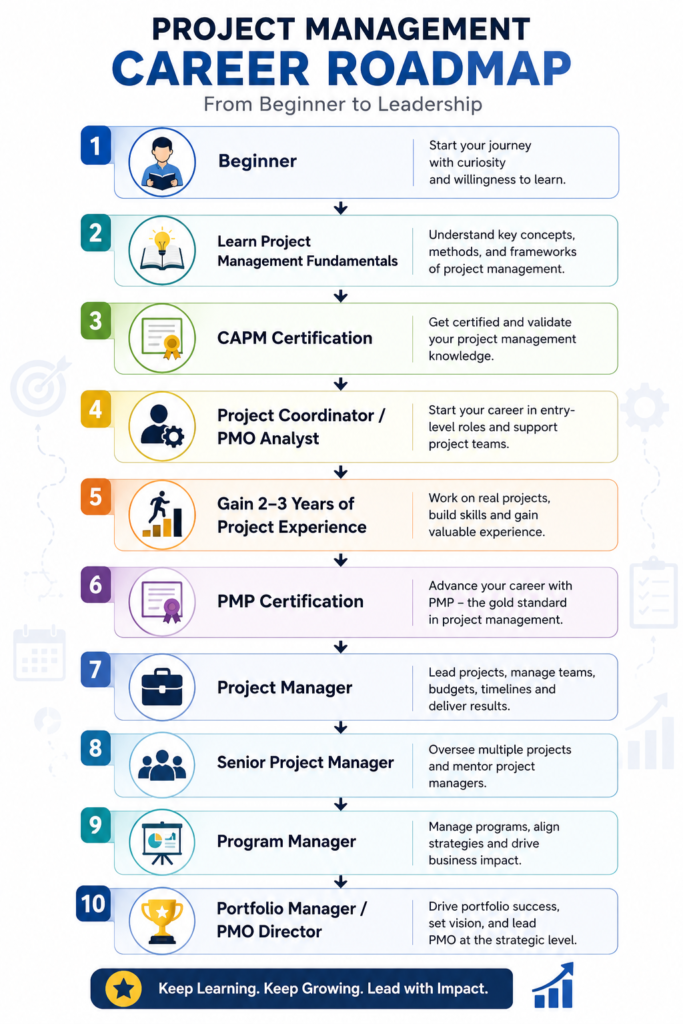
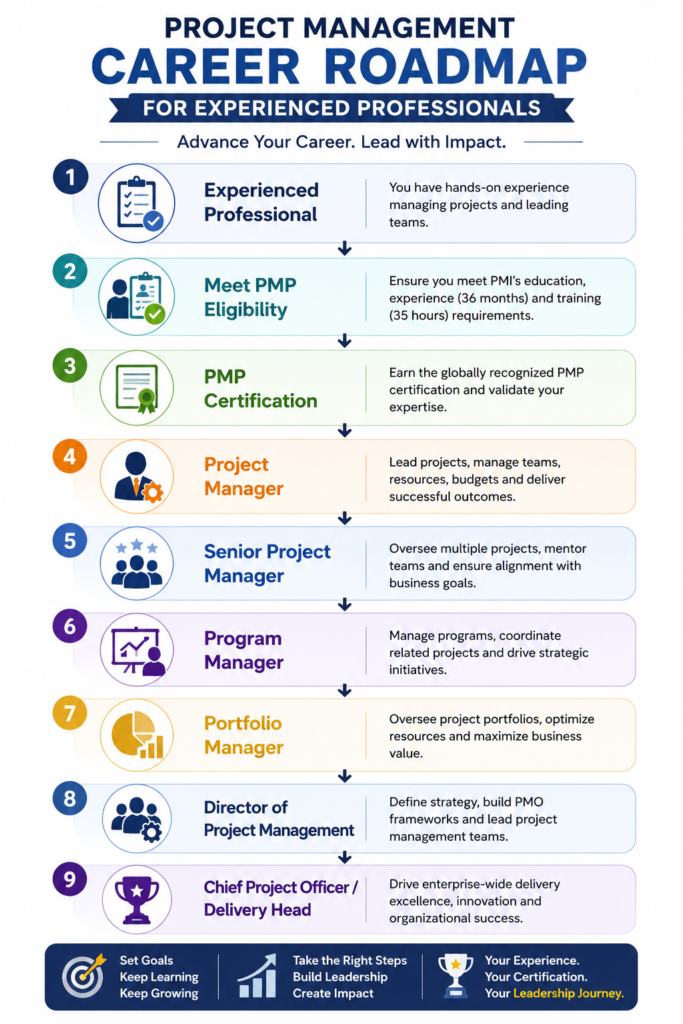
CAPM vs PMP Career Roadmap
Whether you start with CAPM or qualify directly for PMP, both certifications can lead to rewarding careers. Your ideal path depends on your current experience level.
Roadmap for Beginners
Roadmap for Experienced Professionals
CAPM vs PMP: Overall Comparison Table
| Criteria | CAPM | PMP | Better Choice |
|---|---|---|---|
| Certification Level | Entry-Level | Advanced | Depends on Experience |
| Eligibility | Easy | Strict | CAPM |
| Work Experience Required | No | Yes | CAPM |
| Exam Difficulty | Moderate | High | CAPM (Easier) |
| Industry Recognition | Excellent | Excellent | Tie |
| Salary Potential | Good | Excellent | PMP |
| Leadership Opportunities | Limited | Extensive | PMP |
| Global Demand | High | Very High | PMP |
| ROI | Good | Excellent | PMP |
| Long-Term Career Value | Good | Outstanding | PMP |
Final Verdict: CAPM vs PMP – Which One Is Better?
When comparing CAPM vs PMP, there is no single certification that is best for everyone. The right choice depends on your experience, career goals, and current role.
Choose CAPM if you are just beginning your project management journey and want to build a strong foundation. It is affordable, globally recognized, and can help you secure entry-level project management positions.
Choose PMP if you already have project management experience and want to accelerate your career with higher salaries, leadership opportunities, and global recognition. PMP remains the benchmark certification for experienced project managers.
For many professionals, the ideal career path is:
CAPM → Practical Experience → PMP
This progression helps you build knowledge, gain hands-on experience, and eventually qualify for one of the world’s most respected project management certifications.
If your goal is long-term career growth, PMP generally offers the greatest return on investment. However, if you’re starting from scratch, CAPM is an excellent first step toward a successful project management career.
Key Takeaways
- CAPM is ideal for beginners with little or no project management experience.
- PMP is designed for experienced professionals who lead projects.
- CAPM has simpler eligibility requirements and a more approachable exam.
- PMP offers stronger salary potential and access to leadership roles.
- Both certifications are globally recognized and respected by employers.
- Your choice should align with your current experience and long-term career objectives.
Related Articles
- PMP vs Scrum Master Certification: Which One Is Better?
- Google Project Management Certificate: Complete Career Guide
- AWS vs Azure Certification: Complete Comparison
- AWS vs Google Cloud Certification
- CCNA vs CompTIA Network+ Certification
Frequently Asked Questions (FAQs)
What is the main difference between CAPM and PMP?
The primary difference is experience. CAPM is designed for beginners with little or no project management experience, while PMP is intended for professionals who have already led or managed projects and meet PMI’s experience requirements.
Is CAPM easier than PMP?
Yes. CAPM focuses on project management fundamentals and terminology, whereas PMP includes complex, scenario-based questions that test real-world decision-making and leadership skills.
Can I take PMP without CAPM?
Yes. CAPM is not a prerequisite for PMP. If you already satisfy PMI’s eligibility requirements, you can apply directly for the PMP certification.
Which certification is better for beginners?
CAPM is the better choice for students, recent graduates, career changers, and professionals who do not yet have project management experience.
Which certification has a higher salary?
PMP-certified professionals generally earn significantly more than CAPM-certified professionals because PMP validates advanced project leadership skills.
Is CAPM worth it in 2026?
Yes. CAPM remains valuable for professionals starting a project management career. It demonstrates foundational knowledge and can improve employability for entry-level project roles.
Is PMP worth it in 2026?
Absolutely. PMP continues to be one of the most respected project management certifications globally and is highly valued across industries.
How long does it take to prepare for CAPM?
Most candidates prepare in 1–2 months, depending on their prior knowledge and study schedule.
How long does it take to prepare for PMP?
Most professionals spend 2–4 months preparing for the PMP exam, especially because it emphasizes scenario-based questions and practical application.
Can CAPM help me get a job?
Yes. CAPM can help you qualify for entry-level roles such as Project Coordinator, PMO Analyst, Project Administrator, or Junior Project Manager. Practical experience, communication skills, and interview performance also play an important role in securing a job.
Does PMP expire?
Yes. PMP certification must be maintained by earning the required Professional Development Units (PDUs) within PMI’s renewal cycle.
Which industries hire CAPM and PMP professionals?
Both certifications are valued in IT, construction, healthcare, banking, consulting, manufacturing, telecommunications, government, energy, and many other industries.
Can I pursue CAPM after PMP?
Technically yes, but it generally provides little additional value. Since PMP is a more advanced certification, professionals who qualify for PMP typically do not pursue CAPM afterward.
Which certification is better for IT professionals?
For entry-level IT professionals, CAPM can be a good starting point. Experienced IT professionals who manage projects will typically benefit more from PMP.
Which certification should I choose in 2026?
If you have no project management experience, start with CAPM. If you already meet PMI’s experience requirements and want to advance into leadership roles, PMP is usually the better choice.