
Introduction
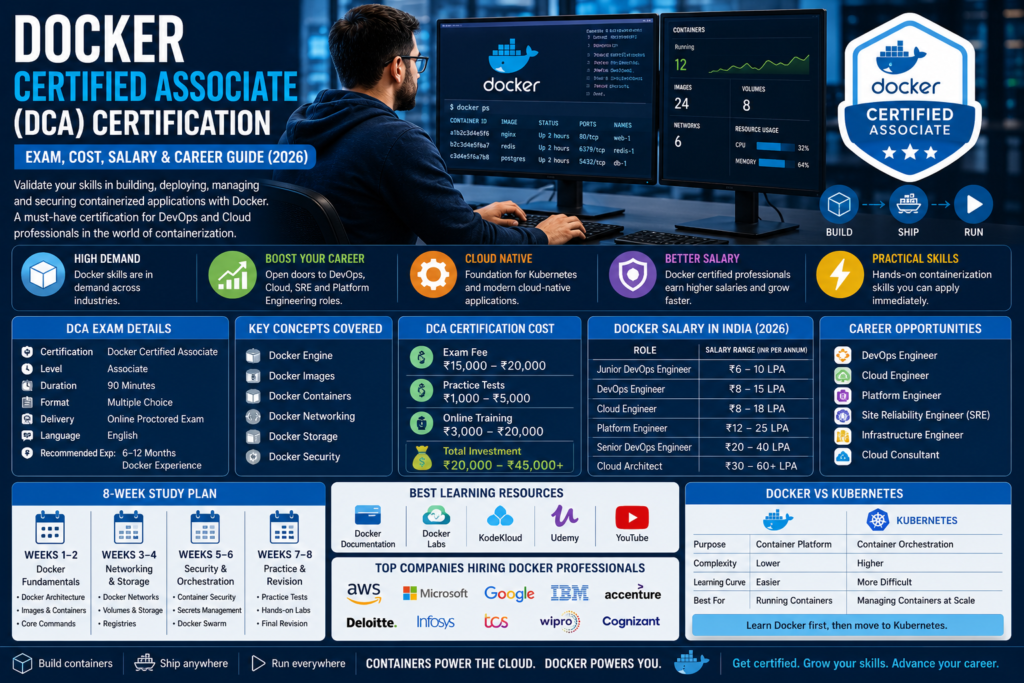
Docker Certified Associate (DCA) Certification is one of the most recognized containerization certifications for DevOps and cloud professionals. The certification validates your ability to build, deploy, manage, and secure containerized applications using Docker technologies.
As organizations increasingly adopt cloud-native architectures and DevOps practices, Docker skills have become highly valuable. Whether you are a DevOps Engineer, Cloud Engineer, System Administrator, or Software Developer, Docker knowledge can significantly improve your career opportunities.
In this guide, you’ll learn everything about Docker Certified Associate (DCA) Certification, including exam details, cost, salary expectations, career opportunities, study resources, and whether Docker certification is worth pursuing in 2026.
Read: DevOps Engineer Roadmap 2026
What is Docker Certified Associate (DCA) Certification?
Docker Certified Associate (DCA) Certification is a professional certification that validates a candidate’s knowledge of Docker containerization technologies. It demonstrates the ability to deploy, manage, secure, and troubleshoot Docker environments.
Docker is a platform that allows applications to be packaged into lightweight, portable containers. These containers can run consistently across development, testing, and production environments.
The certification focuses on:
- Docker architecture
- Container management
- Image creation
- Networking
- Storage
- Security
- Orchestration
For professionals working in DevOps and cloud environments, Docker has become a foundational technology.
Why Learn Docker in 2026?
Docker has transformed how applications are developed, deployed, and managed. Instead of installing applications directly on servers, organizations package applications into containers that can run consistently across different environments.
Containerization is the Industry Standard
Containers have become the preferred deployment model for modern applications because they are lightweight, portable, and efficient.
Strong DevOps Adoption
Docker plays a critical role in DevOps workflows, CI/CD pipelines, and automation processes.
Kubernetes Uses Containers
Kubernetes has become the leading container orchestration platform, and Docker knowledge provides an excellent foundation for learning Kubernetes.
Cloud-Native Applications
Organizations using AWS, Azure, and Google Cloud increasingly rely on containerized applications.
Excellent Career Opportunities
Docker skills are frequently listed as requirements for:
- DevOps Engineers
- Cloud Engineers
- Site Reliability Engineers
- Platform Engineers
- Infrastructure Engineers
Who Should Pursue Docker Certified Associate?
Docker certification is suitable for professionals who work with infrastructure, cloud platforms, software development, and DevOps tools.
This certification is ideal for:
- DevOps Engineers
- Cloud Engineers
- Platform Engineers
- System Administrators
- Site Reliability Engineers
- Software Developers
- Cloud Consultants
- Infrastructure Engineers
Candidates with Linux and cloud computing experience will find the certification particularly valuable.
DCA Exam Details
Before preparing for the certification, it’s important to understand the exam structure and objectives.
| Feature | Details |
|---|---|
| Certification | Docker Certified Associate |
| Level | Associate |
| Duration | 90 Minutes |
| Format | Multiple Choice |
| Delivery | Online |
| Focus Area | Containerization & Docker |
| Recommended Experience | 6–12 Months Docker Experience |
The exam evaluates both theoretical knowledge and practical Docker administration skills.
What Does a Docker Professional Do?
Professionals with Docker expertise help organizations deploy and manage containerized applications.
Typical responsibilities include:
Creating Docker Images
Building reusable images that contain application code, libraries, and dependencies.
Managing Containers
Deploying, monitoring, and troubleshooting containerized applications.
Configuring Container Networking
Ensuring communication between containers and external services.
Implementing Security Controls
Managing image security, access controls, and vulnerability scanning.
Supporting DevOps Processes
Integrating Docker into CI/CD pipelines and automation workflows.
Docker professionals play a critical role in modern cloud-native environments.
Docker Concepts Explained
Understanding Docker fundamentals is essential for certification success.
Docker Engine
Docker Engine is the core software that enables containers to run on a host system.
It manages:
- Images
- Containers
- Networks
- Storage
Docker Images
Images serve as templates used to create containers.
A Docker image typically contains:
- Application code
- Runtime environment
- Libraries
- Configuration files
Docker Containers
Containers are running instances of Docker images.
Benefits include:
- Portability
- Consistency
- Scalability
- Isolation
Docker Networking
Networking allows containers to communicate with each other and external services.
Key networking concepts include:
- Bridge Networks
- Host Networks
- Overlay Networks
- Service Discovery
Docker Volumes
Volumes provide persistent storage for containerized applications.
Without volumes, container data is lost when containers are removed.
Docker Security
Security is a major focus area for containerized environments.
Topics include:
- Image scanning
- Access controls
- Secrets management
- Container isolation
- Vulnerability management
DCA Exam Domains Explained
The Docker Certified Associate exam evaluates knowledge across several key domains.
Domain 1: Orchestration
This domain focuses on managing containerized applications at scale.
Topics include:
- Docker Swarm
- Service deployment
- Cluster management
- Scaling containers
Domain 2: Image Creation and Management
Candidates must understand how Docker images are created and maintained.
Topics include:
- Dockerfiles
- Image repositories
- Registry management
- Image optimization
Domain 3: Installation and Configuration
This domain covers installation and maintenance of Docker environments.
Topics include:
- Docker Engine installation
- Configuration management
- Troubleshooting
- System administration
Domain 4: Networking
Networking skills are essential for containerized environments.
Topics include:
- Network drivers
- Container communication
- Service discovery
- Load balancing
Domain 5: Security
Security remains one of the most important Docker topics.
Topics include:
- Access control
- Secrets management
- Secure images
- Container security
DCA Certification Cost
The total cost of earning Docker Certified Associate Certification depends on the exam fee, study materials, practice tests, and training resources.
| Expense | Approximate Cost |
|---|---|
| Exam Fee | ₹15,000–₹20,000 |
| Practice Tests | ₹1,000–₹5,000 |
| Online Training | ₹3,000–₹20,000 |
| Total Investment | ₹20,000–₹45,000+ |
Candidates can reduce preparation costs by using free Docker documentation, YouTube tutorials, and Docker Labs.
How Difficult is Docker Certification?
Docker Certified Associate is generally considered a beginner-to-intermediate level certification. While the exam is not as difficult as advanced cloud or cybersecurity certifications, it requires hands-on experience with Docker.
Candidates often find the exam challenging because:
- Questions are practical and scenario-based.
- Docker networking concepts can be complex.
- Container security requires deeper understanding.
- Hands-on experience is essential.
Professionals who regularly use Docker in development or cloud environments typically find the certification easier to pass.
How to Prepare for DCA Certification
A structured study plan can significantly improve your chances of passing the certification exam.
Weeks 1–2: Docker Fundamentals
Focus on:
- Docker architecture
- Docker Engine
- Images and Containers
- Core Docker commands
Spend time building and running containers on your local system.
Weeks 3–4: Networking and Storage
Study:
- Docker networks
- Volumes
- Bind mounts
- Registry concepts
Practice connecting multiple containers and managing persistent storage.
Weeks 5–6: Security and Orchestration
Focus on:
- Container security
- Secrets management
- Docker Swarm
- Access controls
Understanding Docker security best practices is important for the exam.
Weeks 7–8: Practice Tests and Revision
Complete:
- Mock exams
- Hands-on labs
- Domain reviews
At this stage, practical experience becomes more important than reading theory.
Best Docker Learning Resources
Using high-quality learning resources can significantly improve your preparation.
Docker Documentation
The official Docker documentation is one of the best learning resources available.
Docker Labs
Provides practical exercises and hands-on learning experiences.
KodeKloud
Popular DevOps learning platform with Docker-focused labs and courses.
Udemy
Offers affordable Docker certification preparation courses.
YouTube
Many instructors provide free Docker tutorials covering both fundamentals and advanced topics.
Combining multiple resources generally produces the best results.
Docker Certification Salary in India (2026)
Docker skills are highly valued because containerization has become a standard practice in cloud-native environments.
| Role | Salary Range |
|---|---|
| Junior DevOps Engineer | ₹6–10 LPA |
| DevOps Engineer | ₹8–15 LPA |
| Cloud Engineer | ₹8–18 LPA |
| Platform Engineer | ₹12–25 LPA |
| Senior DevOps Engineer | ₹20–40 LPA |
| Cloud Architect | ₹30–60+ LPA |
Salary depends on experience, cloud expertise, Kubernetes knowledge, and employer.
Career Opportunities After DCA Certification
Docker certification can open the door to several cloud and DevOps-related careers.
Popular job roles include:
DevOps Engineer
Automate software delivery processes and manage CI/CD pipelines.
Cloud Engineer
Deploy and manage cloud infrastructure using AWS, Azure, or Google Cloud.
Platform Engineer
Build and maintain developer platforms and containerized environments.
Site Reliability Engineer (SRE)
Improve system reliability, scalability, and performance.
Infrastructure Engineer
Manage infrastructure using modern automation and containerization technologies.
Docker skills are frequently required across all of these roles.
Docker Career Path
Docker often serves as the starting point for a broader DevOps and cloud career.
A typical progression looks like:
System Administrator
↓
Cloud Engineer
↓
DevOps Engineer
↓
Senior DevOps Engineer
↓
Platform Engineer
↓
Cloud Architect
↓
DevOps Manager
Learning Kubernetes after Docker can accelerate career growth significantly.
Top Companies Hiring Docker Professionals
Many organizations actively seek professionals with Docker expertise.
Examples include:
- Amazon
- Microsoft
- IBM
- Accenture
- Deloitte
- Cognizant
- Infosys
- TCS
- Wipro
- HCLTech
Containerization skills are valuable across startups, enterprises, and consulting organizations.
Docker vs Kubernetes
Many beginners confuse Docker and Kubernetes because both technologies are commonly used together.
Docker focuses on creating and running containers, while Kubernetes focuses on managing containers at scale.
| Feature | Docker | Kubernetes |
|---|---|---|
| Purpose | Container Platform | Container Orchestration |
| Complexity | Lower | Higher |
| Learning Curve | Easier | More Difficult |
| Best For | Running Containers | Managing Containers at Scale |
| Beginner Friendly | Yes | Moderate |
The recommended learning path is Docker first, followed by Kubernetes.
Refer to the Kubernetes Certification (CKA) Guide for more information.
Is Docker Certified Associate Worth It in 2026?
Docker Certified Associate remains a valuable certification because containerization continues to be a foundational technology in cloud computing and DevOps.
Benefits include:
- Industry-recognized credential
- Strong DevOps relevance
- Practical skills validation
- Improved job opportunities
- Better salary potential
- Excellent foundation for Kubernetes
Professionals planning careers in cloud computing, DevOps, or platform engineering can benefit significantly from Docker certification.
Final Thoughts
Docker Certified Associate (DCA) Certification remains a valuable credential for professionals working with containers, DevOps practices, and cloud-native technologies. As organizations continue adopting containerized applications and modern deployment strategies, Docker skills remain highly relevant across industries.
If you’re pursuing a career in DevOps, cloud computing, platform engineering, or site reliability engineering, Docker certification can provide a strong foundation and improve your career prospects in 2026.
Refer to the other relevant certifications:
- Cloud Engineer Roadmap 2026
- AWS Certified Cloud Practitioner Guide
- AWS Certified Security Specialty Certification
- Cloud Security Engineer Career Guide
- Highest Paying IT Certifications in India
- Top IT Certifications in 2026
Frequently Asked Questions
Is Docker Certified Associate suitable for beginners?
Yes. Candidates with basic Linux and cloud knowledge can successfully prepare for DCA certification.
How long does it take to prepare for Docker certification?
Most candidates require 4–8 weeks of preparation depending on their experience level.
Do I need Kubernetes before learning Docker?
No. Docker should generally be learned before Kubernetes because Kubernetes relies heavily on container concepts.
Is Docker still relevant in 2026?
Yes. Docker remains one of the most widely used container technologies and continues to be a foundational DevOps skill.
Does Docker certification help DevOps careers?
Absolutely. Docker knowledge is considered a core requirement for many DevOps, cloud engineering, and platform engineering roles.
What certification should I pursue after Docker?
Popular next steps include:
– Kubernetes Certified Administrator (CKA)
– AWS Certifications
– Azure Certifications
– DevOps Certifications
– Cloud Security Certifications